What Is Technical Debt? The Complete Guide for Leaders Who Build Software
Technical debt drains $2.41 trillion from the U.S. economy every year, yet most companies don’t even measure it. That’s an invisible tax on every feature, every release, and every strategic decision your engineering team makes. Left unchecked, it turns small shortcuts into system-wide slowdowns that can threaten your market position or, worse, your entire product.
This guide covers technical debt across 8 sections: what it is, how to recognize it, what it really costs, how AI changes the equation, and how to build a pragmatic strategy to manage it. It’s written for leaders who need to turn an abstract engineering complaint into a concrete business variable.
Key Points
|
1. What Is Technical Debt?

Technical debt is the future cost of choosing a quick, suboptimal solution today instead of a better approach that takes longer. Ward Cunningham, a pioneer of agile development, coined the term in 1992. He compared it to financial debt: a little speeds you up, as long as you pay it back through refactoring. If you don’t, the “interest” compounds until entire engineering organizations grind to a halt.
Shipping first-time code is like going into debt. A little debt speeds development so long as it is paid back promptly with refactoring. The danger occurs when the debt is not repaid. Every minute spent on code that is not quite right for the programming task of the moment counts as interest on that debt. Entire engineering organizations can be brought to a stand-still under the debt load of an unfactored implementation, object-oriented or otherwise. – Ward Cunningham (source)
Martin Fowler refined the concept with his Technical Debt Quadrant, which classifies debt along two axes: deliberate vs. inadvertent, and prudent vs. reckless.
| Prudent | Reckless | |
|---|---|---|
| Deliberate | Strategic shortcut with a repayment plan (e.g., shipping an MVP to hit a funding deadline) | Knowingly cutting corners without a plan to fix it (“we’ll deal with it later”) |
| Inadvertent | Discovering a better design after gaining deeper domain knowledge | Poor-quality code from lack of skill or awareness, creating debt the team doesn’t even recognize |
These four quadrants are just the starting point. Technical debt can also be classified by its form (code debt, testing debt, architecture debt, documentation debt, infrastructure debt) or by its origin (inherited from legacy systems vs. caused by rapid growth). In the financial sector alone, you can distinguish at least 16 types of technical debt across origin, intent, form, and business risk.
Not all debt needs to be eliminated. In the early stages of a startup, deliberate technical debt is a financial instrument that buys speed. The MVP-to-Scale transition is the pivot point: that’s when interest payments rise and velocity drops. Knowing when to keep debt and when to pay it back is the real skill. If you have zero technical debt, you’re probably moving too slow.
2. Why Technical Debt Accumulates
Technical debt accumulates because of four recurring pressures: speed-to-market demands, legacy system constraints, limited team resources, and the compounding effects of rapid growth. These aren’t unique to any single industry. They show up wherever software is built under real-world constraints.
- Speed-to-Market Pressure: Teams cut corners to launch fast. Skipping refactoring, reducing test coverage, and hardcoding configurations all ship the product sooner but create rework later.
- Legacy Systems: Older platforms acquired through mergers or built decades ago carry their own layers of outdated architecture. Banks running COBOL mainframes from the 1970s spend 70% of their IT budgets just keeping those systems alive.
- Limited Resources: When the engineering team is small, refactoring and testing get deprioritized. The backlog grows, and the technical foundation weakens with every sprint.
- Rapid Growth: Startups that find product-market fit face a new problem. Systems designed for 100 users buckle under 100,000. Features built to “just work” become bottlenecks that block scaling.
These causes don’t operate in isolation. A startup might deliberately take on speed debt, then grow fast, then lose founding engineers, and suddenly find itself managing what feels like a legacy system. Technical debt follows the growth cycle: in the startup phase it’s a survival tool, in the scale-up phase it becomes a drag, and at maturity it hardens into inherited debt that limits every strategic decision.
3. How Technical Debt Shows Up in Your Product
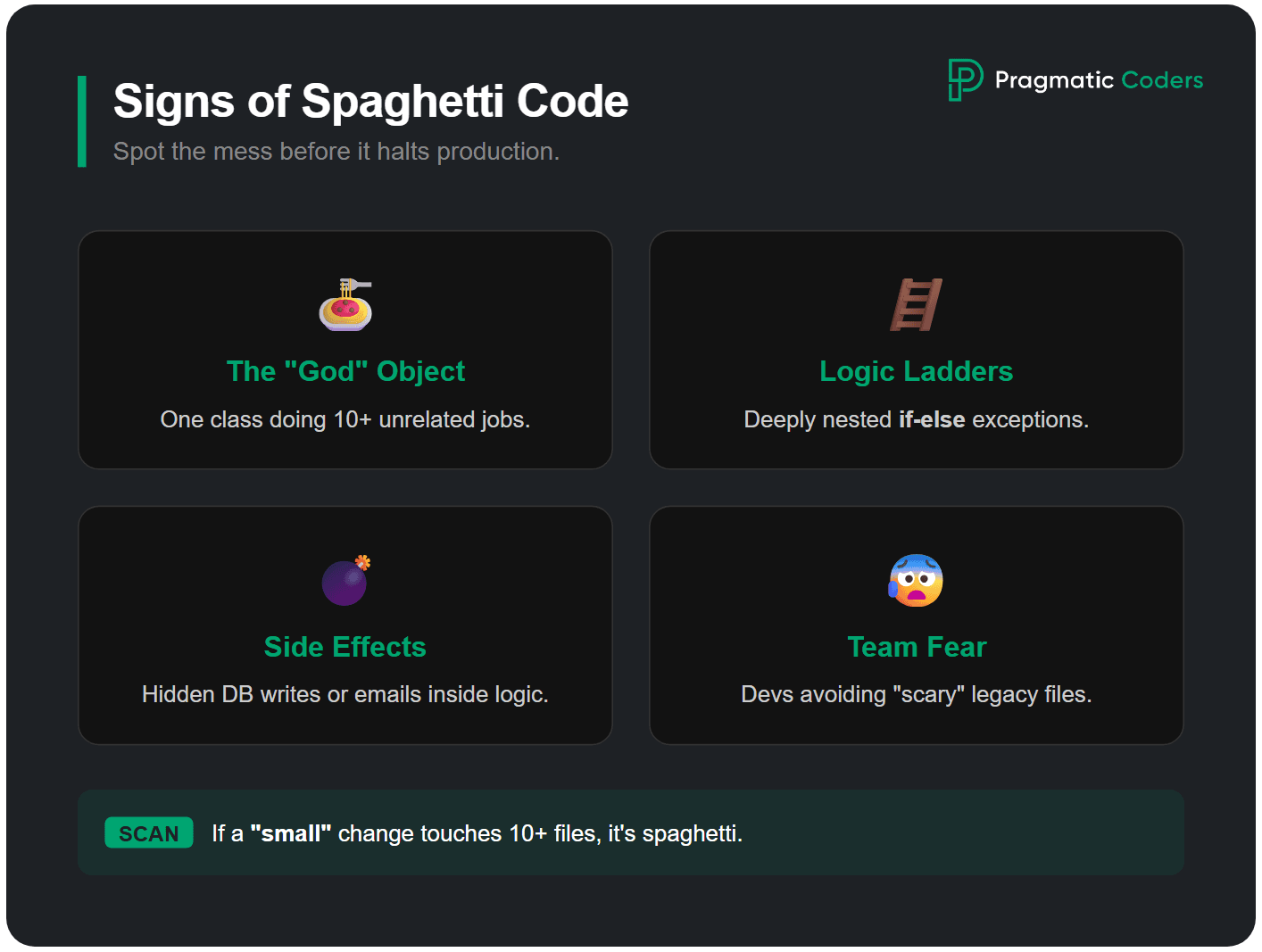
Technical debt surfaces through recurring patterns: unpredictable delivery, fear-based development, code decay, and hidden dead weight. The clearest signal is development that keeps getting slower. Features that should take days take weeks. Simple changes trigger regressions in unrelated areas. Developers avoid certain files because “touching it will break something.”
This fear-driven behavior is one of the most reliable red flags. In fact, five specific patterns predict product failure: unpredictable and slowing delivery, risks hidden until they explode, decisions based on intuition instead of data, engineering teams disconnected from business goals, and learning about production problems from users rather than monitoring.
Spaghetti code (code where responsibilities, dependencies, and side effects are tangled together) is the most visible form of this decay. A “small change” turns into a week of regressions because everything depends on everything. The signs include deeply nested conditionals, functions that handle business logic and database calls and API integrations all at once, and copy-paste fixes scattered across files. The good news: spaghetti code yields to a systematic 6-step untangling method that starts with stabilization, not a rewrite.
Dead code accelerates the problem quietly. Unused functions, abandoned feature flags, and features nobody touches inflate the codebase and increase the risk of every change. Dead code is a business problem that needs systemic removal, not a “someday” cleanup task.
4. How to Diagnose Technical Debt Before It Becomes a Crisis
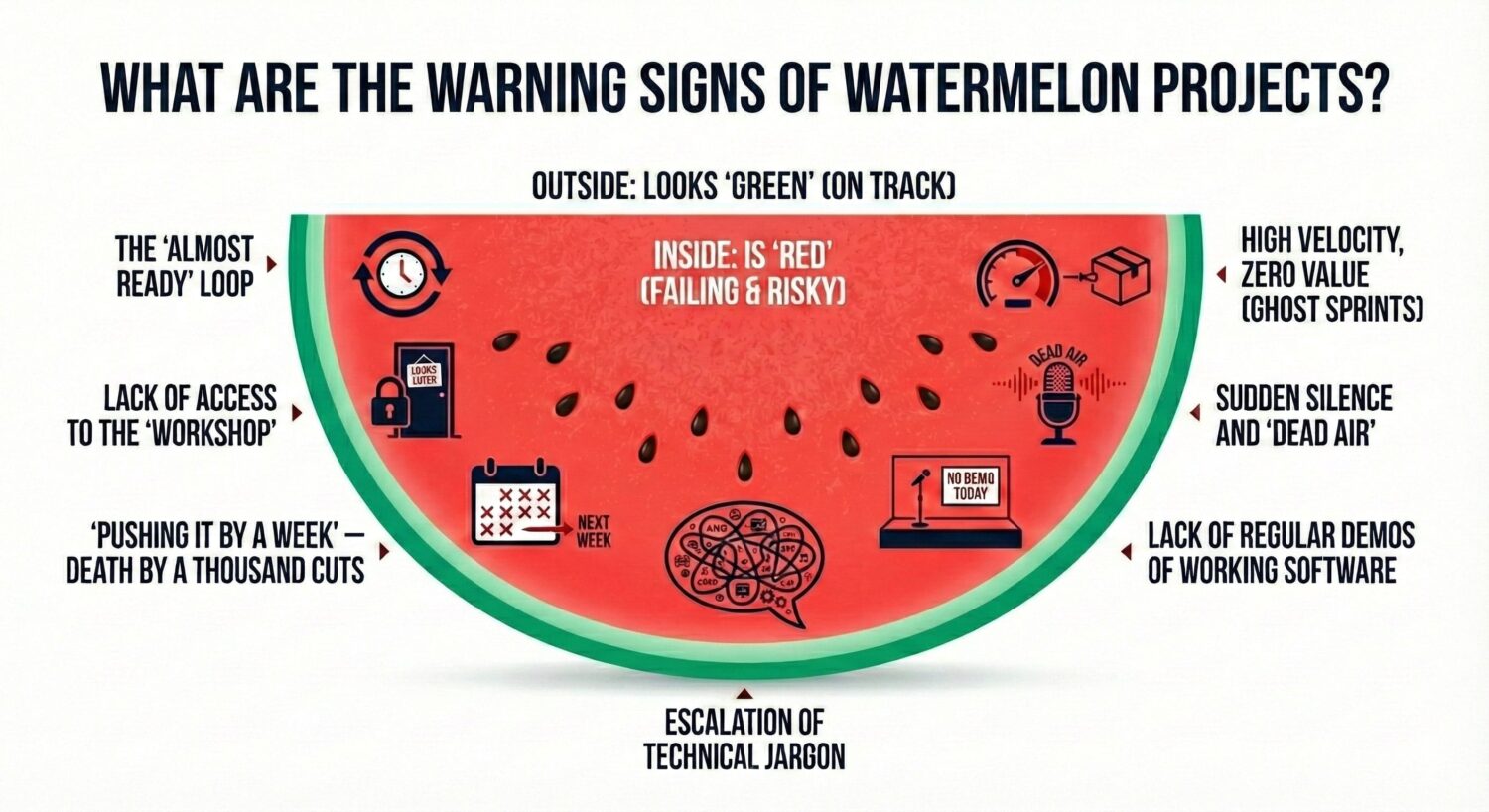
Technical debt is most dangerous when it’s invisible. The first diagnostic challenge is separating real project status from optimistic reporting. The “Watermelon Effect” describes projects that look green in status dashboards but are red underneath: delays, bugs, and chaos hidden behind polished slides. If you hear “everything is on track” but haven’t seen working software in three sprints, your project may be a watermelon.
For a structured self-assessment, the Product Health Checklist evaluates your product across four pillars: Strategy, Discovery, Delivery, and Leadership. The Delivery pillar specifically asks whether technical debt is acknowledged and effectively managed, whether quality metrics exist, and whether production issues are systematically logged. Six specific questions from that checklist have 100% accuracy in predicting project outcomes.

Making technical debt visible requires combining automated tools (static analyzers like SonarQube for code smells), version control data (identifying high-churn files that change frequently), and team workshops where engineers mark the most painful areas of the system. The full playbook for finding and fixing technical debt walks through each method and explains how to classify debt by type so you can choose the right fix.
5. TSB Bank Case Study: How Technical Debt Led to Business Failure
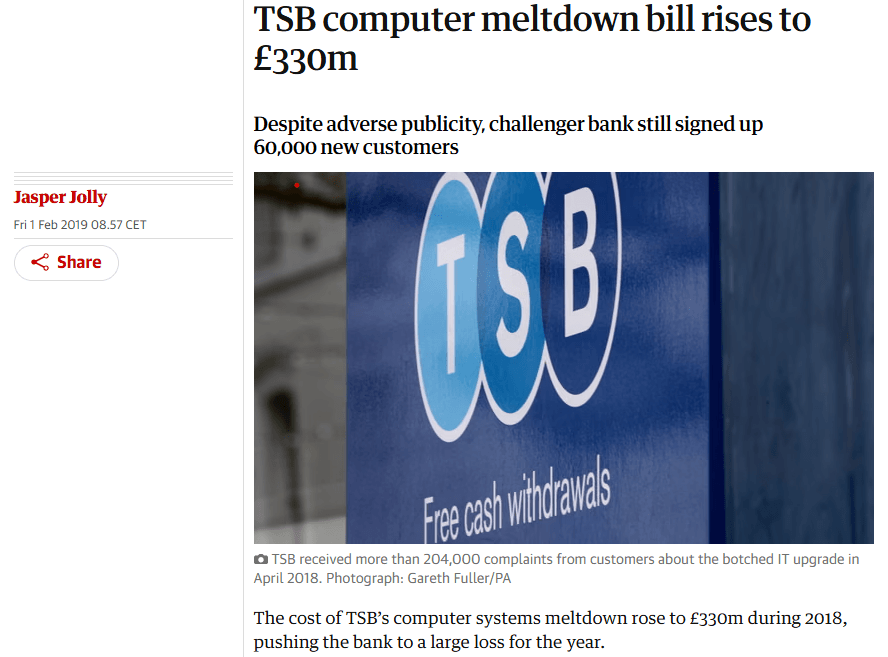
Technical debt that goes unmanaged doesn’t just slow development. It can threaten the entire company. The catastrophic IT migration of TSB Bank in 2018 is one of the clearest examples of what happens when years of accumulated risk finally detonate.
After being acquired by the Spanish banking group Sabadell, TSB decided to migrate its 5.2 million customers from its old IT platform to Sabadell’s custom-built “Proteo4UK” system. The leadership team opted for a “big bang” approach. They switched everything over in a single weekend.
This risky approach, rushed timeline, and lack of testing backfired fast. The system failed almost instantly, and the fallout was severe.
Operational Collapse: Up to 1.9 million customers were locked out of their accounts, some for weeks. The bank received over 225,000 complaints as customers reported missing funds and failed payments. Financial Ruin: The direct cost exceeded £330 million. It covered customer compensation, fraud losses, and operational crisis management. Regulatory fines added another £48.65 million, pushing the total measurable cost to nearly £400 million. Reputational Damage: TSB lost 80,000 customers in 2018, and its brand reputation was left in tatters.
The lesson is concrete: if technical debt is mismanaged, a single event can put the whole company on the line. TSB wasn’t a freak accident. It was the predictable result of years of risk that was never measured, never prioritized, and never paid down.
More about the TSB incident:
Independent, TSB IT meltdown cost bank £330m and 80,000 customers
6. What Is the Real Cost of Technical Debt?
Technical debt carries two categories of cost: the visible expenses you can measure today and the invisible opportunities you’re losing tomorrow. Measuring both turns a developer complaint into a P&L number that leadership can act on.
The direct costs are straightforward. Lost developer productivity is the largest line item. For a team of 10 engineers averaging $120,000 per year, where 30% of their time goes to working around debt, the annual productivity cost is $360,000. They aren’t building anything new. They’re patching what already exists. QA costs rise in parallel because unstable systems need far more testing. Engineers spend an estimated 33% of their time just dealing with technical debt (JetBrains, 2025).
Security shortcuts carry their own price tag. Delaying critical patches to avoid downtime can lead to breaches. The average global cost of a data breach is $4.4 million (IBM, 2024). Response costs, fines, legal fees, and lost customer trust all compound from there.
The hidden costs are harder to quantify but often larger. Every dollar and every hour your team spends wrestling with old code is money not spent on innovation. If your architecture is too rigid to launch a competitive feature, the lost revenue can dwarf the engineering budget. Consider a company that can’t enter a $15 million market because its legacy system won’t support the integration. That missed opportunity is a real cost of technical debt.
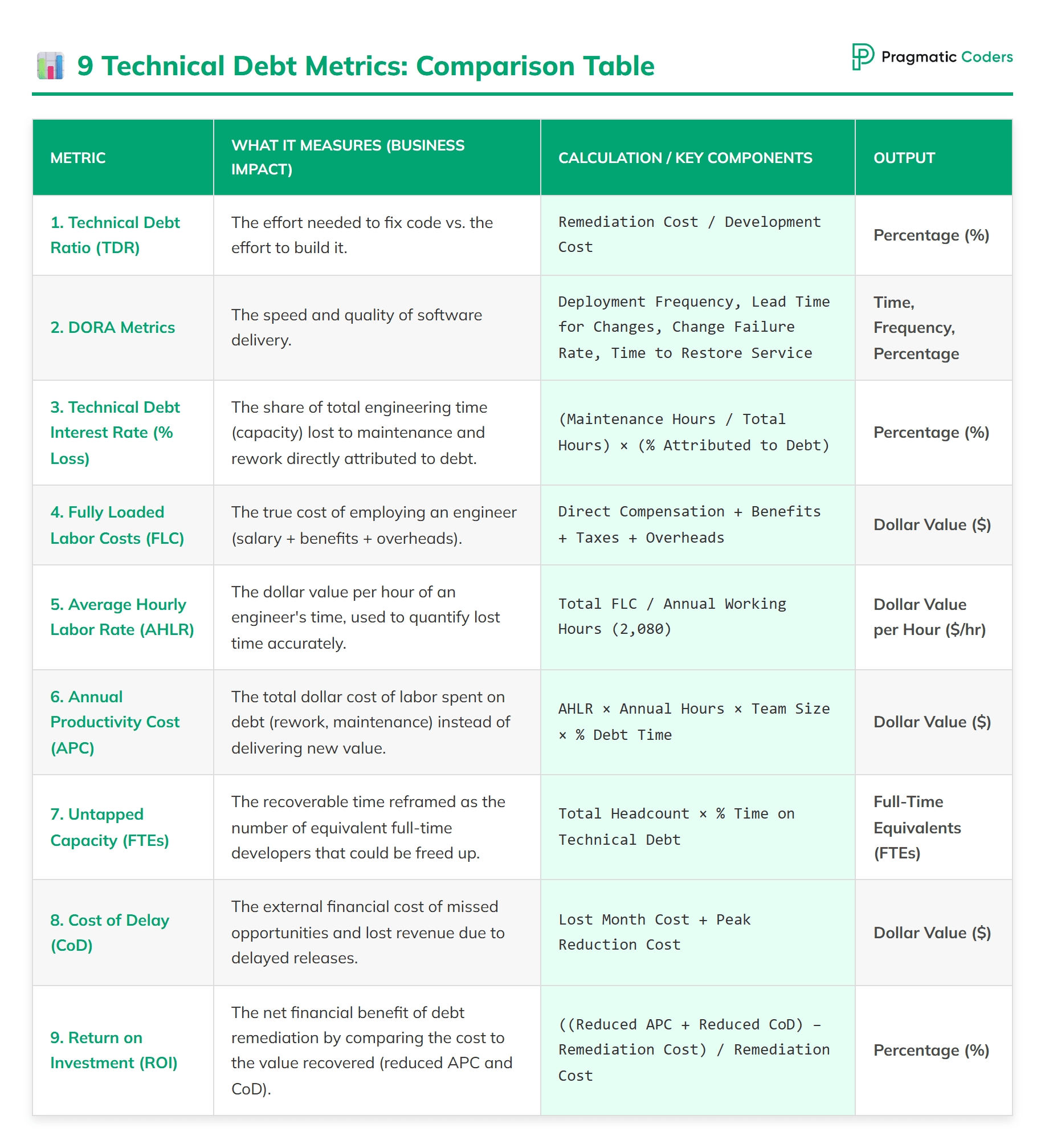
To put hard numbers behind the problem, there are 9 metrics leaders can use to calculate the cost of technical debt. The most actionable include: Technical Debt Ratio (remediation cost vs. rebuild cost, healthy below 5%), DORA metrics (deployment frequency, lead time, failure rate, recovery time), Annual Productivity Cost, and Cost of Delay. These frameworks turn gut feelings into investment cases that finance teams understand.
7. How Technical Debt Gets Worse in the AI Era
Technical debt becomes more expensive when AI enters the picture. AI coding assistants punish you for having messy code. Point an AI at a clean, modular codebase, and it generates useful suggestions and solid boilerplate. Point it at a legacy codebase full of tangled logic and missing documentation, and it produces confident, well-formatted, and often wrong code. The quality of AI output is a direct mirror of your code quality.
The core problem is that AI tools are statistical pattern matchers, not reasoning engines. Legacy systems are full of intentional “weirdness”: business rules encoded as workarounds, edge-case handlers that look like bugs, and architectural decisions that only make sense with years of context. The Chesterton’s Fence principle applies: AI sees the fence, calls it waste, and suggests removing it, unaware that it prevents a production outage.
This creates a widening competitive gap. Companies with clean code use AI as a productivity multiplier. Companies with messy code find that AI amplifies their problems. The real cost of technical debt in the AI era is the opportunity cost of being unable to leverage tools your competitors already use.
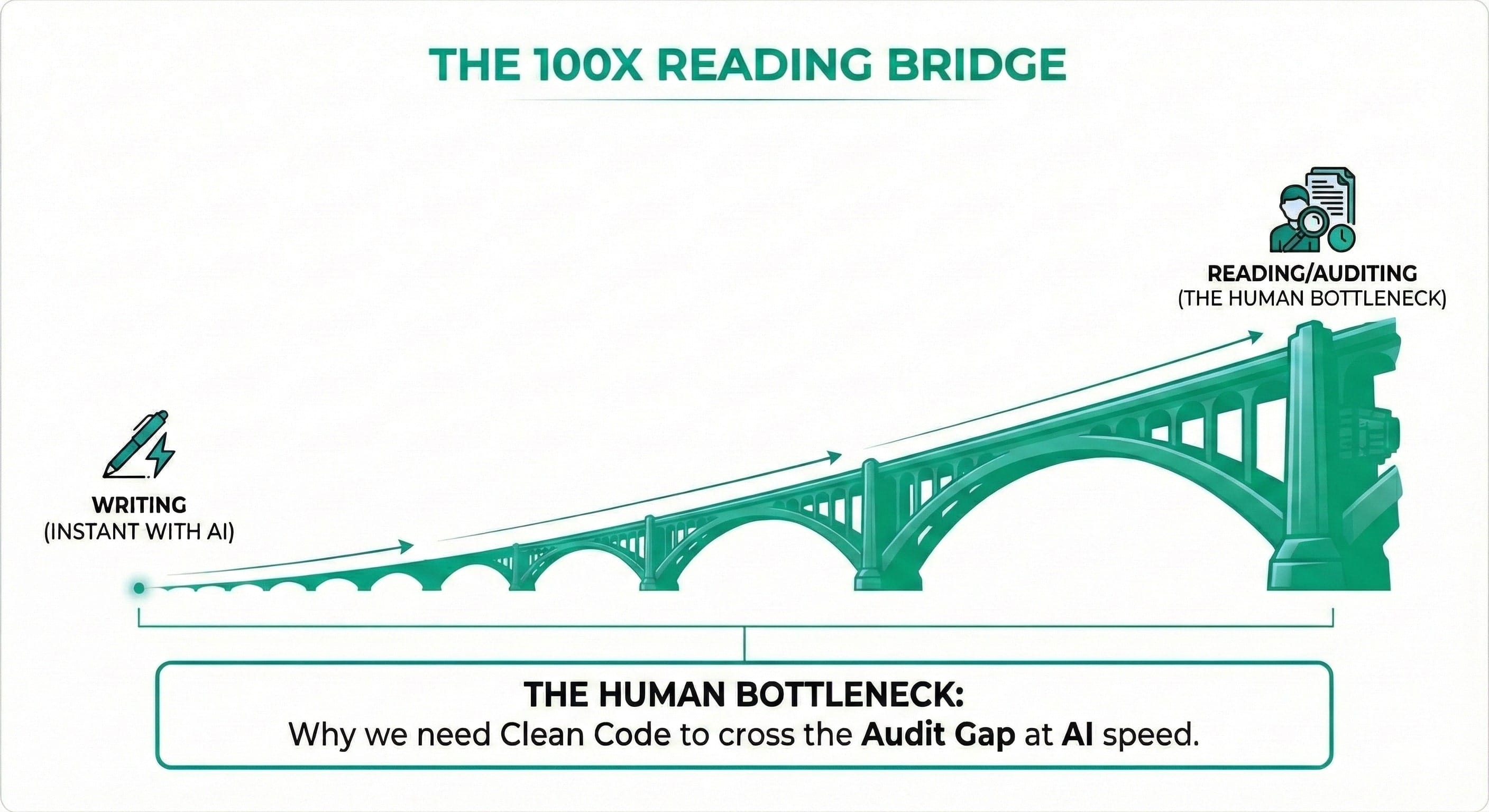
Clean code has become more critical than ever because AI shifts the developer’s role from writer to auditor. When AI produces 1,000 lines in seconds, the bottleneck moves to reviewing that output. Clean Code, automated testing, and CI/CD pipelines form the “immune system” that keeps AI-generated junk out of production.
At the extreme end sits “vibe coding”: programming by iterating on AI output without reading the code. If every release ends in regressions, only one person knows how to deploy, or incidents happen after hours, your codebase may already be running on unmaintainable AI-generated code. A checklist for CEOs and COOs helps diagnose this specific risk before operational costs spiral.
8. How to Manage and Fix Technical Debt
Technical debt can be managed with three repeating steps: make it visible, prioritize by business impact, and invest in repayment through the right strategy. The goal isn’t zero debt. A zero-debt stance signals risk aversion that kills innovation. The goal is an optimal level of debt, governed with discipline.
Step 1: Audit and make technical debt visible.
You can’t manage what you don’t measure. Create a Technical Debt Backlog that treats each issue like a user story: the problem, its business impact, and the estimated cost to fix. Combine automated scanning with team workshops where developers mark the most painful areas. The practical playbook for finding and fixing technical debt walks through this process in detail.
Step 2: Prioritize repayment by impact.
The Pareto rule applies: 80% of the pain typically comes from 20% of the codebase. Assess each item across four dimensions: velocity impact, business impact, risk (security, compliance, stability), and team morale. Then choose the right action:
- Refactor: Restructure code without changing its behavior. Best when the core logic is sound but the structure has decayed. For tangled codebases, a systematic 6-step method works: stabilize the hotspot, add protective tests, delete dead code, create seams, introduce boundaries, and apply the strangler pattern.
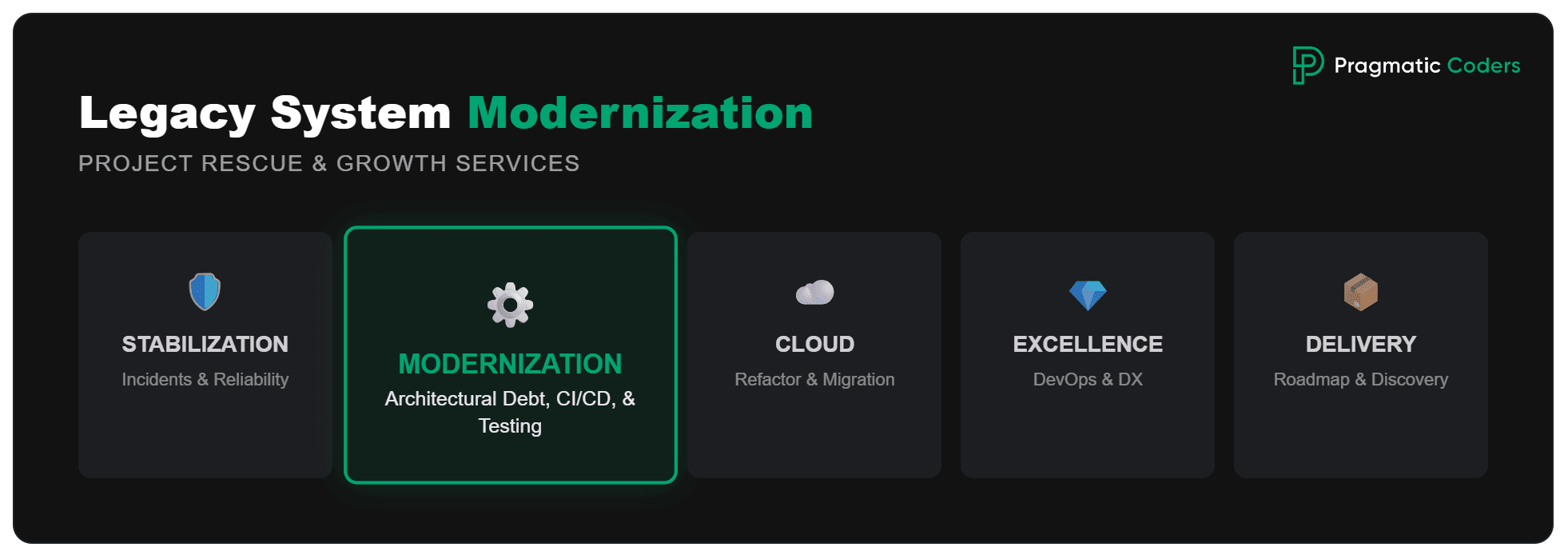
- Modernize: When the problem is systemic, the legacy system modernization playbook covers the 5 R’s: Rehost, Refactor, Rearchitect, Rebuild, and Replace. The right choice depends on business criticality, change rate, technical risk, and team capacity.
- Rescue: When the system is revenue-critical and can’t be turned off, [staged replacement beats a big-bang rewrite]. Stabilize critical flows first, replace incrementally, and measure progress against delivery metrics.
- Accept: Sometimes the most pragmatic choice is to do nothing. Stable, rarely-changed modules where the cost of fixing outweighs the benefit can be left alone.
Step 3: Build the business case.
Don’t ask for a budget to “refactor the payments module.” Present an investment case: “By investing $X to modernize this module, we can recover $360,000 in annual developer productivity and unlock a $15 million market.” Frame technical work as business wins.
Conclusion
![Is your project on fire [EBOOK]](https://www.pragmaticcoders.com/wp-content/uploads/2026/02/Is-your-project-on-fire-EBOOK.png)
Technical debt is manageable when you treat it as a business variable, not just a coding problem. Measure it with concrete metrics. Prioritize it by business impact. Pay it down strategically while continuing to ship.
The hardest part is making the problem visible. A structured audit turns guesswork into a plan with real numbers. From there, every decision about what to fix, what to refactor, and what to accept becomes a rational investment choice.
If you’re ready to stop paying interest on past decisions and start investing in your product’s future, let’s talk. We can help you figure out where to start.
Disclaimer: This guide provides informational content based on our experience rescuing and modernizing software products. It does not constitute professional financial or legal advice.
Bibliography
- Ward Cunningham, “The WyCash Portfolio Management System” (OOPSLA 1992)
- Martin Fowler, “TechnicalDebtQuadrant” (martinfowler.com, 2009)
- FCA Final Notice 2022: TSB Bank plc
- IBM, Cost of a Data Breach Report 2024
- Accenture, What Is Tech Debt
- DZone, The Cost of Technical Debt
- Frederick P. Brooks Jr., The Mythical Man-Month (1975)
Technical Debt FAQ
What is technical debt in Scrum?
Technical debt in Scrum refers to the implied cost of rework created when a team chooses a quick solution over a better approach during sprint work. Scrum teams manage it by maintaining a Technical Debt Backlog alongside the Product Backlog and allocating 10-20% of each sprint’s capacity for repayment. The Sprint Retrospective is the natural place to surface new debt items and decide which to prioritize next.
Is technical debt always bad?
Technical debt isn’t always bad. Deliberate, prudent debt taken to validate a hypothesis (like shipping an MVP with hardcoded configuration) is a legitimate business tool. The danger lies in unplanned debt that accumulates from poor practices, and in planned debt that never gets repaid. A healthy codebase carries some debt intentionally and retires it on a schedule.
What is the 80/20 rule for technical debt?
The 80/20 rule (Pareto principle) applied to technical debt means that roughly 80% of delivery pain, bugs, and slowdowns originate from about 20% of the codebase. Identifying those hotspots through version control churn data and team input lets you focus refactoring where it delivers the highest return. Tackle the critical 20% first.
How does AI affect technical debt?
AI amplifies the consequences of existing technical debt. Clean codebases get better AI suggestions, faster development, and fewer hallucinations. Messy codebases produce more wrong code and a new layer of AI-generated spaghetti. AI can also generate technical debt faster through “vibe coding,” where developers accept AI output without reviewing it. The antidote is clean code, automated testing, and mandatory human code review.
How do you measure the cost of technical debt?
Technical debt cost can be measured using metrics like Technical Debt Ratio (remediation cost divided by development cost, healthy below 5%), Annual Productivity Cost (team size multiplied by salary multiplied by percentage of time on debt), DORA metrics (deployment frequency, lead time, change failure rate, recovery time), and Cost of Delay (revenue lost from late delivery). A TDR above 30% typically signals the need for major intervention.
What are the 5 R's of legacy system modernization?
The 5 R’s are strategies for modernizing legacy systems burdened by technical debt, ordered from least to most invasive: Rehost (lift-and-shift to new infrastructure), Refactor (improve code without changing architecture), Rearchitect (redesign major structural components), Rebuild (rewrite on a new stack), and Replace (substitute with a SaaS or packaged product). The right strategy depends on business criticality, change rate, technical risk, and team capacity.
How to prevent technical debt from accumulating?
Preventing technical debt requires systemic guardrails, not just good intentions. Enforce automated quality gates in your CI/CD pipeline that fail builds when standards aren’t met. Adopt the Boy Scout Rule: leave code a little better than you found it with every change. Allocate 10-20% of sprint capacity for maintenance. Define a clear Definition of Done that includes test coverage, code review, and documentation. Some debt is inevitable, but these practices keep it from compounding.
When should you rewrite vs. refactor a legacy system?
Refactoring is the right choice when the core logic is sound but the code structure has decayed. It’s lower risk and delivers value incrementally. A full rewrite is justified only when the architecture is fundamentally broken, the tech stack is end-of-life, and requirements have changed enough that the old system can’t evolve. Most situations call for refactoring or the strangler pattern (gradual replacement). A big-bang rewrite should be the last resort, used only when the domain is stable, migration is feasible, and you can run both systems in parallel.