Is Clean Code Dead? Why AI Actually Makes Good Coding More Important than Ever
There is a big debate happening right now in the software world, and the question is simple but scary: Since AI can now write code for us, do we even need to care about “Clean Code” anymore?
Some people are saying that Clean Code is now a “waste of time.” They argue that if an AI can just spit out a working app in seconds, we shouldn’t care how the code looks inside. They call Clean Code “fancy handwriting” – nice to look at, but expensive and basically useless in a world where machines do the typing.
But if you look deeper, you’ll see a very different reality. Experts like Wiktor Żołnowski, CEO of Pragmatic Coders, are warning that this way of thinking is a trap. In fact, he argues that AI makes Clean Code more critical than it has ever been in human history.
Let’s break down the big ideas, the risks, and why the “old school” basics are actually your new secret weapon.
1. The “Fast Fashion” of Software (And Why it Fails)
I don’t know if you’ve heard about it, but there’s the idea of Disposable Software.
The logic is simple: AI makes coding so cheap that we can just build something, use it for a few weeks, and then throw it away. If the software is only meant to live for a month, why spend any time making the code clean or organized? It’s like “fast food” or “fast fashion” – cheap, quick, and meant to be replaced.
But here is the problem. In the real world, “temporary” software almost never goes away. Most “quick prototypes” end up becoming the foundation for the entire business. As one senior developer pointed out, AI doesn’t actually finish the job. It gives you “something” that looks like a result, but it’s up to the human to turn that “something” into a safe, working product.
If you build your house on a foundation of “trash code” just because it was fast, you’ll find it impossible to add a second floor later. The cost of fixing that mess will eventually be higher than the profit the software made.
2. The 1% Problem: We Were Never Just Typists
Let’s dig a bit deeper here. To understand why Clean Code still matters, we have to look at how developers actually work.
Before AI, many people thought a programmer’s job was to “type code.” But that was never true. Even back in 2021, in the pre-AI era, most developers only spent about 1% of their time actually hitting keys.
What were they doing the other 99% of the time? They were reading. They were thinking. They were trying to understand how the existing system worked so they wouldn’t break it.
AI has now taken that 1% of typing and made it almost instant. But it hasn’t changed the other 99%. In fact, it has made the “reading and thinking” part much harder.
3. The Wiktor Thesis: The 100x Reading Challenge
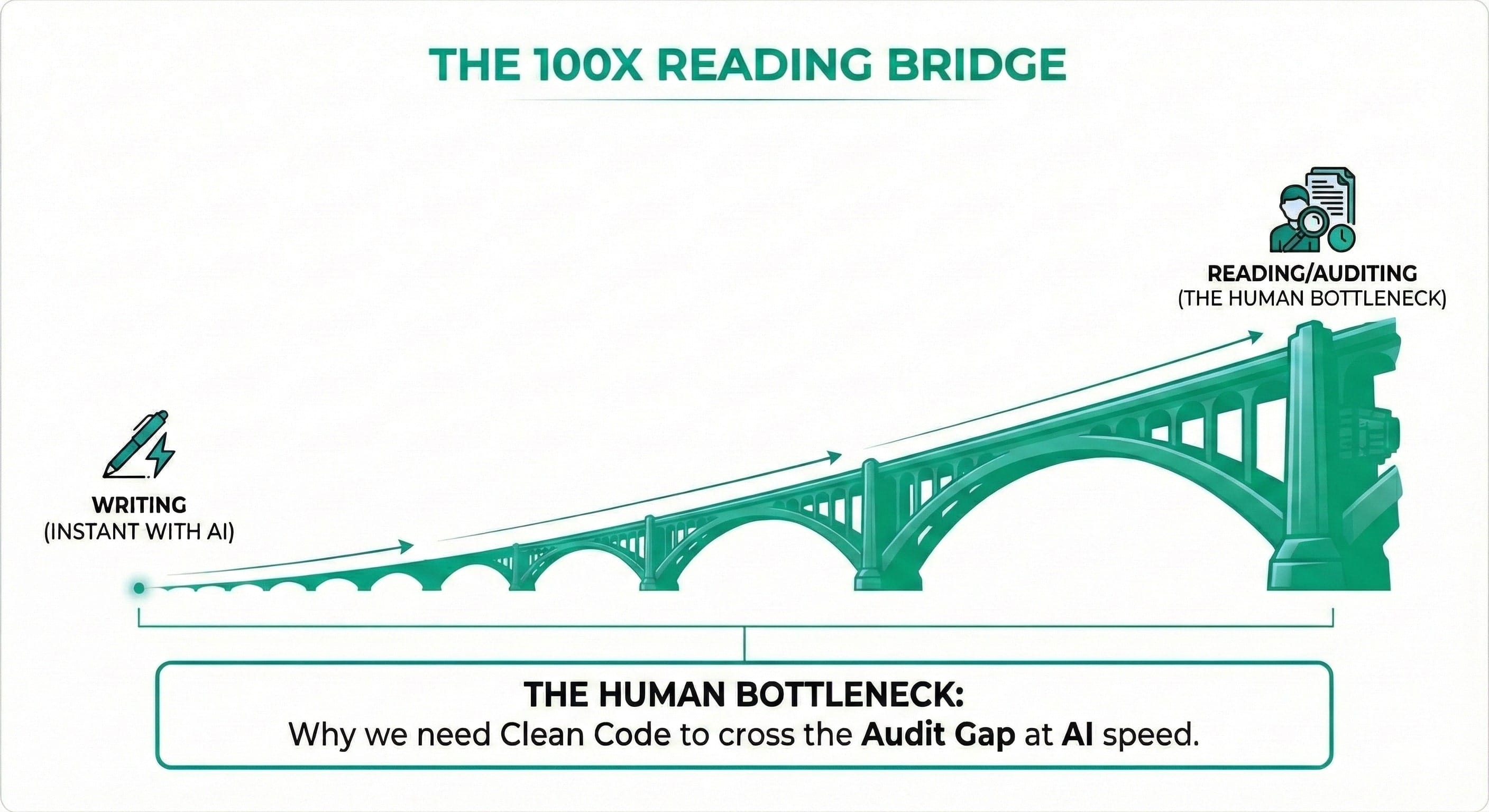
This is the core of the argument from Wiktor Żołnowski.
He points out that the whole idea of “Clean Code” was originally born because we read code much more than we write it. Now, imagine what happens when an AI writes 1,000 lines of code in 10 seconds. You didn’t have to type it, but you still have to audit it.
“The idea of Clean Code was based on the conclusion that programmers spend several times more time reading code than writing it. With AI, this proportion is tens, if not hundreds of times more time spent on reading (unless we’re talking about opportunistic happy-vibe-coding, which still has little to do with programming).” — Wiktor Żołnowski
Humans can’t “speed read” messy code without missing dangerous bugs. If the AI gives you a giant pile of confusing logic, it might take you longer to verify that it’s safe than it would have taken to write it yourself from scratch. Clean Code is the only way to keep the human “auditor” from slowing down the whole process.
4. The Trap of “Vibe Coding”
Of course, we can’t pave over vibe coding. In case you don’t know, it works like this: You ask an AI to build a feature. It gives you some code. You run it, and it seems to work on your screen. You “vibe” with it, trust it, and ship it to your users.
This is the most dangerous thing you can do in software engineering.
AI is “non-deterministic.” This means it’s unpredictable. Unlike a regular mathematical formula, an LLM (the brain of the AI) can make mistakes that look perfectly professional. It can hallucinate security holes or logic that works for one user but crashes for a thousand.
Without Clean Code, you have no way to quickly “see” these errors. You are basically building a Black Box. You are putting your business and your customers’ data inside a box that you don’t actually understand. Engineering is about verification, not “vibes.” As Wiktor puts it:
“So far, no method has been created for an LLM to repeatably produce code that does not require verification.”
5. Why Messy AI Code is a Business Liability
Let’s talk about the money.
Some argue that “good enough” is fine for business. But in software, “messy” always becomes “expensive.”
If your AI is spitting out disorganized code, you are accumulating what we call Technical Debt at an 100x speed. Technical debt is like a high-interest credit card. You get a “win” today (the feature is live), but you have to pay it back with interest later (the system is now harder to change).
If you let an AI fill your codebase with junk, you will soon hit a wall where nobody understands how any of it fits together. At that point, your 100x speed drops to zero. You can’t add new features, and you can’t fix bugs. Your “fast” software has become a “digital landfill.”
Clean code and tests protect the codebase. They do not fix a broken roadmap, fuzzy ownership, or nonstop scope churn. For a wider check on product health, use our Product Health Checklist.

6. The Architecture War: Modularity vs. Junk
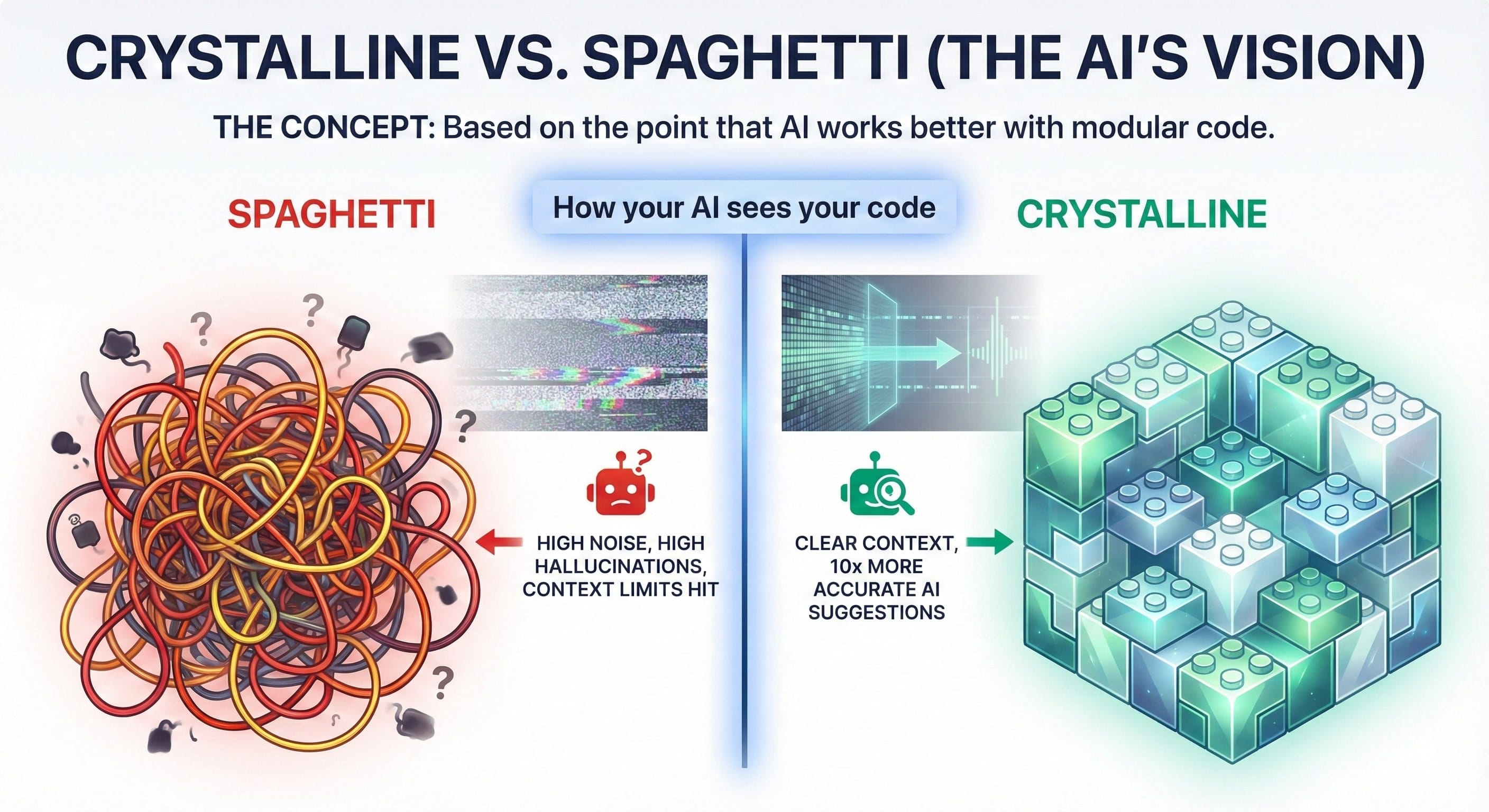
There is a common myth that AI can handle “messy” code better than humans. Actually, the opposite is true. AI works best when things are organized into clear, separate blocks – like LEGOs. This is called Modularity.
If your code is clean and modular, the AI can “understand” the context better. It can give you more accurate suggestions and better fixes. But if you give the AI a giant “spaghetti” mess of code, even the machine starts to get confused. It will hallucinate more and make worse mistakes.
Clean architecture is the secret to making AI actually work at scale. As one developer noted, we need “crystalline” structure now more than ever because it’s the only way to keep the AI focused on the right task.
7. The Future: Will We Stop Using Java and Python?
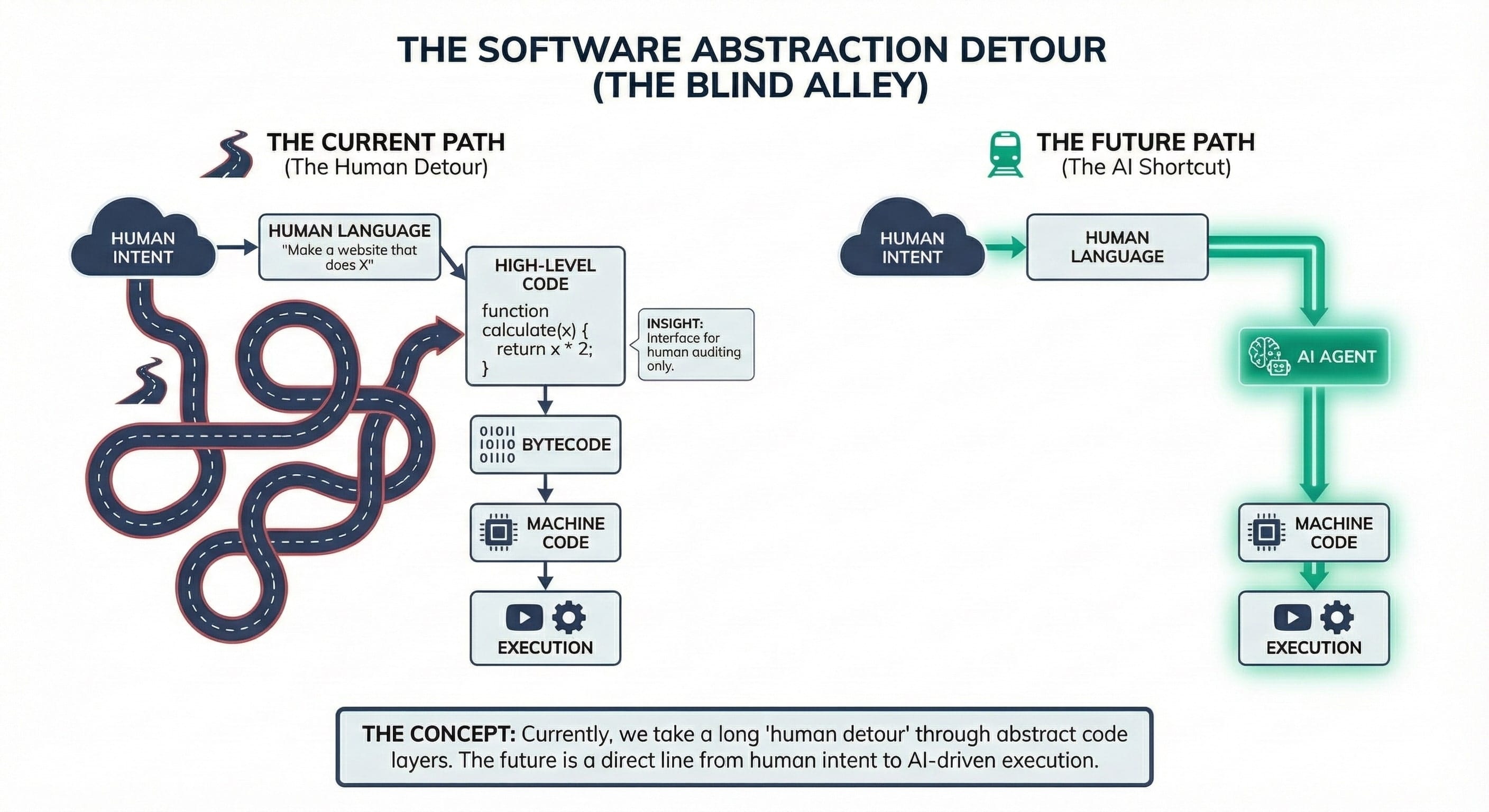
Here’s quite a bold prediction from Wiktor. He believes that the way we use AI today – asking it to write in languages like Java or Python so we can read it – might just be a “blind alley” or a temporary detour.
Why? Because those languages were designed for human brains, not computer brains. We are currently forcing the AI to speak “human” just so we can check its work.
“Look at how it works today: We speak a human language to a machine that runs on binary code. The machine writes high-level code (like Java) for a human to understand, which is then turned into bytecode, and finally into machine code (x86/ARM). All of this just so a human can read and fix it.” — Wiktor Żołnowski
Wiktor argues that once we move past the need for human auditing, the entire way we build software will change.
“I still believe that training LLMs to write in high-level languages is a blind alley. When we reach the point where humans are no longer needed at all for reading, monitoring, and correcting, we can completely skip two layers of abstraction and ask the machine to generate machine code.” — Wiktor Żołnowski
But we aren’t there yet. Right now, high-level code is our only “User Interface” for the machine’s thoughts. Until we have 100% reliable automated ways to check the AI, Clean Code is the only way we can stay in control of the “Black Box.”
If your team ships fast but lives in panic mode—hotfixes, blame, no time to review AI output—your problem may be bigger than “messy functions.” Read Is your project on fire? Self-diagnosis to sort team crisis from normal delivery stress.
![Is your project on fire [EBOOK]](https://www.pragmaticcoders.com/wp-content/uploads/2026/02/Is-your-project-on-fire-EBOOK.png)
8. Why the “Basics” are the New Premium
Interestingly, the developers who are the most frustrated with AI are often the ones who never learned the fundamentals of engineering.
If you don’t know what Clean Code looks like, you can’t tell if the AI is giving you a masterpiece or a disaster. You are like a person trying to use a fancy calculator without knowing how to do basic math – you won’t know when the answer is wrong, right?
Wiktor observes that Clean Code, Test-Driven Development (TDD), and CI/CD are no longer “optional” for top-tier companies. They are the entrance ticket to the AI era.:
“Meanwhile, Clean Code and CI/CD (even TDD to some extent) are the absolute basics that provide more value today with AI than ever before. Furthermore, I notice that the programmers who complain the most about AI are precisely the ones who never mastered these basics.” — Wiktor Żołnowski
9. The “Immune System” of the Codebase
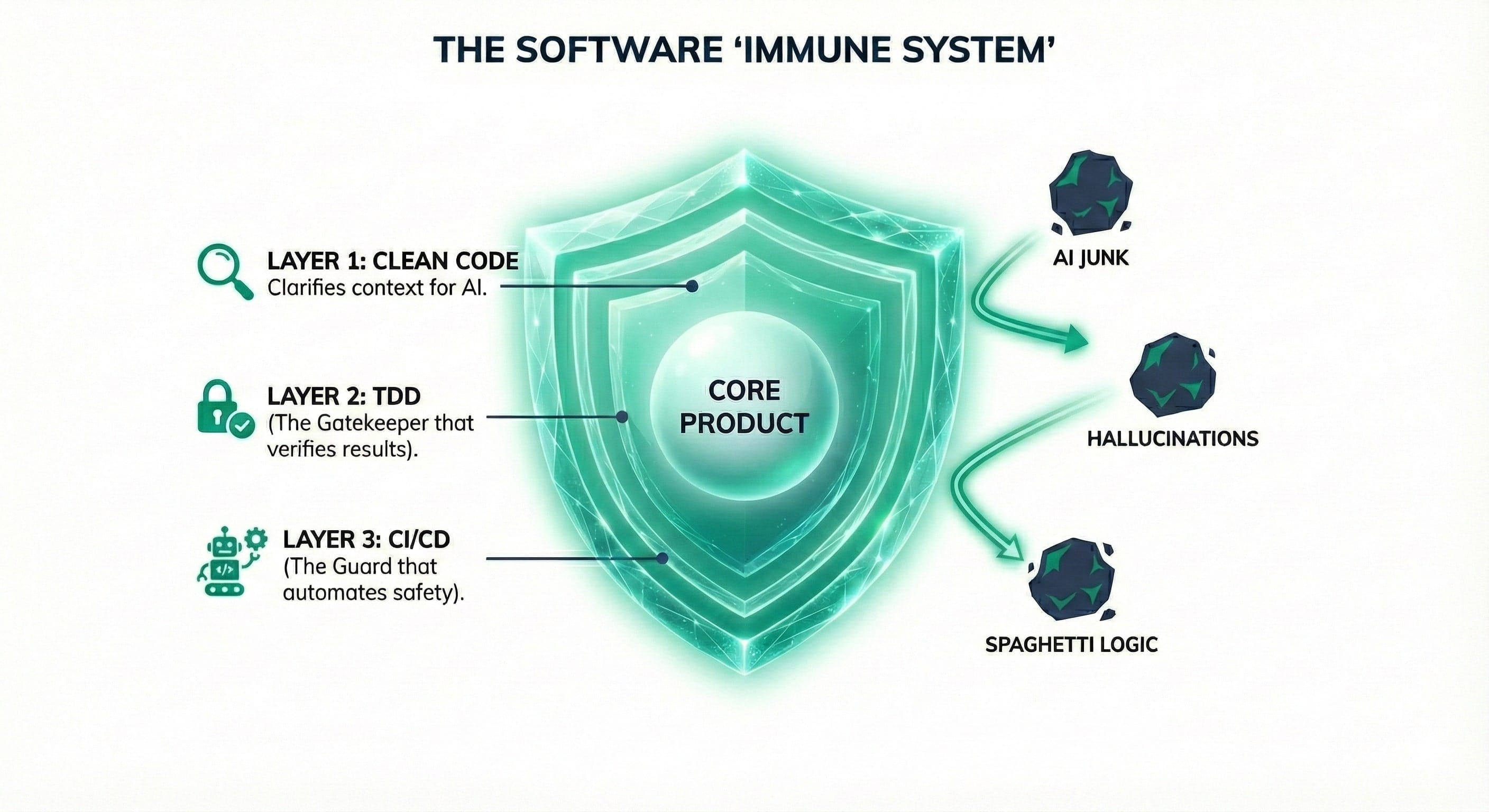
In a world where AI is flooding your project with code, how do you stay safe?
You need an Automated Immune System. This means:
- Test-Driven Development (TDD): Writing tests before the code to make sure the AI actually meets the requirements.
- CI/CD: Pipelines that automatically check for errors and security risks every time the AI suggests a change.
- Clean Code Standards: Refusing to accept “messy” code from the AI, even if it seems to work.
This is the only way to maintain a “Baseline of Trust.” Without this immune system, your codebase will eventually “get sick” and die from too many small AI errors.
10. The New Reality: You are the “Chief Auditor”
Your job title might still say “Software Developer,” but your role is changing.
In the AI era, being a “Senior Developer” means being a System Architect and Verification Specialist. You are the one who designs the high-level plan and then audits the AI’s work to make sure it follows that plan.
The value of a human engineer is in judgment – knowing the business context, the security risks, and the long-term goals that an AI simply cannot understand.
11. Conclusion: Speed is Cheap, Trust is the New Currency
Speed has changed. The act of writing code is becoming a cheap commodity. But integrity doesn’t scale without Clean Code.
In a world where anyone can generate 1,000 lines of code in a second, the value isn’t in the code itself – it’s in the guarantee that the code is correct, safe, and ready for the future.
Work with a software partner whose code you can actually trust. Contact us today.

FAQ for the AI Coding Era
Should I still learn to code?
Absolutely. But you should focus on Software Engineering, not just “writing syntax.” Learn how systems work, how data flows, and how to verify correctness. The AI will do the “labor,” but you need to provide the “intelligence.”
Is Clean Code really just for humans?
Mostly, yes. But because humans are the ones responsible for the software, it’s essential. Also, as mentioned earlier, AI actually generates better results when it works with clean, modular contexts.
What is the biggest mistake companies are making with AI?
Expecting “infinite speed” without investing in “infinite quality.” Giving developers AI tools without teaching them how to audit and maintain code will lead to a massive crash in technical debt within 12-24 months.
How do I start 'Auditing' AI code effectively?
Start by enforcing strict Clean Code rules. If an AI gives you a long, messy function, ask it to break it down into smaller, clear pieces. Demand that it also writes tests for every line it generates.
Will AI eventually write 'perfect' clean code?
Maybe one day. But AI learns from human code. If we stop caring about quality, the AI will start learning from our “trash,” and the quality of AI output will actually get worse over time. This is why we must maintain our standards.
What skills should I focus on in 2026?
Focus on Architecture, Security, and Testing. These are the areas where human judgment is still 10x more valuable than an AI’s “vibe.”
Is the 'Fast Fashion' software idea a total lie?
It works for small, one-time tools. But for any software that handles money, user data, or long-term business goals, it’s a recipe for disaster. Most successful software isn’t disposable; it’s a living asset.
What does 'Crystalline Structure' mean?
It means your code is so clear and modular that any part of it can be understood in isolation. It’s the opposite of “Spaghetti Code,” where everything is tangled together. “Crystalline” code is the only type of code that can be safely audited at the speed of AI.
This article is based on a LinkedIn discussion linked here.