
Scrum Health Checklist
A structured checklist to assess how well your Scrum team collaborates, inspects value, and adapts based on feedback – with a simple scoring model to track progress over time.
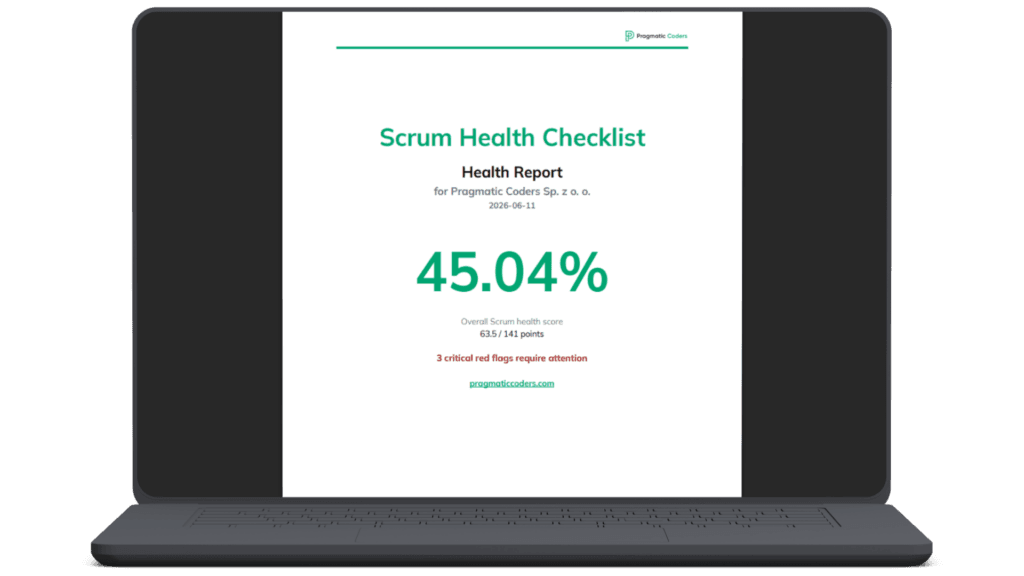
What you’ll get from the checklist
Clear Transparency
Alignment between team and stakeholders, plus internal clarity
Value Inspection
Evidence that increments are reviewed, measured, and don’t degrade quality
Real Adaptation
Changes driven by feedback and metrics, not just opinions
Trackable Score
A simple way to see improvement over time

What’s inside?
Transparency
Team ↔ Stakeholders transparency (vision, backlog predictability, milestone expectations, risk communication)
Internal team transparency (DoD clarity, refinement quality, planning clarity, issue surfacing)
Inspection
- Value inspection (stakeholder review, near-production reviews, value and quality measurement)
- Process inspection (retros, root cause thinking, checking improvements and their effectiveness)
Adaptation
- Value adaptation (backlog changes driven by feedback and metrics, paying down technical debt in changed areas)
- Process adaptation (improvement planning, efficiency/quality actions, completing improvements)
Who is it for?
Product teams
that feel busy but not consistently effective
Scrum Masters
or Delivery Leads who need a concrete improvement baseline
Engineering leaders
and Product leaders who want evidence, not anecdotes
Scrum Health Checklist: How to Improve Delivery Without More Meetings
Your team is shipping. The calendar is full of Scrum events. Stakeholders are “in the loop”.
And yet delivery still feels chaotic. Priorities shift mid-sprint. Reviews don’t change decisions. Retros produce notes – not improvements.
Welcome to the classic trap: you’re doing Scrum, but you’re not getting Scrum.
The issue is rarely one ceremony. It’s usually a breakdown in the empirical foundations that make Scrum work: Transparency, Inspection, and Adaptation. This article is a diagnostic guide based on our Scrum Health Checklist – designed to help you see whether your Scrum is healthy or just good at hiding symptoms.
Pillar 1: Transparency
This is the “shared reality”. If people don’t see the same truth, they can’t make good decisions.
1) Transparency between the Scrum Team and stakeholders
A healthy Scrum setup makes plans visible, aligns on what “near future” likely means, and keeps stakeholders informed about progress and risks – without relying on hallway conversations.
Key questions:
- Is the Product Vision known to every Scrum Team member?
- Does the Product Backlog show with high probability what will be done in the near future (1–2 sprints)?
- Does each backlog item describe the business value it brings?
- Is the Sprint Backlog the complete and only source of what the team is working on during the sprint?
- Does the team communicate business risks, and track technical risks/technical debt effectively?
2) Transparency inside the Scrum Team
Internal clarity reduces “surprise work” and prevents silent blockers.
Key questions:
- Does everyone know the Scrum Master and the Definition of Done?
- Is refinement captured well enough that a developer with the right skills can implement the change?
- After Sprint Planning, does the whole team understand the plan to achieve the Sprint Goal?
- Are problems surfaced transparently so the team can solve them together?
Pillar 2: Inspection
This is the “feedback loop”. If you don’t inspect the right things, you can’t improve intentionally.
1) Inspection of value
Scrum reviews are not a demo meeting – they’re a decision point. A healthy team invites stakeholders to verify the increment and provide feedback, ideally in conditions close to production.
Key questions:
- During Sprint Review, do stakeholders verify the increment and provide feedback?
- Does the team review changes in a near-production environment?
- Does the team measure value delivered (not just output)?
- Does the team measure quality – and ensure increments don’t reduce product quality?
2) Inspection of process
Retrospectives matter only if they produce real learning and real change.
Key questions:
- Does the team verify whether previously planned improvements were implemented?…
- Does the team identify causes of mistakes made?
- Does the retro inspect cooperation, processes, tools, and the Definition of Done?
- Does the team measure the effectiveness of improvements?
Pillar 3: Adaptation
This is the “change”. Without adaptation, you’re just repeating rituals while reality shifts.
1) Adaptation of value
Healthy teams adjust backlog and roadmap based on feedback and evidence – and they handle risk to the Sprint Goal by changing the plan, not by “hoping harder.”
Key questions:
- Does the team adapt the roadmap/backlog based on feedback?
- Does the team adapt the roadmap/backlog based on metrics?
- If risk to Sprint Goal appears, does the team modify the action plan to maximize success?
- Does Daily Scrum result in an actionable plan for the next working day?
- When implementing change, does the team pay off technical debt in the area it touches?
2) Adaptation of process
Teams should change how they work when reality proves the current approach suboptimal.
Key questions:
- In Sprint Planning, does the team consider availability/capacity?
- In retro, does the team plan activities to improve quality and efficiency?
- During the sprint, does the team actually accomplish improvements planned previously?
Conclusion
Scrum Health is not about performing ceremonies correctly. It’s about whether your system reliably produces the outcomes Scrum promises – alignment, fast feedback, and continuous improvement.
If you want a fast baseline, run the Scrum Health Checklist with your team. Mark “No” only when you truly mean it, and write down why – that’s where the improvement roadmap begins.
Want an objective assessment? We’ll run a complete Scrum audit for you.
We’ll work with your team and stakeholders to diagnose the root causes behind weak scores and deliver a prioritized improvement plan – practical changes you can implement immediately. Contact us.
Contents
Want the full picture? We’ll run a complete technical audit for you.
We’ll review your product end-to-end (backend, frontend, mobile, infrastructure) and deliver a clear action plan – risks, quick wins, prioritized improvements, and a pragmatic roadmap.