How to Market to Gen Z in 2026: The Guide

If you’re still using 2020 tactics – polished influencers, interruptive ads, perfect Instagram grids – you’re not just wasting money, you’re pushing people away.
Gen Z grew up in a “Social Recession.” We’re lonely, skeptical, and quick to spot anything fake. Don’t try to “target” us. Be real. Be relevant.
I’ve analyzed the data from Archrival, the International Journal for Multidisciplinary Research (IJFMR), and recent 2024-2025 consumer reports to check what my peers want from brands.
Here’s how to survive the shift in 2026 without looking like Steve Buscemi with a skateboard (“How do you do, fellow kids?”). This is the real guide about Gen Z, written and commented by a Zoomer (born 1998) herself.
Who is Gen Z in 2026?
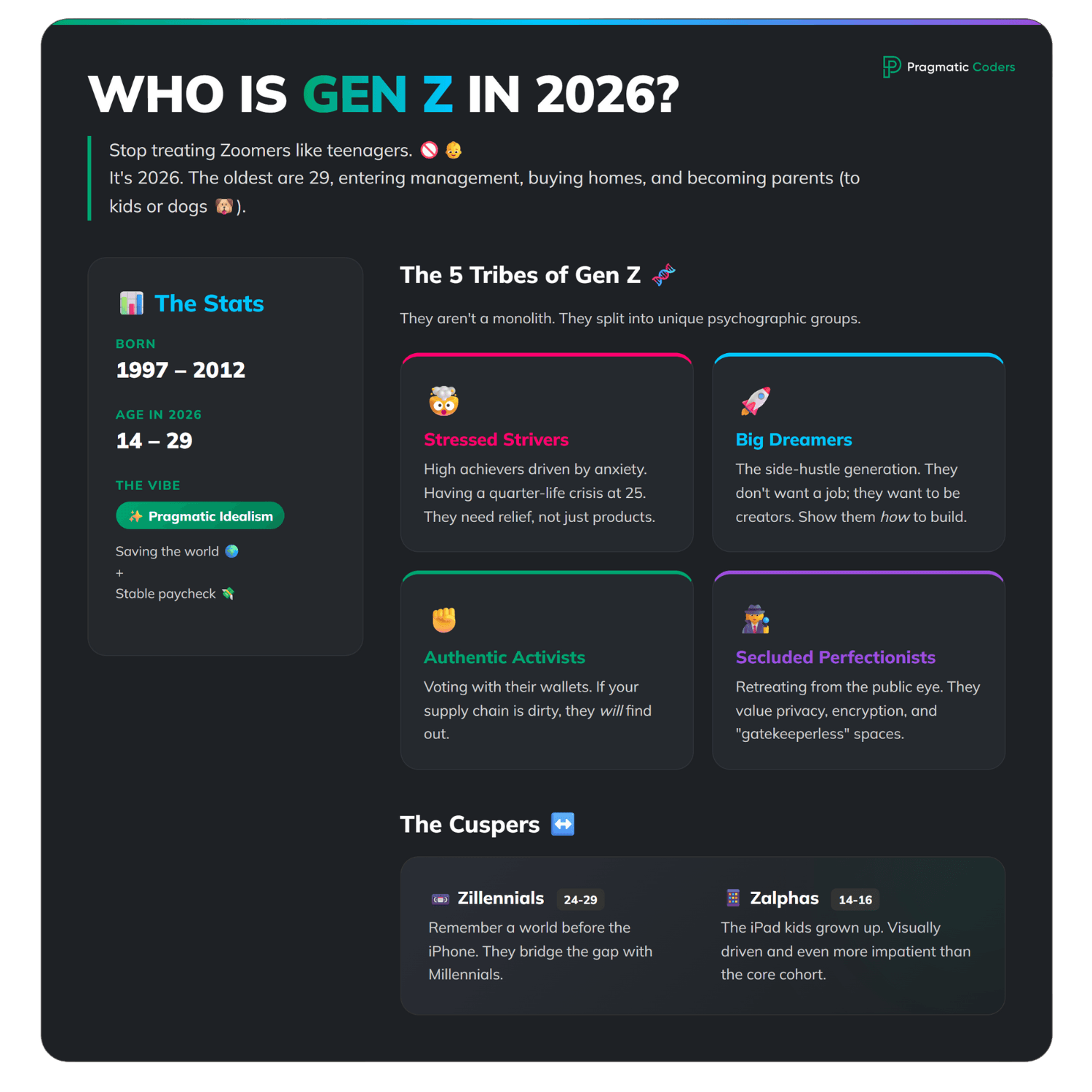
It’s time to stop treating all Zoomers like teenagers. Sure, some are still in their teens, but in 2026, the oldest Gen Zers are turning 29 (sic!). We’re entering management, buying homes (or trying to), and becoming parents (to children or dogs).
The Demographics:
- Born: 1997 – 2012
- Age Range: 14 – 29
- The Vibe: Pragmatic Idealism. They want to save the world, but they also want a stable paycheck because they’ve seen what happens when you don’t have one.
The 5 Tribes of Gen Z
The Z generation isn’t a monolith. Though all subsegments are digitally fluent, they split into different psychographic groups.
- Stressed Strivers: High achievers driven by anxiety. They are burning out at 25. having quarter-life crisis, and looking for brands that offer relief, not just products.
- Big Dreamers: The side-hustle generation. They don’t want a job; they want to be creators. They respect brands that teach them how to build.
- Authentic Activists: They vote with their wallets. If your supply chain is dirty, they will find out.
- Secluded Perfectionists: They are retreating from the public eye. They value privacy, encryption, and “gatekeeperless” spaces.
- The Cuspers:
- Zillennials (24-29): Remember a world before the iPhone. They bridge the gap with Millennials.
- Zalphas (14-16): The iPad kids grown up. They are even more visually driven and impatient than the core cohort.
1. Radical Authenticity
Unless you’ve been living under a rock, you know that Gen Z can smell a marketing strategy from a mile away. If your content looks like an ad, we’re scrolling past it.
The Death of the “Traditional Influencer”
Here’s a pragmatic reality check: trust is now inversely proportional to follower count. The “Mega-Influencer” – with millions of followers that has scripted product recommendations while at the same time being totally unrelatable – isn’t a person anymore; they’re a billboard. And nobody trusts a billboard. Oversaturation and fake-sounding posts have made influencers less trustworthy. Movements like #deinfluencing (98.4k TikToks) show Gen Z prefers real voices.
It’s not like we don’t trust any influencers anymore. But the thing is: Brands often focus on big influencers, yet 92% of Gen Z consumers trust nano- and micro-influencers more – they’re simply more authentic and engaging.
The Data
Influencers > traditional celebrities/businesses
- Gen Z is 3.2× more likely to trust a product recommendation from a micro-influencer than from a traditional celebrity (69% vs 22% trust). (StackInfluence)
- 41% of Gen Z trust influencers for product recommendations more than they trust ads from a business. (GoDaddy)
Influencers
- 81% of Gen Z prefers influencers who create community over those pushing products. (Archrival)
- 52% have purchased a gift based on a creator’s recommendation in 2023. (Mavely)
We’re seeing a massive shift towards “De-influencing” – where creators gain credibility by telling people what not to buy. The market was full of paid shills, and Gen Z pushed back by demanding honesty.
Peers Over Pros
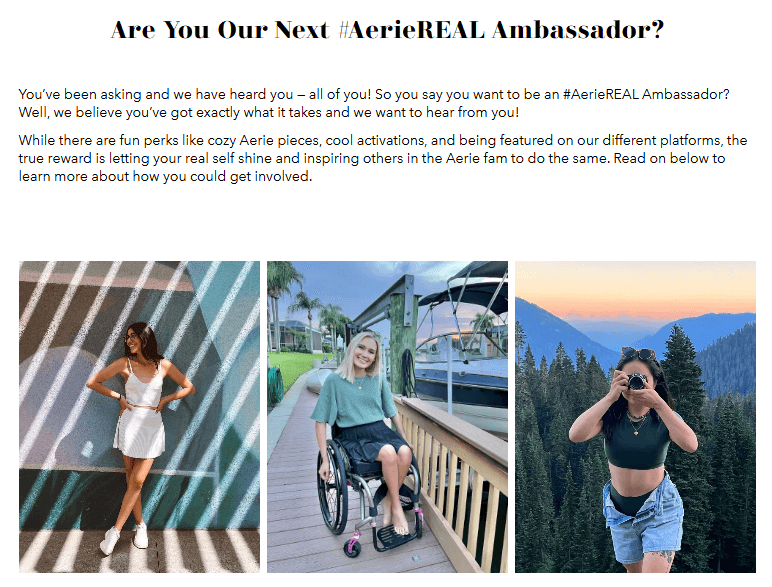
A recommendation from a random user with 200 followers often carries more weight than a celebrity endorsement. Why? Because the random user has nothing to lose.
Case Study: The Rise of “UGC” (User-Generated Content) – Look at how brands like Aerie stopped using airbrushed models years ago. By 2026, this is the baseline. Brands that use “real people” in their campaigns are seeing 2.6x higher consumption rates of their content compared to brand-only posts.
Employees are the New Influencers
Your best influencers are already on your payroll.
- Duolingo: They didn’t hire a celebrity. They gave a social media manager a green owl suit and told them to be “unhinged.” The result? A cult following that engages with a language learning app like it’s a meme page.
- Sherwin-Williams: Remember the paint-mixing guy on TikTok? He was just an employee who loved mixing paint. It was satisfying, it was real, and it did more for the brand’s visibility than a Super Bowl ad. Pity that the company didn’t want to see his potential and… fired him.
Pragmatic Tip: Audit your content. If it looks too polished, break it. Use raw video, native fonts, and unscripted moments. Perfection is suspicious. If you have a budget for a high-production shoot, cut it in half and give the rest to 50 micro-influencers to just “do their thing.”
| MY OPINION: The people I follow online are not huge influencers. In fact, most of them have a max of a few hundreds of thousands followers on Instagram, but some – as few as a couple of k on YouTube. I much more appreciate the imperfect in the marketing, but at the same time, I can feel sometimes brands are pushing the “body positivity” and “political correctness” way to far – like, it feels they themselves don’t really believe in it, they just do it because they think this is what they should do. And did I buy anything I saw such mini-influencers using. Sure. I’ve been into indoor plants recently, and next week I’m ordering castile soap for my begonias. |
Also check:
- Gen Z healthcare in 2026: Expectations & trends
- Gen Z reveals 6 true yet overlooked banking trends
- How to design a mobile banking app for Gen Z
2. Community is the Business Model (Not Just an Email List)
For years, marketers treated “community” as a buzzword for “people we can spam.” In 2026, that’s a fatal error. Community isn’t a strategy; it’s the whole business model.
The Theory: Network Effects & Gatekeeperless Spaces
We are witnessing a structural shift from “Audience” (one-to-many) to “Network” (many-to-many).
- Gatekeeperless Spaces: Gen Z has retreated from the performative, algorithmic gaze of Instagram to private, “gatekeeperless” spaces like Discord and Geneva. Here, psychological safety makes radical self-expression possible.
- The Network Effect: The value of your brand now scales with the number of connections between your users, not just their connection to you. If your customers aren’t talking to each other, you don’t have a community; you have a mailing list.
The Data:
- 35 of Gen Z is active on Discord. (Backlinko)
- Discord now hosts over 19 million active servers.
- 65% of Gen Z feel more confident in community-focused apps like Discord and Twitch than on open social media. (Ampero)
The Phenomenon of “Tandem Fandoms”
Archrival’s research identifies a new behavior: “Tandem Fandoms.” Gen Z communities are not siloed; they are a sprawling, intersecting web.
- The Insight: A user isn’t just a “gamer” or a “beauty enthusiast.” They are in a “finance 101” group chat, a “book club” Discord, and a “political meme” subreddit simultaneously.
- The Opportunity: Brands that understand this can create “cross-pollination.” When the Kamala Harris campaign released a camo hat similar to Chappell Roan’s merch, it wasn’t a coincidence; it was a masterclass in leveraging Tandem Fandoms. It connected political identity with pop culture identity, creating a “stickier” bond than either could achieve alone.
| MY OPINION: So true. My mix is plants on IG, art & lit on Substack, and true crime & fitness on YouTube. |
Co-Creation: Hand Over the Keys
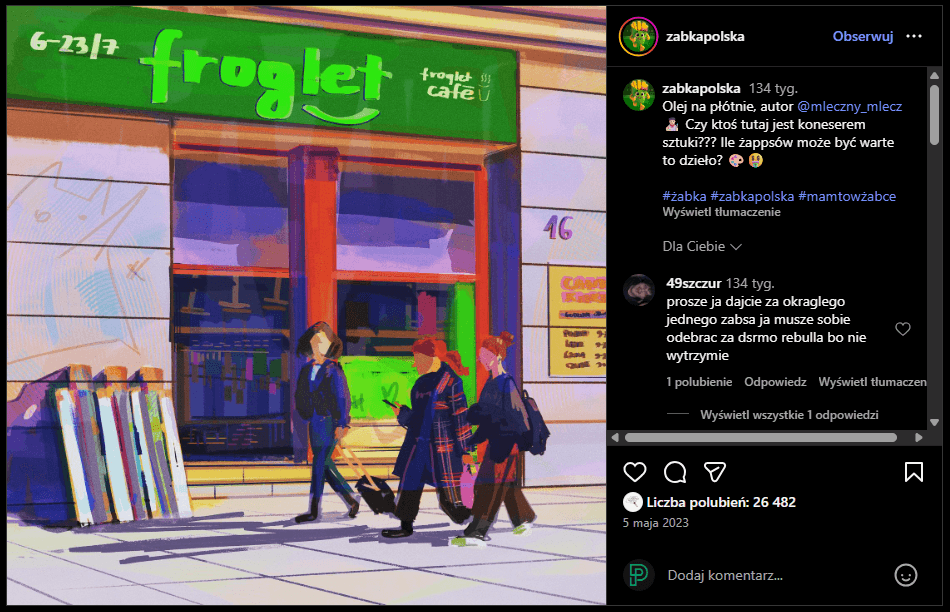
The most successful brands of 2026 are the ones that surrender control. Don’t just ask for feedback; let them build the campaign.
- Lego Ideas: This is the gold standard. Fans design sets, the community votes, and Lego manufactures the winners. The creator gets a cut. It’s not marketing; it’s partnership.
Stat Check: Campaigns incorporating User-Generated Content (UGC) generally see a 29% higher conversion rate than those without. (Everyone Social)
| MY OPINION: I’ve experienced this firsthand. Besides plants, I do digital painting. I posted an illustration featuring a Żabka store, and they reposted it. Not only did my follower count skyrocket, but their repost got significantly higher engagement than their usual brand posts. It seems to be a trend with all their UGC. |
Pragmatic Tip: Stop treating your community managers like customer support agents. They are your most important marketers. Give them the budget to do cool shit for the community without asking for an ROI immediately.
3. The “Phygital” Renaissance: The Retail Resurrection
Remember when everyone thought the Metaverse would replace the mall? Yeah, that didn’t happen. We’re witnessing a “Retail Resurrection.” After growing up on Zoom, Gen Z is desperate to “touch grass.”
The Theory: The “IRL-gorithm”
Here is the paradox: Gen Z lives online, but they find physical reality more inspiring.
- The Data: 74% of Gen Z say IRL experiences are more inspiring than digital ones. (Vogue)
- The Mechanism: This is the “IRL-gorithm.” They go to physical stores to find the “source material” for their digital content. The store feeds the feed. If your store isn’t “content-worthy,” it doesn’t exist.
| MY OPINION: ‘m getting more and more tired of the Internet. While I love using it and it’s an important part of my life, the information overload, my 8-hour computer job, and the AI noise represent a lot to handle, making me anxious and tired at times. That’s probably where my plant hobby comes from. I also see more and more really young people picking up activities like knitting, sewing, and paint-by-numbers – all sorts of things that help us unwind and ‘feel’ the reality around us. |
The “Antiverse” Sentiment
Let’s be honest: corporate virtual worlds are cringe.
- The Reality: 43% of Gen Z say the idea of the metaverse makes them cringe. (Archrival)
- The Shift: They don’t want to shop in a pixelated Walmart. They want to hang out in actual Roblox (gaming) or go to a physical thrift store for the thrill of the hunt.
Retail as Media: The Landmark Strategy
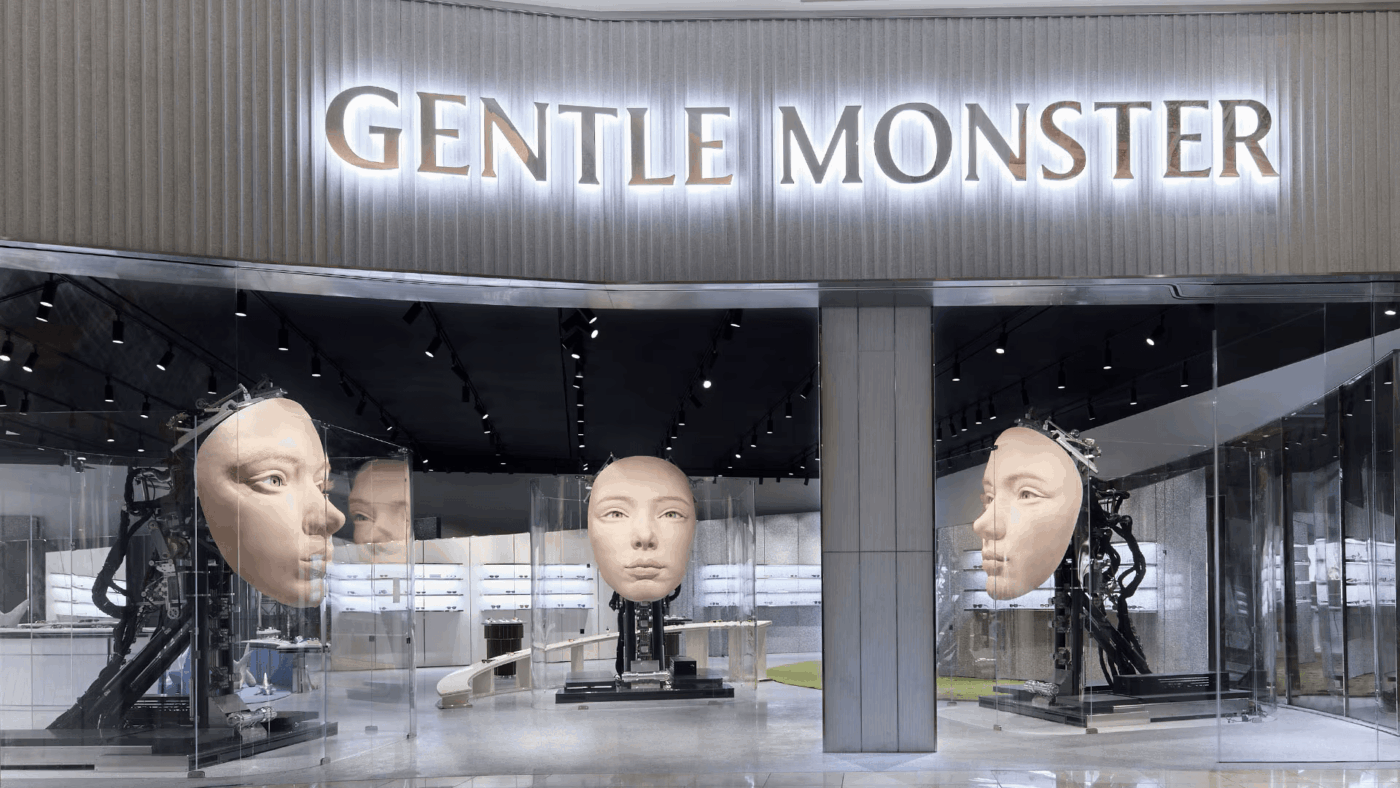
Physical stores aren’t for distribution anymore (Amazon won that war). They are for discovery. The store is a media channel.
- The Vibe Shift: It’s not about a staged “Instagram wall” – that’s 2018. It’s about chaotic energy, bin stores, and pop-ups.
- Case Study: Gentle Monster: This Korean eyewear brand treats its stores like art galleries. Every location is a surrealist installation. You go for the weird robot sheep; you stay to buy the sunglasses.
- The Hub: Successful brands turn stores into “Landmarks” – places you have to visit. Hosting run clubs (like Gymshark or Hoka) turns a transaction point into a community hub.
The Omnichannel Expectation
While they love the store, they expect the digital layer to be seamless.
- 37% of Gen Z planned to shop in-store more frequently in 2025, but they will be on their phones the whole time. (PwC)
- They are checking prices, looking up reviews on TikTok, and sending photos to the group chat.
Pragmatic Tip: Don’t optimize your store for efficiency. Optimize it for dwell time. If they want to hang out, they’ll eventually buy something. And make sure your in-store WiFi is fast, because they will be Googling your competitors while standing in your aisle.
| MY OPINION: The WiFi part is spot on (I’m looking at you, IKEA Cracow store). |
4. Mastering the “Algo Life”: TikTok is Google
The linear customer journey? It’s a relic. Gen Z has embraced the “Algo Life” – they trust algorithms to know what they want before they do.
Spending Snapshot (Numerator)
Average Gen Z household spend: $16,552/yearTrips per year: 586
Spend per trip: $28
Share of U.S. households: 8%
Share of CPG/general merchandise/QSR spend: 6.1% (up from 2.6% in 2020)
Combined Gen Z + Millennial spend share: 32% (up 8 points since 2020)
The Theory: “Gen Overwhelm” & Outsourced Discovery
Why do they trust the algorithm? Because they are drowning.
- Gen Overwhelm: 80% of Gen Z feels exposed to more brands and ads than any other generation. They are burned out. (Archrival)
- The Solution: They use the algorithm as a shield. They have “Outsourced Discovery.” Half of Gen Z says their algorithm knows their tastes better than their parents. (Archrival)
The Two Modes: Inspire & Inquire
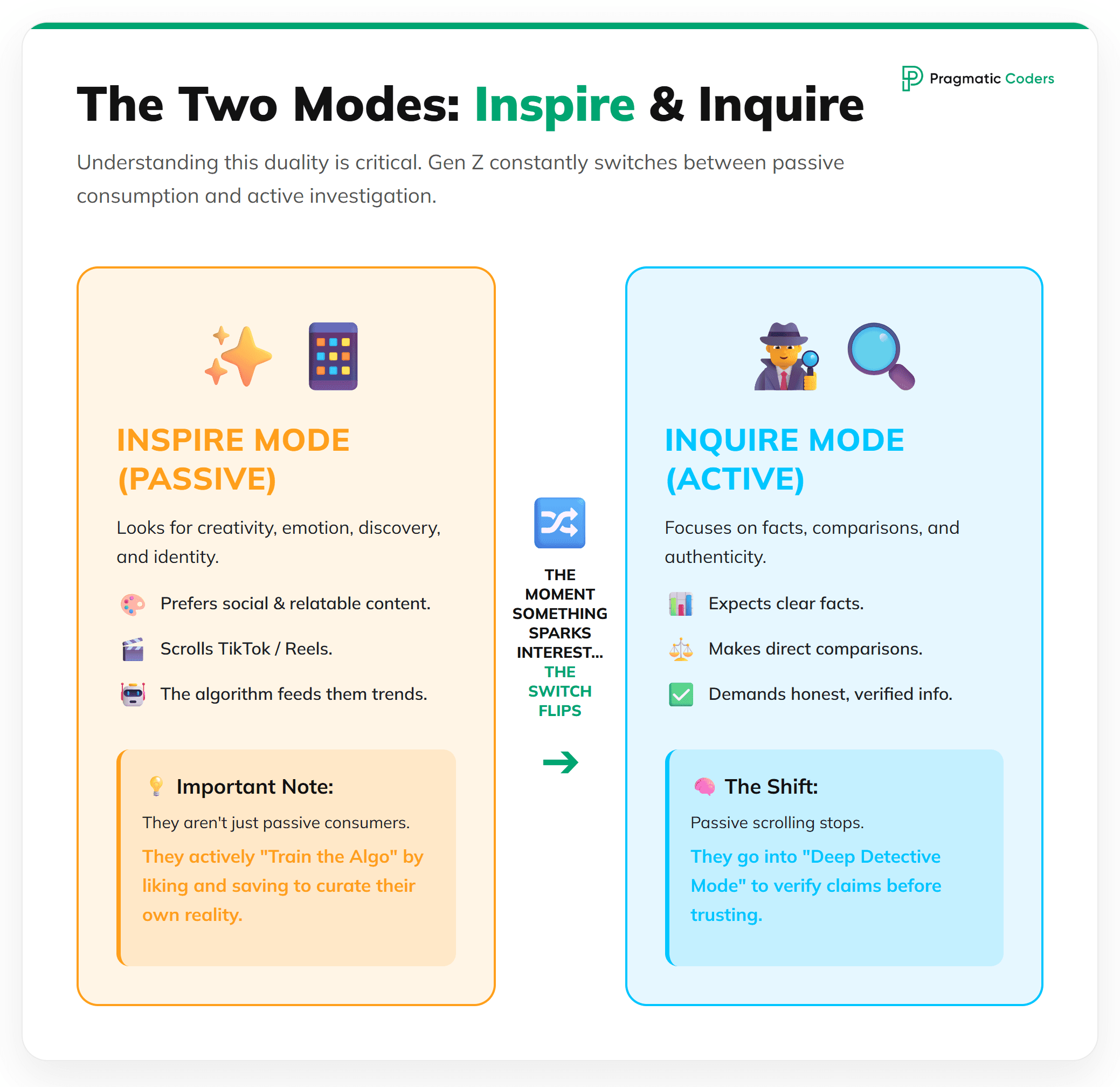
Understanding this duality is critical:
- Inspire Mode (Passive): Looks for creativity, emotion, discovery, and identity. Prefers social media, relatable content, and micro-influencers. They scroll TikTok/Reels. The algorithm feeds them trends. Your brand needs to appear here organically.
- Note: They aren’t just passive consumers; they actively “Train the Algo” by liking and saving specific content to curate their own reality.
- Inquire Mode (Active): Focuses on facts, comparisons, and authenticity. Expects clear, honest, verified information. The moment something sparks interest, the switch flips. They go into deep detective mode.
The “Splintered Path” to Purchase
Gen Z has disrupted the traditional “marketing funnel.” Their path to purchase is often nonlinear — full of detours, side-quests, inspiration points, saved wishlists, and deep dives, rather than a straight line from awareness → decision → purchase. (Archrival)
Many start with a scroll, a viral video, or aesthetic inspiration. Others begin with intense research, ingredient checks, peer reviews, price comparisons. At times, they’ll do both — cycling between “Inspire” and “Inquire” until the right balance of emotion and information aligns.
For brands — and product teams — this means success depends on delivering both: evocative, culturally fluent inspiration and clear, transparent, credible information.
- The Journey: TikTok Video -> Comments Section (Social Proof) -> Reddit Thread (Deep Dive) -> Digital Window Shopping (Cart Abandonment).
- The Data: 44% of Gen Z fill carts with no intention of buying, just to “save” the items for later.
Case Study: The Ordinary & CeraVe
@cerave @Dr Raj Arora said it best 👏 Keep it simple with a 2-step routine: Balancing Air Foam Cleansers + Intensive Moisturizing Lotion #CeraVeEADV2025
Skincare used to be about mystical claims. Then came “SkinTok.” Brands like The Ordinary and CeraVe exploded because they (and the dermatologists on the platform) explained the science in 15 seconds. They didn’t sell “beauty”; they sold “ingredients.” They optimized for the search terms “retinol for beginners” and “how to fix barrier repair.”
Pragmatic Tip: SEO for social is mandatory.
- Keywords: Put them in your captions, your text overlays, and even speak them in the video (the auto-captions pick it up).
- The “Receipts”: You cannot hide bad feedback. Engage with it. If there is a negative comment, reply with radical transparency. Acknowledging a flaw builds more trust than deleting the comment.
5. Earning “Loyal-ish” Behavior
Brand loyalty in 2026 is a paradox. Gen Z is constantly switching brands, yet they are capable of intense devotion – if you earn it. We call this being “Loyal-ish.”
The Theory: Brand Monogamy
Here’s the twist: Gen Z wants to commit.
- The Insight: Despite the narrative that they are fickle, they crave “Brand Monogamy.” They are playing the field, but they are looking for “The One.”
- The Contract: It’s a reciprocal relationship. “What have you done for me lately?”
- Trend Loyalty: 43% of Gen Z buy products just because they are trending. This is “fast loyalty.” It burns bright and dies fast. (Retail Rewired)
- True Loyalty: This is earned through values and utility. 58% are loyal to brands that reflect their values. (Bangeri)
Surviving the Itch
Wyświetl ten post na Instagramie
Attention spans are short. You need to constantly reinvent your benefits.
- Daily Doses of Communication: Think of social media like texting a crush. It’s not about ads; it’s about that daily “good morning” text (entertainment) that keeps them interested.
- Gamification: Apps that gamify the experience (like the Starbucks app or Nike Run Club) keep users in the ecosystem daily.
- Personalization: 54% appreciate AI-driven recommendations. They want you to know what they like. (Cropink)
Pragmatic Tip: Stop asking “What can this community do for me?” and start asking “What can I do for them?” Sponsor their meetups. Fund their projects. Be a patron. If you want loyalty, you have to give loyalty first.
Conclusion: Build a World, Not a Customer Base
The mandate for 2026 is simple but terrifying for traditional marketers: Dismantle the machine.
- Replace “Reach” with Resonance.
- Replace “Control” with Co-Creation.
- Replace “Transactions” with Relationships.
Gen Z is tired of the noise. We’re tired of the fakeness. But we are desperate for connection. If you can be the brand that actually matters – that stands for something real and treats us like partners rather than targets – you won’t just survive. You’ll win. And, if you need help winning, reach out to us – we know how to build software for Gen Z.
Now, go touch some grass.

Resources
This article was synthesized from the following key sources:
Trend Reports & Insights (Archrival):
- Community, According to Zs
- The New Rules of Influence
- Network Effect
- Broken Social Scenes
- Brands with Benefits
- Pixels and Bricks
- The New Consumer Mindsets: Inspire & Inquire
- Algo Life
- The New Gen Z Landscape of Love
- Local I.P.
Academic Research:
- International Journal for Multidisciplinary Research (IJFMR): “A Study on Marketing to Gen Z: Understanding the Preference and Behaviors” (ISSN: 2582-2160)