5 Body Leasing Problems That Can Slow Your Project Down
Your project is short on people, and hiring developers takes months? When that happens, body leasing looks like a lifeline: you sign a contract, get a few developers on board, and the project finally starts moving. But expectations can exceed what those contracted developers can actually deliver. And if the project is stuck for reasons other than a lack of people, adding more people won’t fix it. It may even make things worse.
Body leasing doesn’t always work. It mainly works when a well-run project simply needs more capacity. But it fails when the real problem lies elsewhere: in the process, the priorities, or how the team works. In this article, I’ll show five situations where body leasing starts to creak, and how to check whether it’s really the right choice for your project. I’ll also suggest an interesting alternative.
Key Points
|
1. Body Leasing Makes Chaos Worse When the Problem Is Not a Lack of People
If the team can’t deliver because of problems with process, quality, or priorities, or because of a complex domain, adding people will make the situation worse, not better. More people don’t remove a bottleneck. They often tighten it.
Without a product vision, priorities, and a business goal, it’s hard to make independent decisions. Contractors then start executing tasks instead of solving real problems, often with no contact with users. You end up with software that works technically but is barely useful in practice. The codebase grows, and further development gets harder and harder. Very often the problem isn’t the contractors themselves, but weak management of their work.
This is the same headcount trap you see when scaling internal teams. More people means more communication channels, more dependencies, and longer queues, not more value delivered by default.
It’s at its worst on projects that are already on fire. If technical debt is spiraling, documentation is missing, and nobody knows who is actually responsible for which part of the system, you don’t need more pairs of hands. You need someone who will first understand the system and take responsibility for fixing the problem. When a deadline is close, it’s often better to cut scope and set priorities than to add people who will slow your internal team down even more at the start.
More cooks won’t save a dish that has no recipe.
2. In Body Leasing, Responsibility for Results Stays With the Client
In classic body leasing, you get extra people on the team, but responsibility for delivering the outcome still sits with you. The partner is responsible for making people available, not for the project result.
That has consequences in day-to-day work. A contractor who knows they’re only there temporarily rarely makes bold calls on architecture or paying down technical debt. It’s safer to close tasks that can be checked off quickly. That’s not ill will. It’s the natural result of thinking, “I won’t be here much longer anyway.”
It gets worse when a chain of middlemen sits between you and the contractor. Each link slows communication and dilutes responsibility until nobody takes ownership.
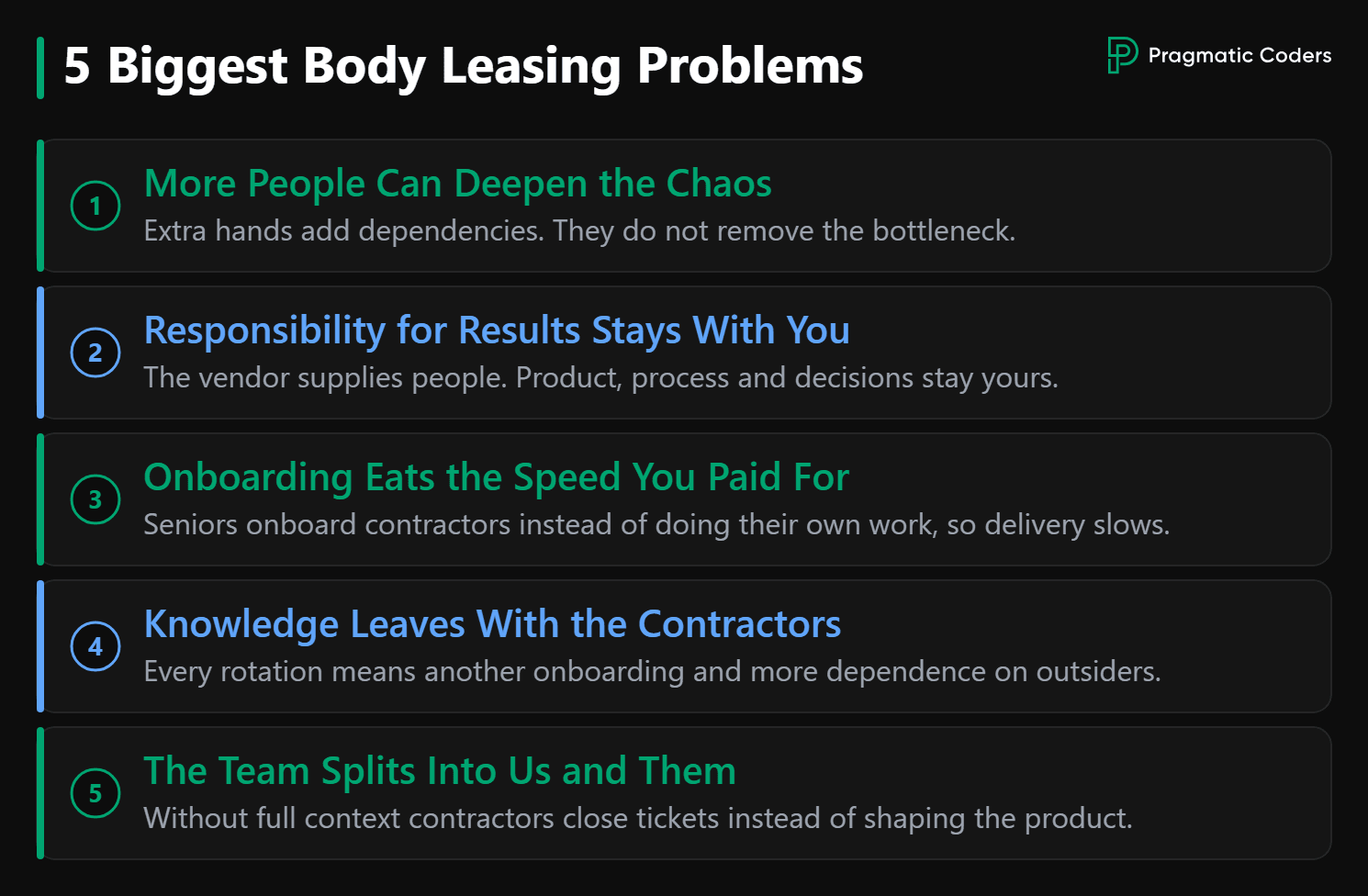
3. Onboarding in Body Leasing Eats Into the Speed You Were Promised
A large part of the speed you buy gets eaten up by onboarding. A new person’s first weeks are usually not a boost to team capacity. They’re a drop. The new contractor doesn’t know who to ask about what, so they ask seniors. Seniors get pulled off their own work, and for a while you pay for more people and less team output.
The problem is rarely technical skill itself. More often, what’s missing is domain context and an understanding of how the parts of the system connect. Someone can be productive technically and still not know where a change should go. That’s especially true in systems where logic and data are spread across many services. A new person may write correct code and still change the wrong part of the system. On top of that, outsiders often have limited access and no decision-making power, so it’s harder for them to actually get work moving.
Body leasing works best when contractors get clearly defined work and enough context. If they first have to learn a complex domain, onboarding takes longer and the promised speed disappears. Another problem shows up when a contractor has finally learned the system and how to work in it well, but then leaves and takes that know-how with them. Onboarding their replacement starts from scratch, but the bar is already higher because the system has grown in the meantime.
And if there’s no senior on hand to walk the contractor through the project, the new person has to learn everything alone, by trial and error. Setting up the environment or learning how the team works is only the beginning. Most of the time gets eaten up by building domain knowledge and understanding why the system works the way it does. On a short contract, the new person may only be starting to get the context as their agreement runs out.
Do the math on a timeline. If someone joins for six months and spends three months onboarding, you only see real results for half the period you’re paying for. In a complex or regulated domain, that ratio looks even worse.
4. Contractor Rotation Raises the Risk of Knowledge Loss
As I already mentioned, when a contractor leaves, the company can lose part of its knowledge of the system. In body leasing, that isn’t a one-off risk. It’s built into the model. Every time a contractor spends a few months on a key module, they pick up decisions and dependencies you can’t see in the code. That knowledge walks out with them when the contract ends. In theory, documentation is the safety net. In practice, few teams keep it thorough enough to explain why the system works the way it does.
With frequent rotation, the system goes legacy fast. Not because the technology got old, but because nobody knows exactly how and why each module works anymore. Every further change then means digging through the code, and the risk of failures rises with every deployment.
The opposite scenario isn’t safe either. When the same contractors stay on a project for years, knowledge doesn’t spread. It piles up outside your company. That’s how you end up with a low bus factor: only a few people hold critical project knowledge, and they sit outside your organization. In practice, that means vendor lock-in: formally you have the code, but without those people it’s hard to change anything safely.
So if you go with body leasing, require solid documentation from day one and make sure knowledge keeps moving into your own team. That’s the only way know-how stays in the company instead of walking out with the contractors.
5. Body Leasing Creates an “Us vs. Them” Divide on the Team
It’s easy for a contractor to end up shut out of the team. They use different communication channels, don’t take part in all the meetings, and often work under different terms. Without the full context, they focus on executing tasks instead of thinking about the product. That’s how you get a divide between “us” (the internal team) and “them” (the contractors) in a group that was supposed to work as one team.
From the contractor’s point of view, that’s one of the most painful costs of the model. It’s hard for them to feel part of the company that employs them, because, day to day, they work for the client. On the client side, they’re outsiders too. So it’s easier for them to treat the project like a temporary gig: they deliver the assigned tasks, but they don’t engage in decisions about the product as a whole.
Resistance shows up on the other side as well. The decision to use body leasing usually comes from management, not from the team. Internal developers can be reluctant, and contractors are sometimes onboarded so they never get any real say in decisions or how the team works. Instead of shipping faster, the team gets stuck in tension and loses time on extra coordination.
When Body Leasing Makes Sense and Actually Helps You Ship More
Since the model doesn’t always fail, it’s worth being honest about when it really works. It works when the process is solid and the team only lacks capacity or a specific technical skill. If requirements, priorities, decisions, architecture, or quality are shaky, extra contractors won’t fix the problem. In practice, body leasing makes sense when:
- the product is stable, and requirements, backlog, architecture, and ways of working are in order;
- the client has a clear vision and priorities, makes decisions efficiently, and gives feedback quickly;
- there’s a senior on the team with time to onboard contractors, hand over context, and support them early on;
- contractors fill a specific skill gap, take on a defined slice of a less critical part of the system, or help with a periodic spike in load;
- the engagement lasts long enough for the onboarding cost to pay off, and contractors are treated as part of the team.
A simple move also works well. You start new contractors in less critical parts of the system first, and move people who already know the project from meetings and day-to-day work into the core module. Even if they haven’t touched that code before, they have context, so onboarding is faster and safer than dropping outsiders straight into the most complex business logic.
One more nuance. Quick prototypes, once a typical job for hired programmers, often get built very fast with AI today. So in that area, body leasing loses importance.
So before you hire contractors, check whether the team can make use of the extra capacity.
Body Leasing or External Project Support? Diagnose the Problem First
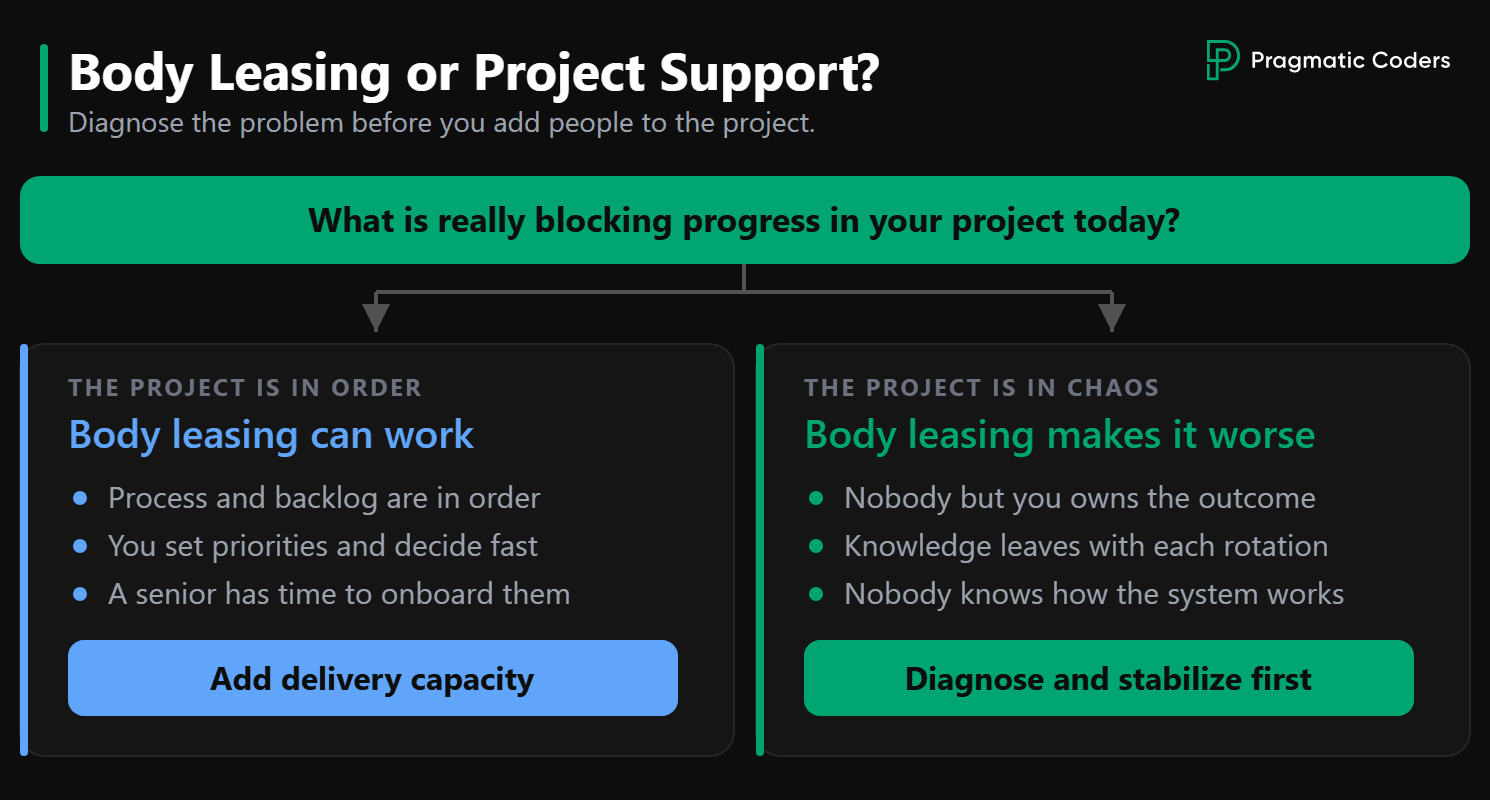
A good decision doesn’t start with “Where do we get people?” It starts with “What is actually blocking progress on this project today?” That answer tells you whether body leasing will help, or only push the real diagnosis further down the road.
- If your project is well-run and the real problem is lack of capacity, body leasing can be a sensible choice.
- If the project is chaotic, nobody but you is responsible for the result, or knowledge walks out with every rotation, you need diagnosis and stabilization first, not more people.
A safe first step is an honest project self-diagnosis. It helps you separate being short on people from lacking control over how the team works. Only then can you see whether the project needs more people, or a better way of working.
When to Choose External Project Support
When the problem lies in how the work itself is done, you won’t solve it by adding more contractors to the project. That’s why we support technology projects under a different model: we take responsibility for delivering the outcome, not just for having people present. We work side by side with your team and bring proven practices that help you measure real progress and forecast the project end date more reliably.
We start by separating facts from claims. We check the state of the product and the code, how the team works, the scope, and the dependencies. Then we point to the real causes of the problems, not only the symptoms. A large share of our projects are takeovers after other vendors and rescues of at-risk deliveries, so we quickly see where process, technical, or decision-making chaos is hiding. Only once the foundations are stable do we help scale the team safely.
We also work deliberately on raising the bus factor: we transfer knowledge and build documentation so the project stops depending on one or two people. We don’t push change from above. Instead of announcing “from today we work this way,” we show better solutions in practice and let the team come around to them over time.
Hybrid Work Instead of Fully Remote Contractors
In typical body leasing, contractors often work fully remote. We deliberately take a hybrid approach: we meet in our office, and when the project needs it, the whole team also works from the client’s office. That shared time speeds up knowledge exchange and shortens the path to decisions. In complex projects, those gains really help you ship changes faster and more safely. Not because remote work doesn’t work, but because a well-run hybrid setup makes it easier for everyone to work from the same context.
As a result, you regain control of the project. It’s easier for you to predict deadlines, the team works more effectively, and product development stops depending on individual people. When the engagement ends, what stays with the company is not only the work delivered, but also an orderly process, documentation, and knowledge.
Conclusions
Body leasing has a place in the market. It works when the team already knows how to work well and only needs extra capacity. When there’s chaos, unclear responsibility, or project knowledge walking out of the company with people, it usually only makes the problems worse.
So before you sign a contract, check whether what you really lack is people, or rather how the project is being run.