What Are Managed Services in Software Development? And When Do They Actually Make Sense?
For a lot of companies, the first instinct is simple: hire more engineers, add capacity, move faster.
That works – up to a point.
But once a product is live, the challenge shifts from building features to keeping the system reliable, secure, and ready to grow.
And somehow, all of that has to happen. That is where managed services start making sense.
What are managed services in software development?
Managed services are an ongoing collaboration model in which an external partner takes responsibility for a defined part of a company’s technology operations.
The key point is that the client is not only buying capacity. They are buying continuity, accountability, and a clearer ownership model.
Instead of asking:
“Can you give us a few strong engineers?”
the question becomes:
“Can you take care of this area so it runs well every day?”
That is a big shift. Once the conversation moves from staffing to ownership, the value changes too. You are no longer paying only for output. You are paying for operational stability, technical discipline, and the confidence that somebody is actually watching over a critical part of the system.
What is usually included in managed services?
The exact scope depends on the company, product maturity, and business context, but managed services in software development often include:
cloud and infrastructure management,
monitoring and observability,
CI/CD maintenance and release support,
incident response and production support,
security improvements and operational hardening,
bug fixing and technical maintenance,
reliability and performance work,
cost optimization,
environment setup and infrastructure automation,
ongoing technical improvements.
In more advanced setups, the scope may also cover disaster recovery planning, rollback mechanisms, access control, operational documentation, and support for compliance-heavy environments.
That is why managed services should not be reduced to “maintenance.”
Maintenance is part of the job. But the bigger goal is to keep the system healthy, predictable, and easier to scale.
Managed services vs team augmentation vs dedicated product team
These models are often bundled together, even though they solve very different problems.
Here is the cleanest way to separate them:
| Model | What the client gets | Main value | Best fit |
|---|---|---|---|
| Team augmentation | Individual specialists joining an existing setup | Extra capacity | Companies with strong in-house ownership that need more hands |
| Dedicated product team | A cross-functional team responsible for a delivery stream or product area | Delivery capability and shared ownership | Companies that want to build or scale a product area with external support |
| Managed services | Ongoing operational ownership of a defined technical area | Stability, continuity, and lower operational overhead | Companies that need someone to run and improve a platform area over time |
Team augmentation
In team augmentation, external specialists join the client’s existing team. The client usually keeps ownership of priorities, architecture, delivery process, and roadmap.
This model answers:
“Can you add strong people to our team?”
It is mostly about capacity.
Dedicated product team
A dedicated product team is broader. Instead of adding individual specialists, the partner provides a team that can deliver a product stream, feature area, or platform domain with more autonomy.
This model answers:
“Can you help us build and grow this part of the product?”
It is about delivery capability and shared ownership of outcomes.
Managed services
Managed services go one step further. The focus is not only building. It is also running, maintaining, improving, and protecting a defined part of the system over time.
This model answers:
“Can you take responsibility for this area so it does not depend on our team managing it day to day?”
It is about continuity and operational ownership.
What managed services are not
This is usually where things get clearer.
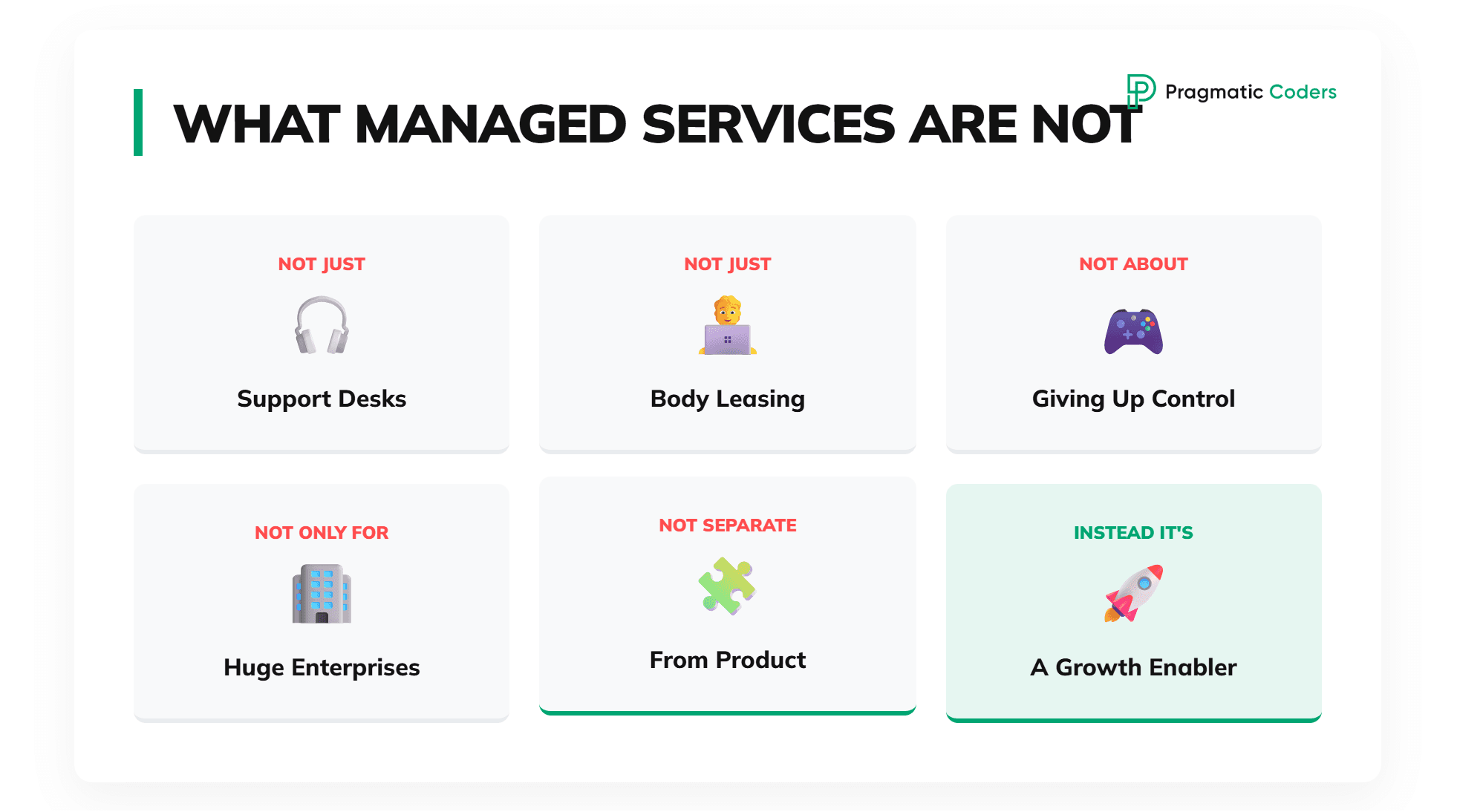
They are not just support desk services
A good managed services partner does not only react to incidents. They improve the system so incidents become less frequent, less painful, and easier to resolve.
They are not body leasing with a nicer label
If the model is basically “here are a few engineers, now manage them yourself,” that is not really managed services. The core of managed services is responsibility, not staffing.
They are not about giving up control
Done properly, managed services make responsibilities clearer. The client still owns business goals, priorities, and strategic direction. The partner owns agreed technical and operational areas.
They are not only for big enterprises
Scale-ups, product companies, and teams growing quickly often have the strongest need for managed services — especially when internal engineering time is too valuable to spend on constant operational overhead.
They are not separate from product thinking
This matters a lot. Infrastructure, releases, security, quality, and reliability all affect product velocity. If managed services are handled in isolation, they become a cost center. If they are connected to product goals, they become an enabler of growth.
When do managed services make sense?
Managed services are not for every company at every stage. But they become very relevant in a few common situations.
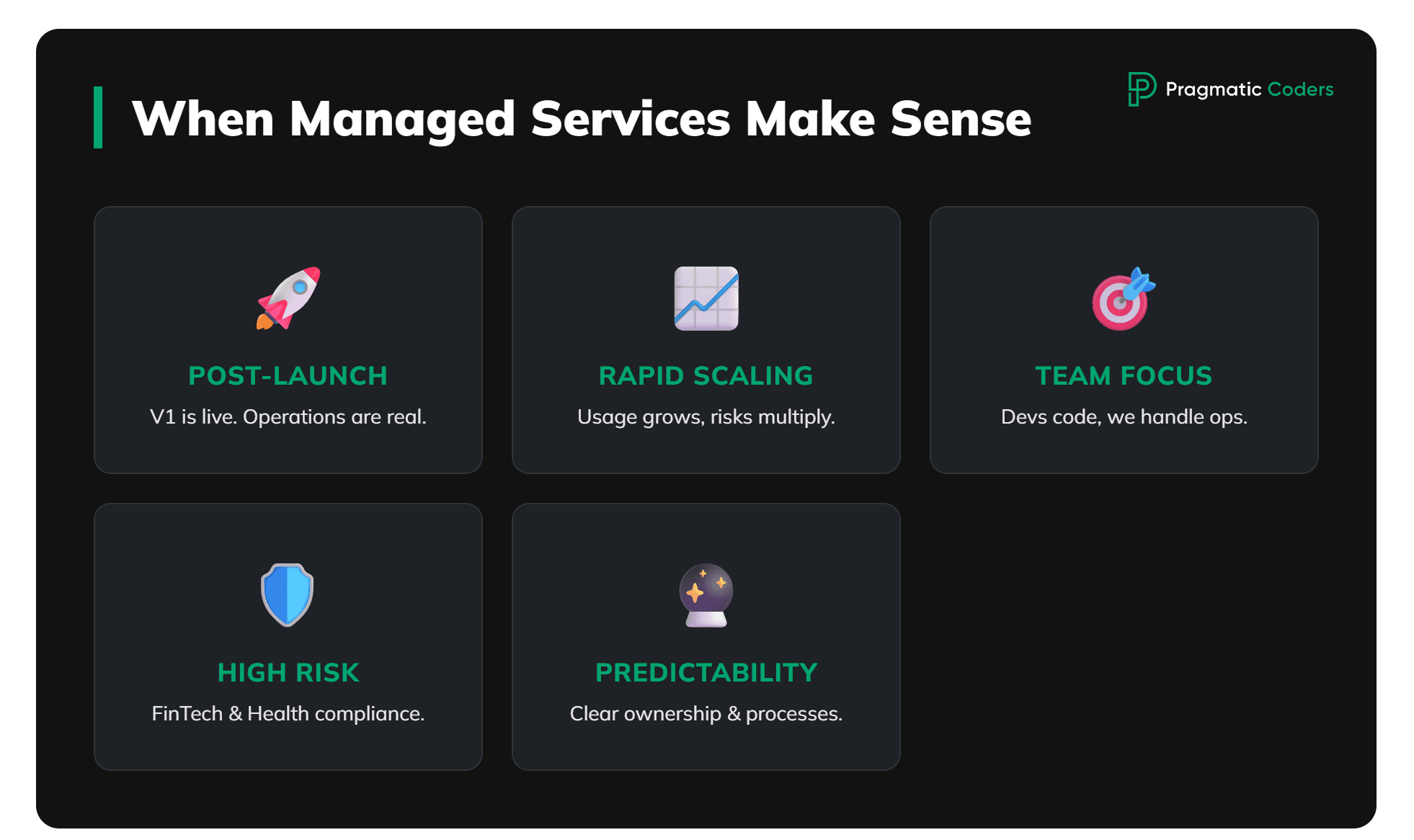
After launch
Shipping V1 is one thing. Running it well is another. Once a product is live, operational work becomes real very quickly.
During scaling
As usage grows, the system gets more demanding. Weak release processes, fragile infrastructure, and limited observability stop being minor inconveniences and start becoming business risks.
When internal teams need focus
A product team should not spend all its energy dealing with infrastructure maintenance, deployment issues, or repetitive operational work. Managed services help protect focus.
In regulated or high-risk environments
In FinTech, healthcare, and similar domains, operational maturity is not optional. Security, traceability, resilience, and controlled releases matter from day one.
When the business wants predictability
Managed services help when a company wants clearer ownership, repeatable processes, transparent escalation paths, and confidence that someone is taking care of critical technical areas.
How Pragmatic Coders approaches managed services
At Pragmatic Coders, managed services make the most sense when they are treated as part of a broader product and technology partnership — not as a narrow support function.
That is an important distinction.
We do not think about this model as “keeping the lights on” and disappearing into the background. We see it as taking responsibility for the technical and operational foundations that let a product keep running, keep scaling, and keep evolving without unnecessary friction.
In practice, that means combining operational ownership with product thinking.
This shows up in areas such as cloud applications, infrastructure managed as code, continuous delivery, testing automation, security, and long-term platform improvement. Together, these capabilities create a setup in which maintenance, reliability, delivery, and product growth are connected — not treated as separate tracks.
That is why managed services fit especially well for companies that no longer want a pure team augmentation model.
The value is different.
A useful example here is Atom Bank. We helped Atom increase its ability to deliver business changes fast, including building a new remote engineering team and laying the foundation for a nearshore hub in Poland. While this case study is not framed explicitly as a classic managed services story, it shows the kind of long-term, high-responsibility partnership that sits much closer to ownership than simple resourcing. You can read it here: Atom Bank: A remote team for the UK’s first fully digital bank.
Atom Bank: Establishing an entirely new, remote team for the UK’s first fully digital bank in just under nine months.
Atom Bank: A remote team for the UK’s first fully digital bank
Final thoughts
Managed services in software development are not about adding more people.
They are about giving ongoing technical ownership to a team that takes responsibility.
That can mean production support, DevOps, and cloud operations. Or it can mean owning part of a platform and keeping it stable as the business grows. Whichever you need, we can help.

What are managed services in software development?
Managed services in software development are an ongoing collaboration model in which a partner takes responsibility for a defined part of a company’s technology operations. This can include infrastructure, DevOps, monitoring, production support, security, maintenance, and ongoing technical improvements.
How are managed services different from team augmentation?
Team augmentation gives a company extra engineering capacity. Managed services are about ownership. Instead of adding individual specialists to an internal team, a managed services partner takes responsibility for running and improving a specific technical area over time.
Are managed services just another name for support?
No. Support can be part of managed services, but it is only one piece of the model. Managed services also include proactive improvements, operational discipline, reliability work, automation, and long-term technical health.
When do managed services make the most sense?
They usually make the most sense once a product is live and operational complexity starts to grow. This often happens during scaling, in regulated environments, or when internal product teams need to stay focused on roadmap and customer value instead of day-to-day operational work.
Do managed services mean losing control over the product?
No. In a good setup, responsibilities become clearer, not weaker. The client still owns business priorities and product direction, while the partner takes ownership of agreed technical and operational areas.
Are managed services only for large enterprises?
Not at all. They can be especially useful for scale-ups and growing product companies that need stronger operational maturity without building every capability in-house.
What is typically included in managed services?
The scope varies, but it often includes infrastructure management, monitoring, CI/CD support, incident response, security improvements, bug fixing, maintenance, reliability work, and performance optimization.
How do managed services relate to dedicated product teams?
A dedicated product team focuses on building and growing a product area. Managed services focus on keeping a defined technical area stable, secure, and operationally healthy over time. In practice, the two models can complement each other.
Can managed services still include ongoing development work?
Yes. Managed services are not limited to maintenance. They can also include technical improvements, modernization, automation, and selected development work that helps the system remain stable and scalable.
How do I know whether I need managed services or a dedicated team?
A simple rule of thumb: if the main need is to build a product area, a dedicated product team is usually the better fit. If the main need is to run, maintain, secure, and improve a live system over time, managed services are often the stronger option.