Why IT Teams Underperform: 4 Delivery Bottlenecks
Your engineering team looks busy. Standups happen, Jira tickets move, devs stay heads-down all day. But releases keep slipping. A one-line config change takes a week. Shipping anything to production has become a quarterly event.
Slow delivery rarely comes down to one lazy engineer or one bad sprint. The bottleneck is usually the system itself: how work moves from idea to production, and where it gets stuck. Before you blame the team, hire more developers, or kick off a rewrite, take a hard look at the delivery system they work inside.
Why IT Team Productivity Depends on the Delivery System
When an IT team feels slow, the first question shouldn’t be “who’s underperforming?”, but “what makes the delivery difficult here?”
Even strong engineers slow down inside a broken delivery system. Poor priorities, fragile architecture, unclear ownership, weak tooling, missing feedback loops, and slow decisions all drag productivity down before a developer writes a single line of code.
Most of that drag never shows up in a status report. A developer rereads old code for hours before changing a single field. Decisions sit unmade for weeks because no one is sure who owns them. The same engineers get pulled into roadmap work, production support, urgent fixes, and executive requests in the same week.
Everyone is busy, but valuable work is not moving smoothly.
A useful diagnosis starts with four places where IT team productivity usually breaks:
- The team measures activity instead of value.
- The product is hard to change safely.
- The work system destroys the flow.
- Knowledge, risks, and ownership gaps stay hidden for too long.
Before asking why the team is slow, first ask what “productive” actually means.
Why Activity Metrics Hide Low Software Development Productivity
Low productivity often starts when a team is optimized for activity and output instead of business value.
Velocity, ticket counts, hours logged, and sprint completion rates can be useful signals. But they are not the same as progress. Activity means people are doing things. Output means the team produces something. Outcome means something changes for users or the business. Impact connects that outcome to revenue, risk reduction, retention, or cost savings.
A team can close fifty tickets and still fail to improve the customer experience. They can ship features nobody uses, or push velocity up while the product gets harder to maintain.
The diagnostic question: pick the current sprint or any active initiative. Can someone in leadership name the business outcome it is supposed to drive in one sentence?
If the answer is vague, the team may be productive only on paper. If the outcome is clear but delivery still feels slow, check the technical state of the product.
How Technical Debt Slows Software Delivery
Technical debt and missing engineering foundations turn simple changes into slow, risky, and expensive work. The business never sees the code itself, only the drag it produces.
A “small” pricing change touches billing, onboarding, invoices, admin panels, customer notifications, and reporting. A simple UI update breaks checkout. A new developer needs months to become productive because half the system’s logic lives in senior engineers’ heads, not in the code or docs. Releases require long manual testing. Bugs return after being “fixed.”
What Leaders See vs. What Happens Underneath
Technical debt usually shows up as business friction before anyone names it as a technical problem. The table below translates common leadership symptoms into the engineering issues behind them.
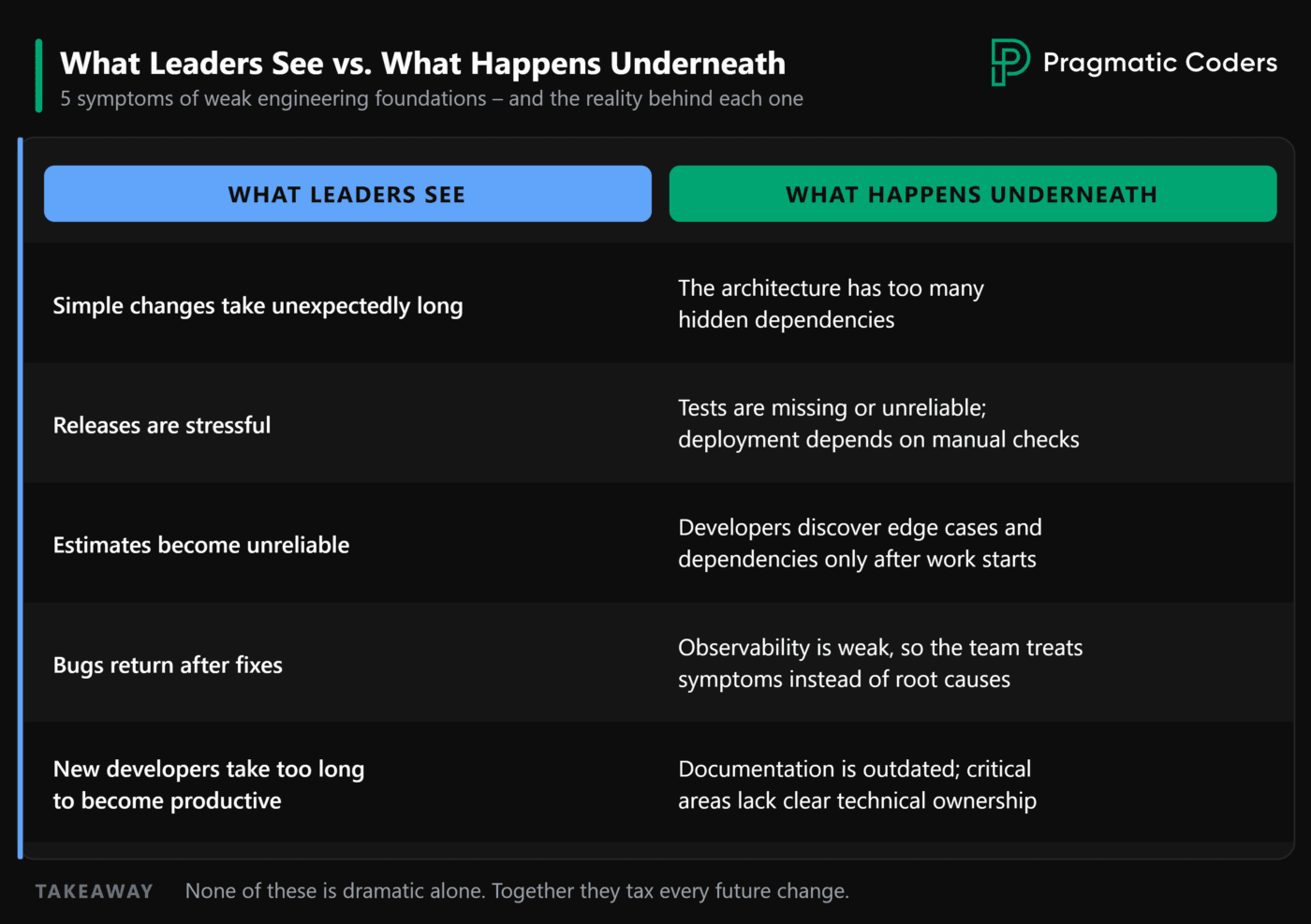
None of these problems needs to be dramatic on its own. Together, they create a tax on every future change.
In Stack Overflow’s 2024 Developer Survey, technical debt was reported as the top workplace frustration for professional developers, selected by 63% of respondents. That matters because technical debt affects morale, speed, predictability, and delivery cost.
For the business, technical debt means delivery risk, not developers asking for prettier code.
If releases are painful, don’t start by asking whether developers are fast enough. Ask whether the product is safe enough to change by looking at the foundations that usually decide delivery speed: architecture, testing, CI/CD, observability, data, and security.
But not every slowdown starts in the codebase. Sometimes the product is healthy enough, but the way work enters the team destroys flow.
How Unclear Priorities and Too Much Work in Progress Slow IT Teams
A team can be technically capable and still slow if the organization constantly changes direction or pushes too much work into the system.
Everything is priority one. The roadmap changes every sprint. Stakeholders bypass the agreed process. Developers jump between roadmap features, production support, urgent fixes, meetings, and one-off executive requests. Work starts before the previous work is finished.
That can feel responsive. In practice, it slows delivery.
Software work depends on context. After a task switch, getting back into the problem usually takes longer than the switch itself. A team can start five features in a sprint, finish none of them, and go into the next sprint with more open threads than it started with. That stalled, scattered work is also one of the quietest budget drains, so it’s worth seeing how to limit work in progress and reduce software development costs.
The board looks full, but users see little change.
Atlassian’s 2025 developer experience research found that developers spend only 16% of their time coding, while 50% report losing 10 or more hours per week to non-coding tasks. The top time-wasters include finding information, adapting to new technology, and context switching between tools.
How severe is this? Recoverable if priorities shift because of a real business change. Critical if every sprint starts with “just one urgent thing” and ends with unfinished work rolling into the next one.
AI will not fix this by itself. It can help developers write code faster, but it does not decide which work matters, reduce active priorities, or remove interruptions.
The question worth asking is how much valuable work actually finishes each sprint.
If priorities are clear and work is focused, but delivery still slows down, check what the team depends on but cannot see.
How Knowledge Silos and Ownership Gaps Create Delivery Bottlenecks
Productivity drops when the team cannot see what it depends on. In practice, that usually happens in two ways: critical knowledge sits with specific people, and technical risks never get translated into business decisions.
Knowledge Silos Turn People Into Bottlenecks
One senior developer understands the critical module. One person knows how deployment really works. One engineer always handles production incidents. One product person holds the business context for a key workflow.
The system works while those people are available, so nobody treats it as urgent. Then someone goes on holiday, leaves, or gets pulled into another project. Delivery slows down because the team was never as independent as it looked.
The warning sign: the team has enough people, but delivery still depends on a few specific people being available at the right moment.
Poor Communication Keeps Delivery Risks Invisible
Risks can stay hidden even when engineers know about them. Developers may know that one part of the system is fragile, but leadership hears only that “some refactoring would be useful.” Engineers may see that the release process is risky, but the business sees green status reports.
The way engineers frame risk changes whether leadership treats it as optional cleanup or a business constraint.
“Refactoring” sounds optional. “This change will remain slow and risky until we reduce dependency between billing and onboarding” is a business issue. “We need better tests” sounds technical. “We can’t release this flow confidently without manual regression checks every time” is a delivery risk.
The first step is making dependencies visible. Who knows what? Who owns what? Who can deploy, debug, approve, and decide? Which risks are known inside engineering but not understood by leadership?
At this point, the question is no longer “why is the team slow?” It is “which constraint is slowing this team down right now?”
How to Diagnose Low IT Team Productivity
The fastest way to improve productivity is to identify the real constraint before choosing the solution. Otherwise, you may add people to a prioritization problem, buy tools for a communication problem, or start a rewrite when the real issue is flow.
Start with the symptoms, then trace them back to the constraint.
| If You See This | The Likely Cause Is | Check This First |
|---|---|---|
| Many tickets close, but business progress is unclear | Activity or output is being mistaken for value | Business goal per sprint or initiative |
| Simple changes take weeks | Technical debt or fragile architecture | Tests, dependencies, ownership, release process |
| Releases are stressful or risky | Weak engineering foundations | CI/CD, rollback process, observability, automated tests |
| Everyone is busy, but little gets finished | Too much work in progress | Number of active priorities and unfinished tasks |
| Priorities change every sprint | Weak product ownership or unclear trade-offs | Decision process and roadmap discipline |
| Work stops when one person is unavailable | Knowledge silo or low bus factor | Access, documentation, shared ownership |
| Risks appear only after deadlines slip | Poor business-engineering visibility | How technical risks are communicated and escalated |
Most slow teams have more than one constraint. But one constraint usually hurts more than the others right now.
If simple changes are slow and releases are risky, start with technical health. If everyone is busy but little gets finished, start with work in progress. If the roadmap keeps shifting, start with decision-making. If progress depends on one person, start with knowledge distribution and ownership.
Diagnosis protects you from treating symptoms as causes.
Where Leaders Should Look First to Improve IT Team Productivity
Once the pattern is visible, the next move should match the bottleneck. Treating every productivity problem the same way is how teams waste months fixing the wrong thing.
If the problem is measurement, look at how your organization defines progress. A team measured only by tickets, velocity, or utilization will eventually optimize for those signals.
If the problem is technical friction, look at the product’s foundations. Slow changes, risky releases, and unreliable estimates usually point to architecture, testing, CI/CD, observability, or documentation gaps.
If the problem is repeated delivery confusion, look beyond engineering alone. Unclear priorities, hidden risks, and shifting scope often signal broader product development issues, not just engineering execution problems.
Conclusion: Improve the System Before Blaming the Team
Low IT team productivity is almost always a delivery system problem.
Instead of asking whether developers are working hard enough, ask better questions. Are we measuring value or activity? Is the product safe to change? Are priorities clear enough for work to finish? Can the business see the risks and dependencies that slow delivery down?
The most productive teams stand out for creating the conditions where valuable changes move safely from idea to production, not for raw coding speed.
So before you add people, replace tools, change vendors, or start a rewrite, diagnose where work actually slows down. The signal is usually already there. You just need to look at the delivery system, not only the people inside it.