Product-market fit strategy – what it is, why it matters, and how to build it correctly
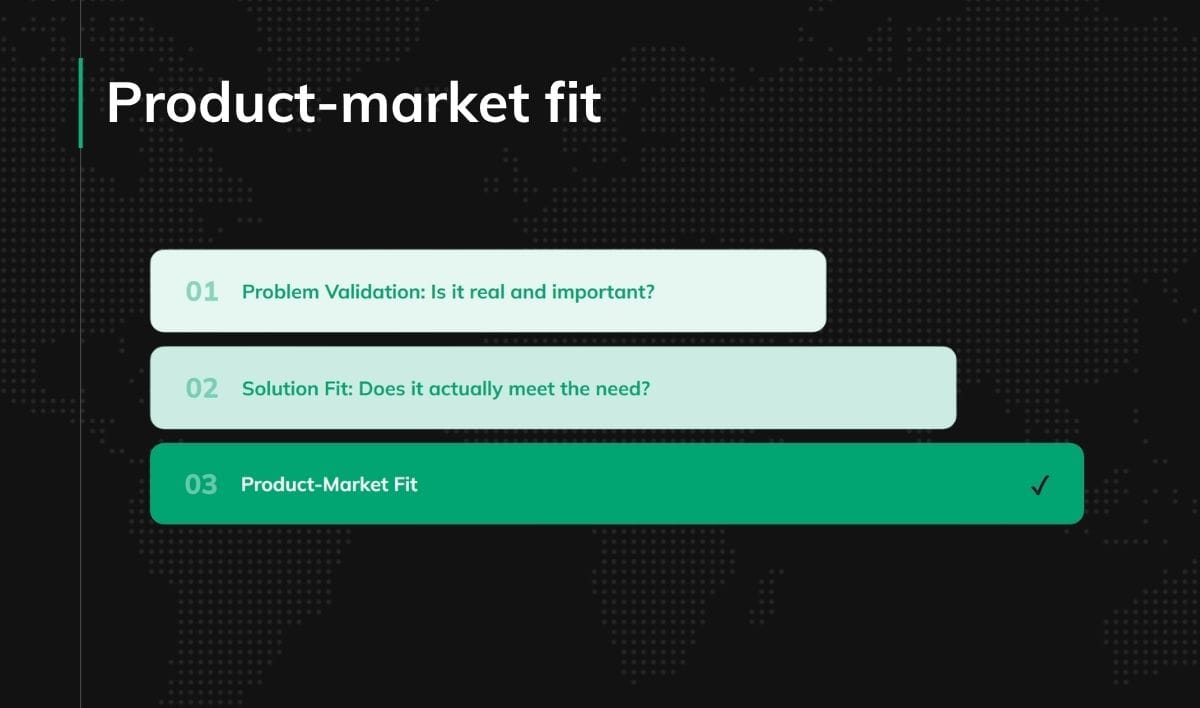
The biggest problem with many products is not that they are weak. It is that people do not need them enough. That is why product-market fit is one of the most important topics in product building, because it decides not only what a good product is, but also whether it has any chance to grow.
In this article, we explain what product-market fit (PMF) is, why it matters, and how to reach it – based on the thinking of experts like Ash Maurya, Marc Andreessen, and Rahul Vohra.
Product-market fit – different definitions
Product-market fit is a situation where you are in the right market with a product that this market truly wants.
When we talk about product-market fit, it is worth noting that this is not one idea from one author. It is rather a phenomenon described by different experts from different angles, and that is the best way to understand it.
Marc Andreessen – classic definition of product-market fit
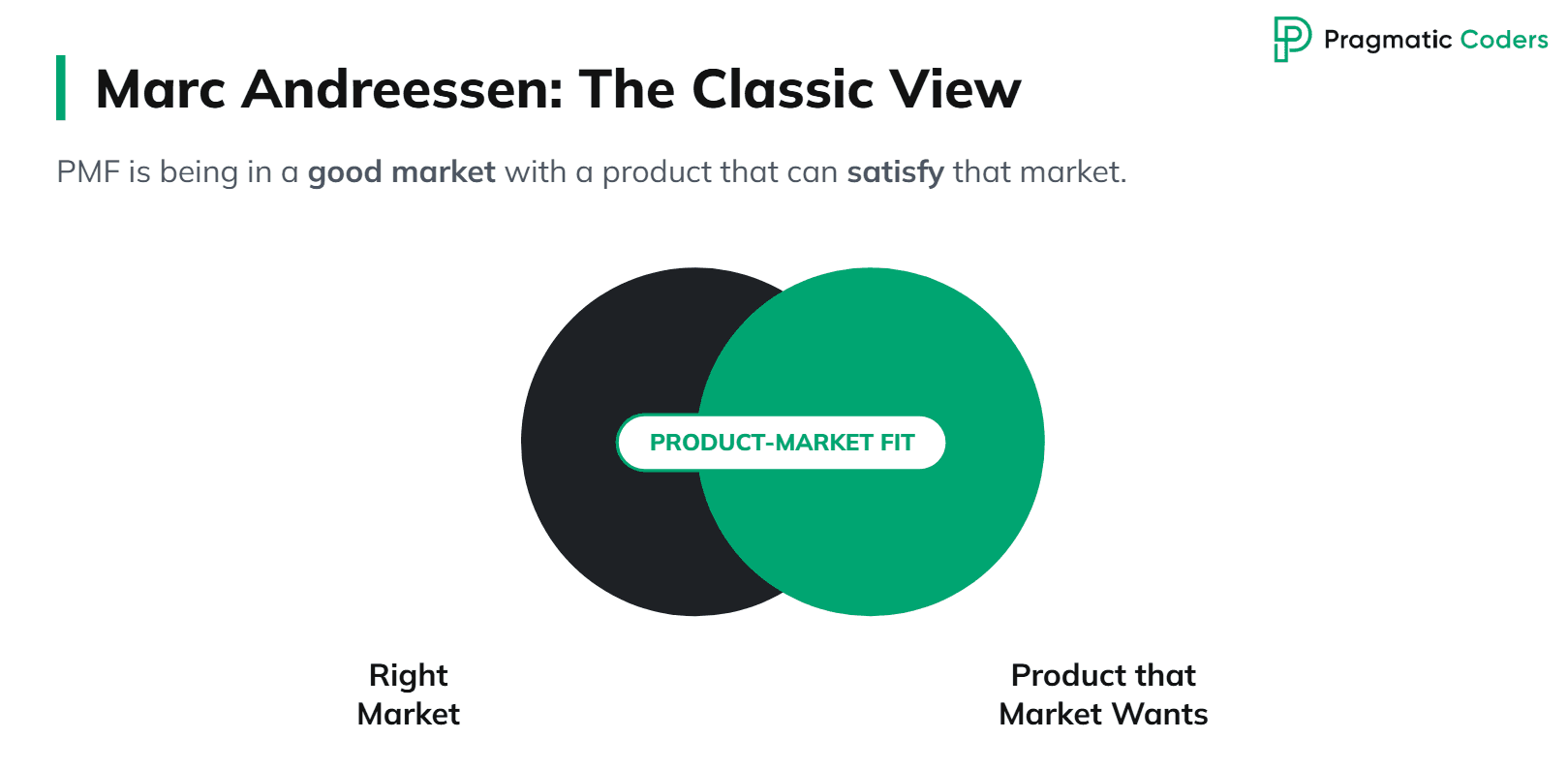
Marc Andreessen gave the most classic definition of product-market fit. In simple words, PMF is a situation where you are in the right market with a product that this market truly wants.
Steve Blank and Eric Ries – definition of product-market fit
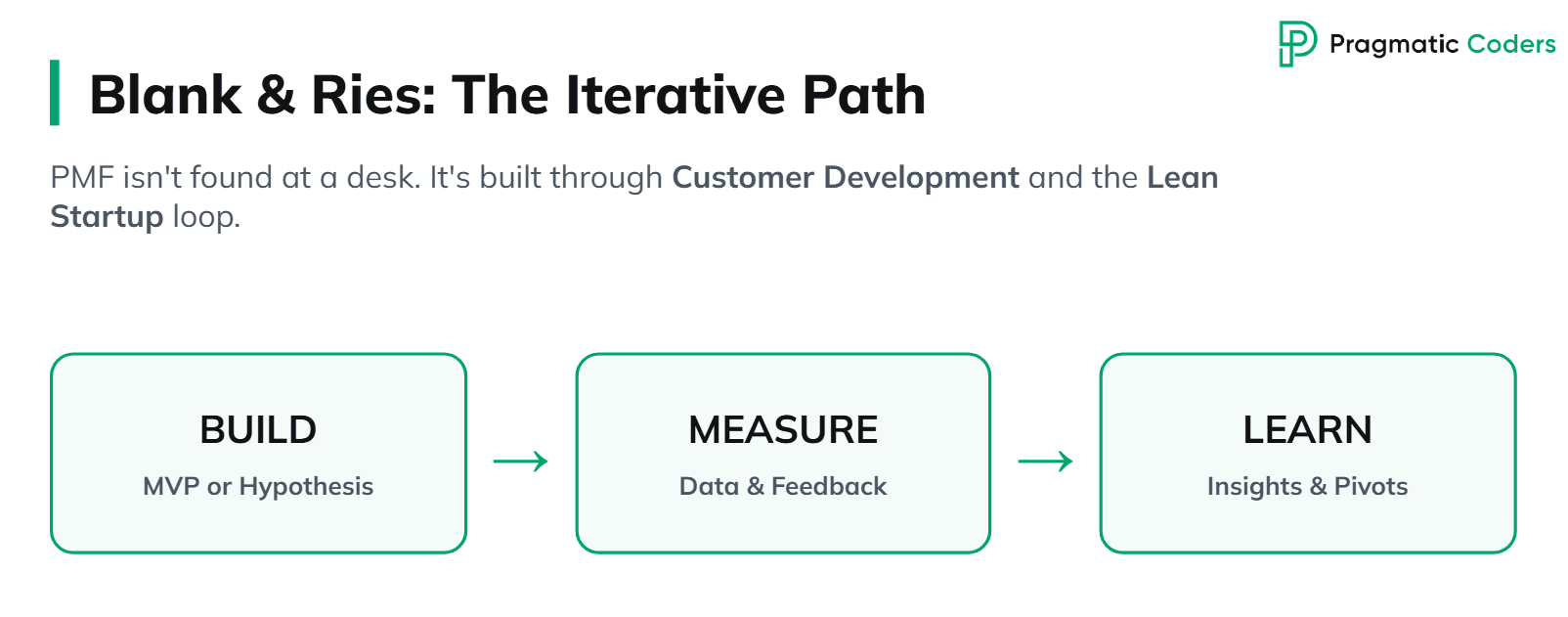
Steve Blank and Eric Ries focused more on how to get there. They showed that product-market fit is not created at a desk or in a strategy presentation. It is built through customer contact, hypothesis testing, experiments, and iterative learning. Steve Blank developed the customer development approach, which is the process of discovering the customer and their needs before a company starts scaling the product. Eric Ries popularized Lean Startup logic and the build–measure–learn loop. The idea is simple: build a solution or part of it, check market response, draw conclusions, and make the next decision based on what you learned.
Ash Maurya – definition of product-market fit
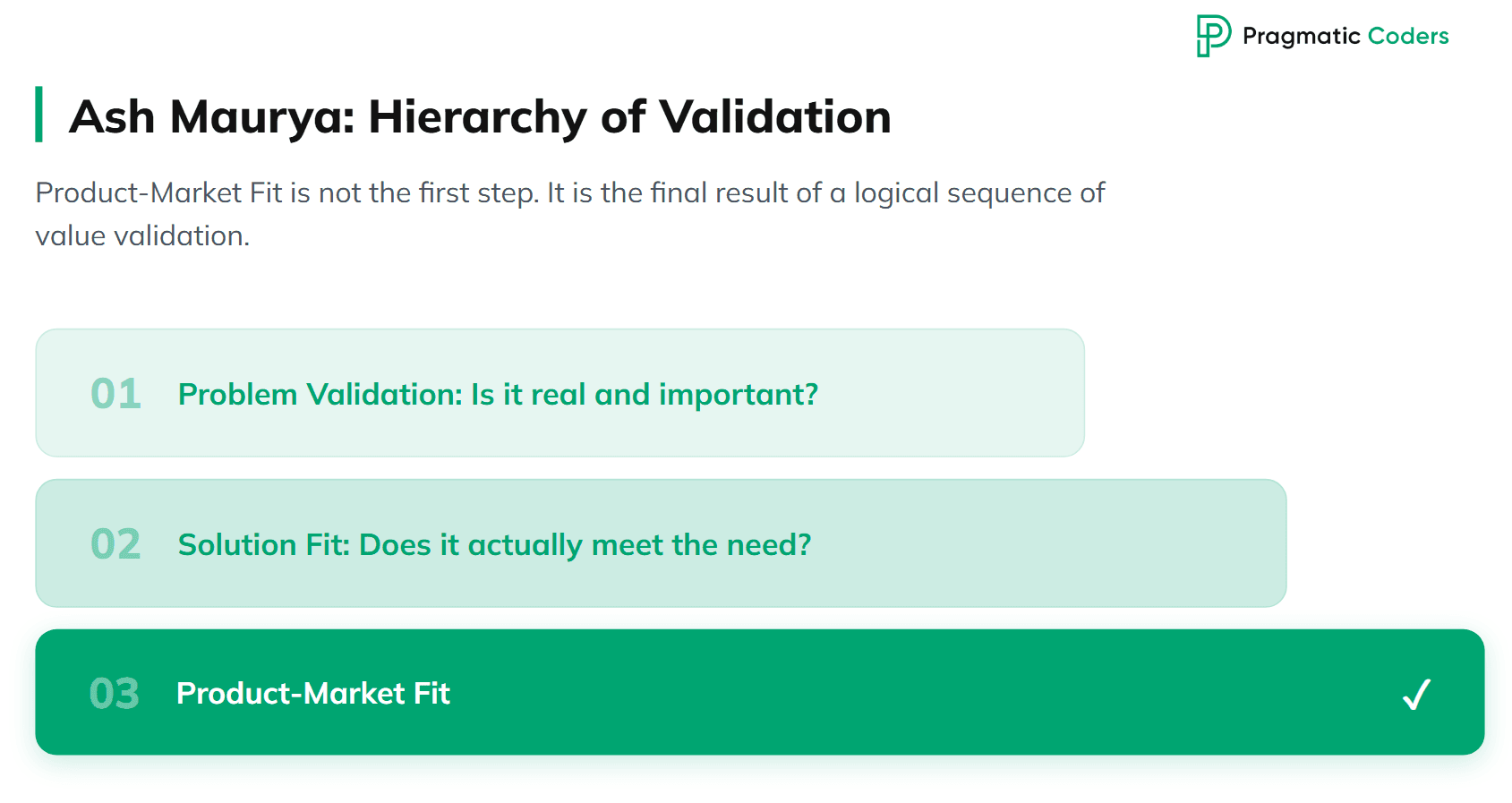
Ash Maurya organized this even further by showing a clear order. First, we must make sure that
- the problem really exists and is important,
- then check whether our solution meets that need,
- and only then can we talk about product-market fit.
This is important because many companies assume too early that they already have PMF, even though they have not validated the value of the solution itself yet.
Sean Ellis – definition of product-market fit
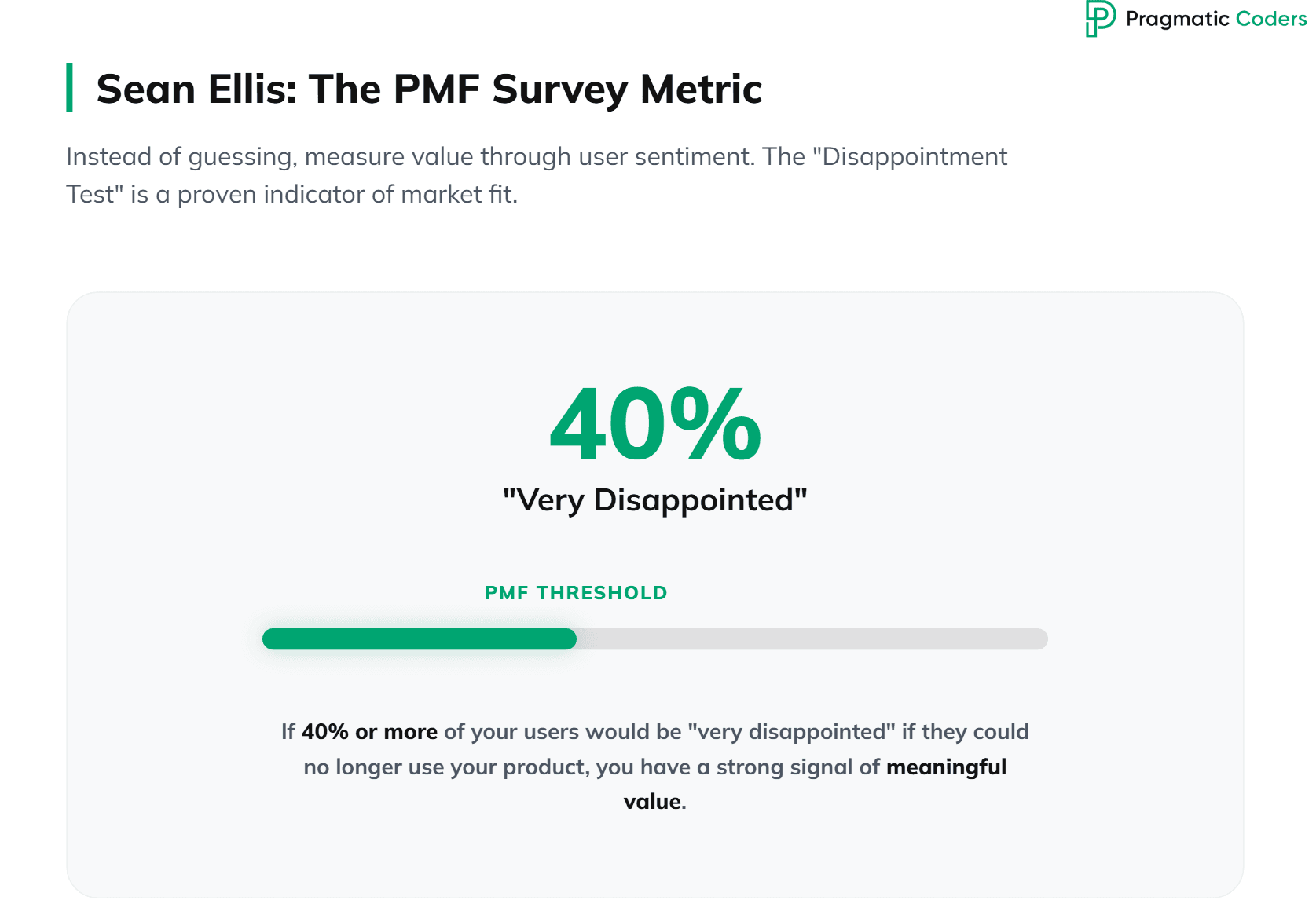
Sean Ellis proposed a more practical way to identify PMF signals. His famous test says that if at least 40% of users say they would be very disappointed if the product disappeared, this is a strong signal that the product delivers meaningful value.
Rahul Vohra – definition of product-market fit
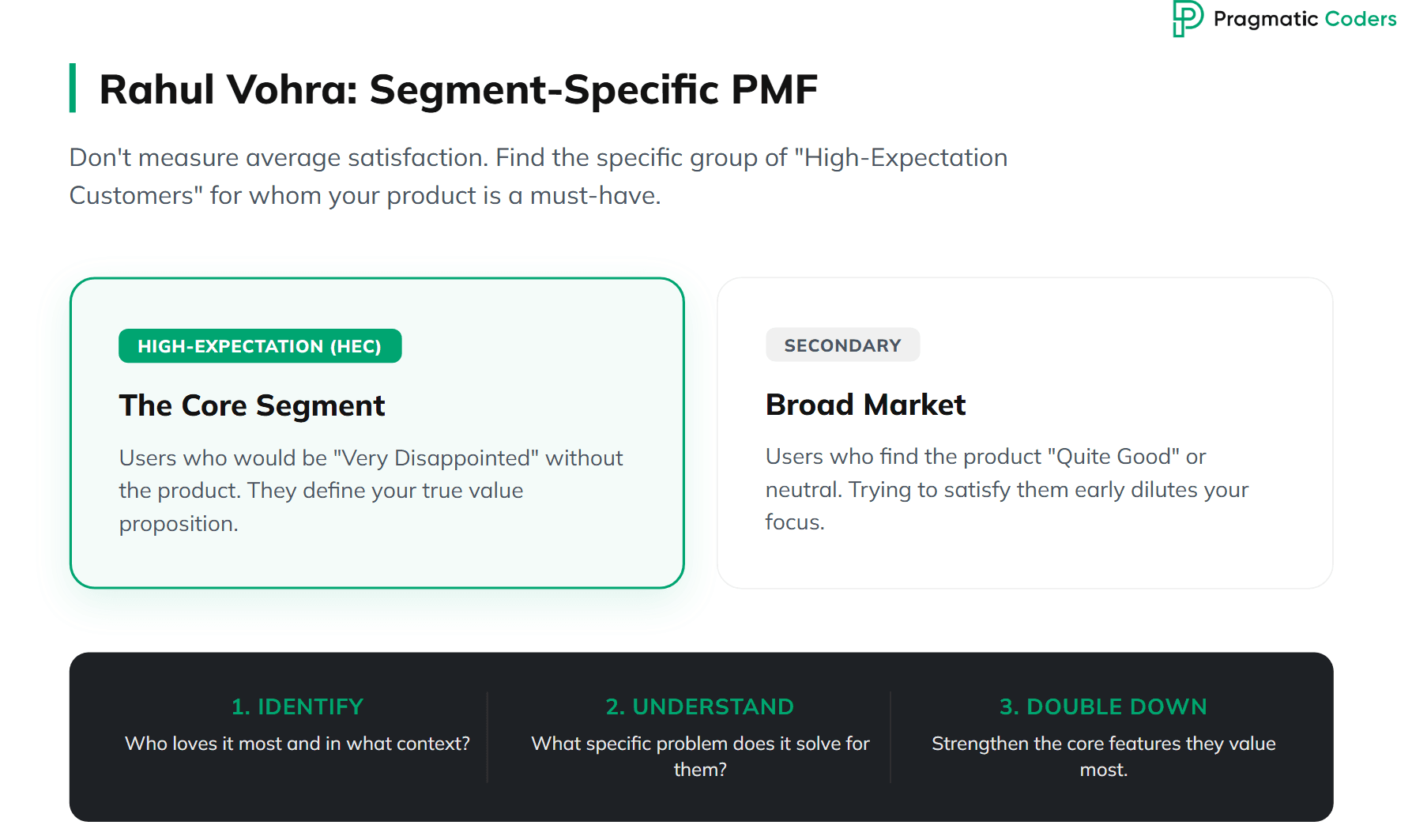
Rahul Vohra, CEO of Superhuman, went one step further and showed that product-market fit rarely appears across the whole market at once. Much more often, a product strongly resonates first with one specific group of users, while for others it is only “quite good” or even not very relevant.
This is an important mindset shift, because many companies assume that if the product does not impress the broad market, then PMF does not exist. Vohra shows the opposite – first find the group for whom your product is truly valuable and hard to replace.
In practice, this means we do not look only at the average opinion of all users. We try to identify the people who love the product the most. We ask: who are they, in what context do they use the product, what problem does it solve for them, and what exactly gives them the most value?
Only when we understand this can we intentionally grow the product in that direction. So instead of trying to satisfy everyone, we strengthen what already works best in this specific segment. This can mean improving the core use case, simplifying value communication, aligning onboarding better, or developing features that matter most to this group.
Why product-market fit matters
Why is product-market fit so important?
Because in practice it decides whether we are building something the market truly needs, or only something that seems like a good idea to us. That is a fundamental difference. Without product-market fit, you can have a great team, a polished product, and a lot of work invested, and still fail to build a lasting business because demand is not strong enough.
There is a very telling statistic that shows this clearly: according to CB Insights analyses, the second most common reason startups fail is no real market need, which in practice means no product-market fit (43%).
PMF is also important because without it, it is very easy to scale too early. Michael Seibel from Y Combinator points out that founders often think they already have product-market fit, and then start hiring, increasing budgets, and optimizing the product before they truly discover what should be built. This is a very accurate warning: growth before PMF often reveals the problem faster instead of solving it.
Marc Andreessen once wrote that in a great market, “the market pulls product out of the startup.” In simple words: when demand is real, the market starts pulling the product on its own. With true fit, you do not need to push everything by force. Traction appears, customers come back, they recommend the product to others, and the team starts trying to keep up with demand instead of artificially creating it.
If you want to quickly check whether your product has healthy PMF foundations, download the Product Health Checklist. It is a short checklist that helps you assess what is working and what needs improvement before you start scaling.

How to reach product-market fit correctly
1. Steve Blank and Eric Ries: start with the market, not the solution
From the perspective of Steve Blank and Eric Ries, the path to product-market fit starts not with building the product, but with understanding the market. The point is not to assume we already know what customers want, but to treat the idea as a hypothesis and test it.
In other words, according to them, product-market fit cannot be invented. It must be discovered.
This means:
- start with hypotheses about the customer and their problem,
- talk to users,
- check how they solve the problem today,
- run small experiments instead of building the full product at once,
- learn and iterate.
This is their most important lesson: do not assume you know – verify.
2. Ash Maurya: first problem-solution fit, then PMF
Maurya says it very clearly: do not skip steps.
Before we even start talking about product-market fit, we must first reach problem-solution fit. This means you need to confirm:
- that the problem is real,
- that it is important,
- that it applies to a specific segment,
- that your solution truly addresses that problem.
In this approach, validation is crucial, meaning consciously checking what is still only a hypothesis. Maurya points out that at the start, it is worth focusing on the riskiest assumptions – the assumptions that are most dangerous for the success of the whole idea. Because if it turns out that the customer does not feel the problem or does not see value in the solution, then further product development makes no sense.
So according to Maurya, the right path looks like this: problem -> solution -> market fit -> scaling
3. Marc Andreessen: make sure you are in the right market
Andreessen reminds us that PMF is not only about product quality. It is also about asking:
- did you choose the right market,
- is the problem strong enough,
- is there real demand.
According to him, you can have a good product and still not have PMF if:
- the market is too small,
- the problem does not hurt enough,
- customers do not want to change their current behavior,
- timing is wrong.
So building PMF correctly is not only about polishing features. It is also about checking whether this market truly wants this.
4. Sean Ellis: look for proof that the product would be hard to lose
Have you ever had situations where you were not very impressed by something, but needed to sound diplomatic, so you said it was “interesting”?
It is similar with products. “Interesting” is not enough, and that is exactly what Ellis says by asking a very practical question: would users truly feel the loss of this product?
This leads to an important rule: we do not measure PMF by users saying “this is interesting” or “this is nice.” We look at whether:
- the product solves an important problem,
- users want to come back to it,
- they would miss it if it disappeared,
- real value appears, not only one-time interest.
Product-market fit starts when the product builds real stickiness and becomes part of users’ daily flow. That is why, besides Ellis’s test itself, we also look at retention (do users come back), engagement (how intensely they use it), and more broadly voice of customer (how they talk about its value). Only this full set of signals shows that the product is not only interesting, but truly important.
5. Rahul Vohra: find the segment where PMF is strongest
Vohra says: do not try to satisfy the whole market at once.
That is why segmentation is so important – dividing the market into groups of users with different needs and contexts of use.
Vohra suggests finding your so-called core users, the users who feel the product value the most, and understanding their case deeply. In other words: who they are, in what context they use the product, and what exactly makes it so valuable for them. In practice, this approach leads to what we can call sharpening the fit. Instead of expanding the product to everyone, we focus on those who already react most strongly today, and we strengthen that exact value.
How to reach product-market fit: a simplified 6-step version
If we combine all these approaches into one method, we get very consistent logic:
- Step 1 Identify a specific customer segment. Not “everyone,” but one specific group.
- Step 2 Understand a real, important problem. Not a theoretical problem, but one that really hurts.
- Step 3 Test the solution in small iterations. Do not build everything at once.
- Step 4 Check whether the solution gives noticeable value. Do users come back, use it, value it, recommend it?
- Step 5 Find the segment where response is strongest. Do not look only at the average of the whole market.
- Step 6 Strengthen what works before you scale. First depth of fit, then width.
If you see that your team is constantly firefighting and product decisions are reactive, stop for a moment and run a diagnosis. The ebook Is your project on fire. Self-diagnosis will help you name the sources of your problems and organize your next steps.
![Is your project on fire [EBOOK]](https://www.pragmaticcoders.com/wp-content/uploads/2026/02/Is-your-project-on-fire-EBOOK.png)
Further reading
Want to learn more about product management in IT and beyond? See the interview with Michał Kania, Product Manager at Pragmatic Coders:
If your team feels like it is working hard but still not seeing results, the issue is often not the pace of work, but the lack of a clear product-market fit.
These are exactly the kinds of situations we work with every day. We help teams that are stuck before reaching PMF. Together, we diagnose where the real problem lies, bring clarity to priorities, and design the next steps so the product starts addressing real customer needs.
If you’d like, we can start with a short diagnosis of your situation and identify the fastest path to improvement.