Scrum Checklist for IT Product Development
Your sprint calendar is full. Standups happen every morning. Retros are booked. The board gets cleaned up every two weeks. From the outside, your Scrum looks healthy.
But ask yourself: are sprints smoother than three months ago? Are retro action items actually getting done? Is the team shipping more value, or just more tickets?
Most teams we work with are are struggling because the empirical engine underneath those ceremonies – Transparency, Inspection, Adaptation – is broken. The rituals happen, but the feedback loop that makes Scrum actually work has gone silent.
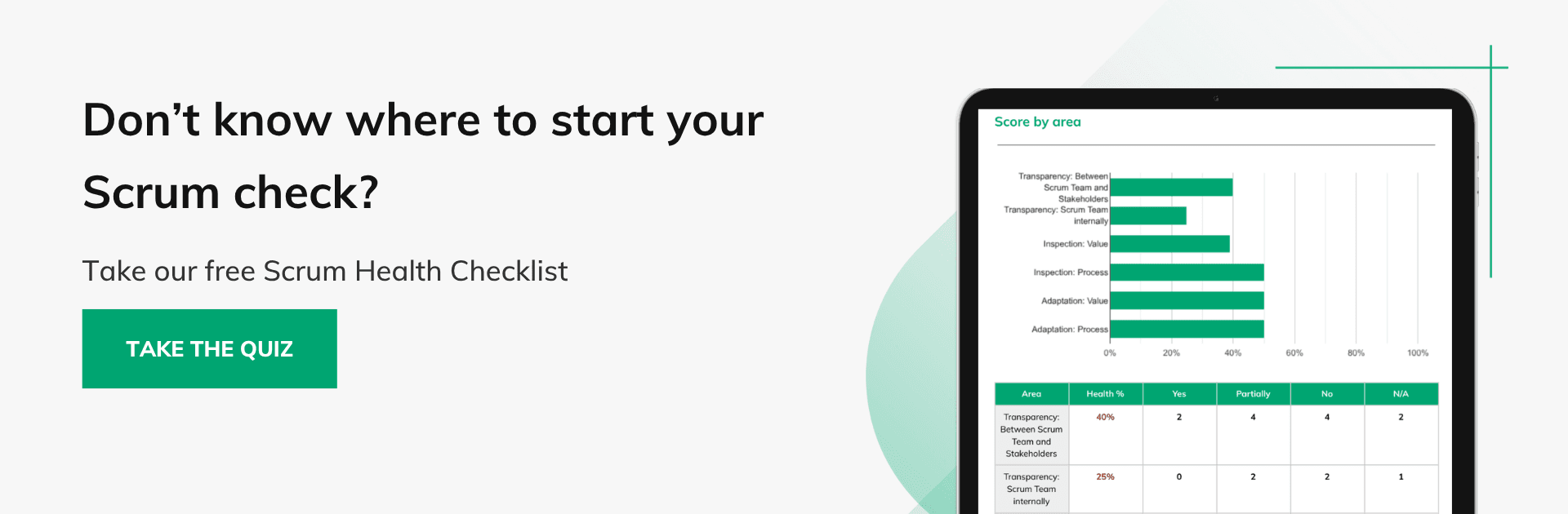
- The Scrum Health Checklist (SHC) is a diagnostic tool built from our experience working with over 150 product teams. It contains 47 questions across the three Scrum pillars, organized into six areas.
This article walks through each section of the checklist, explains why it matters, and shows you the kind of questions it asks. If you want the full checklist to run with your team, you can download it here.
How the Scrum checklist is organized
The Scrum checklist follows the three empirical pillars of Scrum. Each pillar is split into two sub-areas:
| Pillar | Sub-areas |
|---|---|
| Transparency | Between Scrum Team & Stakeholders · Scrum Team internally |
| Inspection | Value · Process |
| Adaptation | Value · Process |
Transparency is the foundation — without it, Inspection has nothing reliable to examine, and Adaptation has nothing solid to act on. Problems in the first pillar cascade into the other two.
Transparency
Between Scrum Team and Stakeholders
Transparency between the Scrum team and stakeholders is key to good collaboration. It keeps communication clear, expectations aligned, and progress visible in real time. Without it, teams can drift out of sync, misunderstand each other, and lose trust before anyone notices the problem.
This is the largest section of the checklist (12 questions) because this is where most teams break down first. The symptoms are familiar: stakeholders surprised by what was delivered, the team building features nobody asked for, or a roadmap that exists on paper but governs nothing.
Example questions:
- Is the Product Vision known to every Scrum Team Member?
- Does each Product Backlog Item describe the Business Value it brings to the Product?
- Is the Scrum Team able to predict the approximate date of completion of the milestone?
A team that answers “No” to most of these is running a task execution engine with Scrum labels on it. The Sprint Review becomes a demo nobody acts on, and the Product Backlog becomes a to-do list instead of a strategic tool.
Scrum Team internally
Transparency inside the Scrum team is what makes it feel like one team, not just a few specialists working next to each other. When people openly share what they are doing and what is blocking them, trust grows, collaboration gets easier, and responsibility becomes shared. Without that, people fall into silos, work in isolation, and often assume others know things they actually do not.
This section is shorter (5 questions) but hits fundamental gaps that are easy to overlook.
Example questions:
- Does every Scrum Team Member know who the Scrum Master is?
- Does every Scrum Team Member know the Definition of Done?
- Is the knowledge obtained in the Refinement process written down in such a way that any Developer with appropriate competences can implement the change?
The question about the Definition of Done is more diagnostic than it seems. In our experience, when team members cannot state the DoD from memory, the “done” label means different things to different people.
Inspection
Value
Value inspection ensures that the features delivered actually align with business objectives and meet customer expectations. Regular inspections help teams spot issues early and keep improving. Without value inspection, there is a risk of delivering software that works technically but misses the point commercially — building the wrong thing, correctly. That pattern is one of the most common hidden bottlenecks behind underperforming IT teams: activity climbs while real business impact does not.
This is one of the heaviest sections (12 questions) because value is where Scrum either justifies its existence or becomes expensive overhead.
Example questions:
- During the Sprint, does the Scrum Team provide single finished Sprint Backlog Items to Stakeholders for review?
- During the Sprint Review, do Stakeholders verify the Increment and provide feedback?
- Does the Scrum Team measure what value the delivered Increment brought?
Two questions deserve special attention. First, whether stakeholders actually verify the Increment during Sprint Review — not just watch a demo, but engage, ask questions, and provide feedback that changes what happens next. If your Sprint Review is a one-way presentation, the inspection loop is broken.
Second, whether the team measures delivered value. Most teams can tell you what they shipped. Few can tell you what it achieved. Without that measurement, you cannot distinguish a successful sprint from a busy one.
Process
Process inspection helps the team find what is not working, keep quality high, and improve the way they work. By reviewing the process regularly, the team can see what slows them down, adjust workflows, and work more effectively.
The Sprint Retrospective is where this happens (or where it fails to happen). This section (8 questions) examines whether your retros are functional or ceremonial.
Example questions:
- During Retro, does the Scrum Team verify whether previously planned improvements have been implemented?
- Does the Scrum Team measure the effectiveness of the improvements made?
- During the Sprint Retrospective, does the Scrum Team identify the causes of mistakes made?
The first question is the most telling. If the team plans improvements in retro but never checks whether those improvements were actually implemented, the entire inspection-adaptation cycle is broken at its most critical point.
Adaptation
Value
Value adaptation ensures the team responds to what it learns. It is the difference between a team that reacts to feedback and one that just collects it. Adapting to changing requirements, market conditions, and customer feedback ensures that the team delivers the most valuable features — not the ones that were relevant three months ago.
This section (7 questions) tests whether your team actually changes course when the evidence says it should.
Example questions:
- Does the Scrum Team adapt the Roadmap / Product Backlog based on available feedback?
- Does the Scrum Team adapt the Roadmap / Product Backlog based on metrics?
- Is the Backlog modified based on changes in the Product environment (e.g. market conditions)?
The Daily Scrum question catches a common anti-pattern: teams that use the daily standup as a status report instead of a re-planning session. If the team detects at Tuesday’s standup that the Sprint Goal is at risk and does nothing until the next Sprint Planning, we have a problem.
Process
Process adaptation is the mechanism that keeps the team’s way of working aligned with reality. Adaptable make it possible for the team to address evolving needs, incorporate new tools, and improve collaboration. Without process adaptation, inefficiencies persist, quality drifts downward, and the team keeps repeating the same mistakes with a clear conscience — because “we discussed it in retro.”
This is the smallest section (4 questions) but arguably the one with the highest leverage.
Example questions:
- During Sprint Planning, does the Scrum Team take into account the availability of Scrum Team Members in the planned Sprint?
- During the Sprint Retrospective, does the Scrum Team plan activities to improve quality?
When the process is healthy but the product is not
The Scrum Health Checklist diagnoses how your team works. But a team can run flawless sprints and still build the wrong product — if the strategy is unclear, discovery is absent, or stakeholders are misaligned on what success looks like.
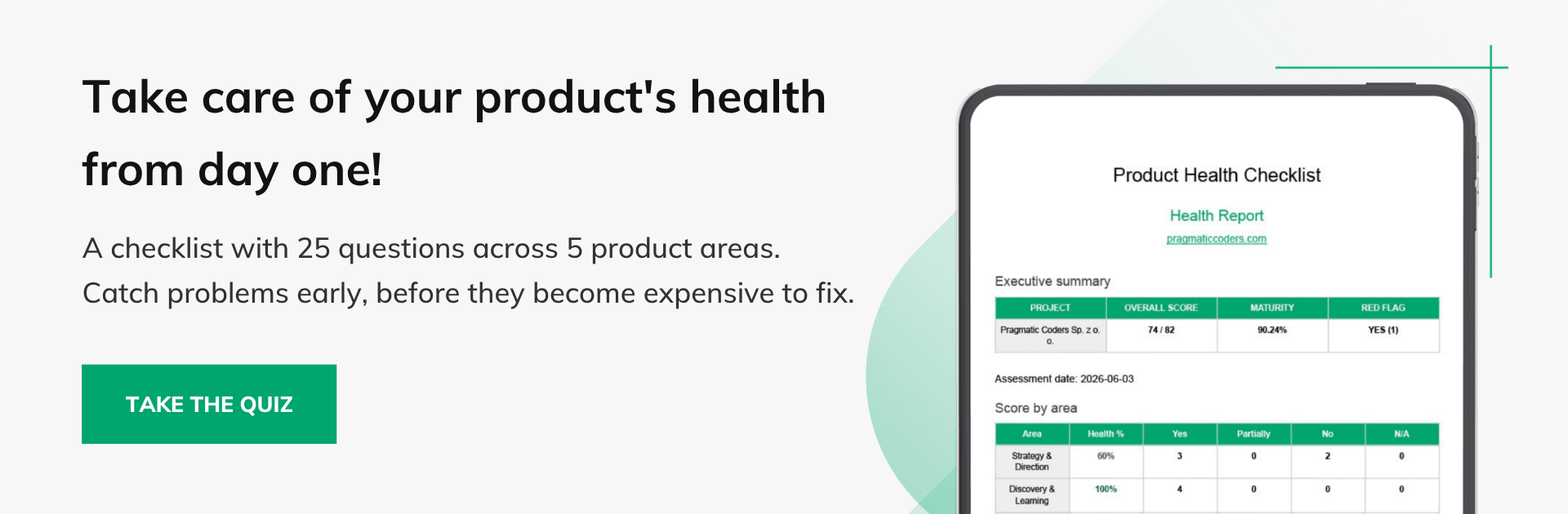
That is exactly what the Product Health Checklist (PHC) is designed to catch. Where the SHC examines Transparency, Inspection, and Adaptation at the process level, the PHC examines five product-level areas: Strategy & Direction, Discovery & Learning, Delivery & Quality, Client & Executive Alignment, and Team Leadership & Ownership.
The two checklists are complementary. A low SHC score in Inspection → Value (e.g. the team does not measure what value the Increment brought) often points to a deeper gap in PHC’s Discovery & Learning area (e.g. no structured analytics approach). A low SHC score in Transparency → Stakeholders (e.g. roadmap not confirmed in Sprint Review) may trace back to a PHC gap in Client & Executive Alignment (e.g. the decision-maker has not confirmed direction in six weeks).
If your SHC results look healthy but delivery still feels off, run the PHC next. If both checklists show problems, start with the PHC — product-level misalignment is usually the root cause, and process improvements cannot compensate for a missing strategy.
Read: Product Health Checklist — Is Your Product Secretly Sick? →
Download the Product Health Checklist →
How to run the Scrum checklist with your team
The Scrum Health Checklist is not a survey, but a conversation. Here is how to get the most out of it:
- Duplicate the template and name it (e.g. “Project X — April 2026”).
- Book at least 30 minutes with your Scrum Team. This is not a solo exercise as the discussion at each question is more valuable than the answer itself.
- Respond with a single answer: Yes or No. Answer “Yes” only when you are fully satisfied with the area. If you hesitate, the answer is “No.”
- Explain every “No.” The explanation column is where the real diagnostic value hides. A “No” without context is a missed opportunity.
- Repeat regularly. The SHC is designed for periodic use. Fill it out once a quarter and compare scores over time to see whether your process is actually improving or just changing shape.
Download the Scrum Health Checklist →
Conclusion
Scrum is an empirical framework. Its value comes from the feedback loop: make work visible (Transparency), examine what happened (Inspection), change what needs changing (Adaptation). When that loop is intact, teams get faster, smarter, and more aligned with every sprint. When it is broken — even partially — teams get ceremonies without improvement.
The Scrum Health Checklist does not grade your team. It shows you where the loop is broken. Most teams we work with find that their problems are concentrated in one or two areas, and fixing those areas has a cascading effect on the rest.
If your checklist reveals issues across multiple pillars and you are not sure where to start, we can help. We offer a free 30-minute consultation — you describe how your sprints actually run, we ask the diagnostic questions, and you leave with one concrete change to implement in your next sprint.
- Recommended reading: Scrum problems often signal deeper product issues. If quality problems show up as nonstop incidents, firefighting, or missed dates, read Is your project on fire? Self-diagnosis for a deeper symptom review.
![Is your project on fire [EBOOK]](https://www.pragmaticcoders.com/wp-content/uploads/2026/02/Is-your-project-on-fire-EBOOK.png)