How to Reduce Software Development Costs: 4 Proven Ways

IT spending keeps climbing, yet product development is visibly slowing down. Customers are getting restless over promised fixes. Investors are losing patience. You feel your budget slipping away. The first instinct is often to hire more people or scramble to find a cheaper team to turn things around.
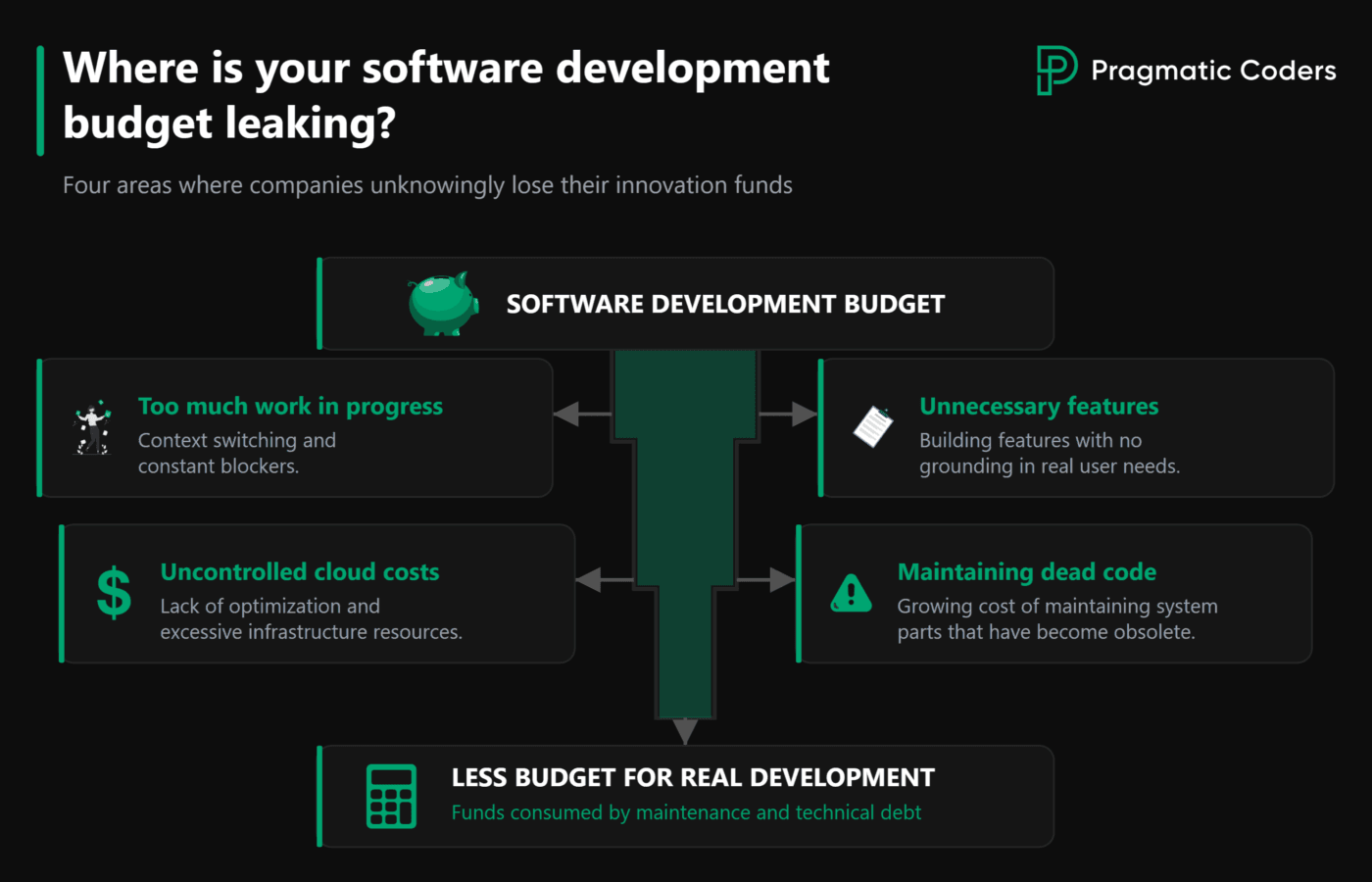
But that is a dead end that typically only deepens the crisis. The problem is rarely the team’s actual development speed. The budget is leaking because too much of it funds raw activity instead of concrete business outcomes. Money goes into features nobody uses, too many simultaneous tasks, and unmanaged infrastructure. Here are four proven ways to stop this drain and regain control over your technology costs.
Key Points
|
Why Your Software Development Budget Disappears Faster Than the Product Gets Built
Budget leaks in software projects are rarely caused by slow coding. Instead, money disappears because too much of your budget finances raw activity rather than tangible business outcomes. This means building features nobody needs, running too many parallel initiatives, and letting code and infrastructure run unmanaged. Before we dive into specific tactics, we need to examine this mechanism and reframe how we view technology costs.
Take features, for example. Every single one has a long, expensive tail. You have to design, build, and test every new addition. Then you must maintain, fix, document, and integrate it for years to come. Every one of these steps costs money. Cramming more features into your application drives up your fixed maintenance costs, whether anyone uses them or not. From a financial standpoint, a bloated product isn’t “richer.” It is simply more expensive and harder to maintain.
This is why expanding the team rarely fixes anything. Hiring cheaper developers or adding headcount does nothing if you keep feeding them unnecessary work. Instead of viewing software development as the cost of churning out features, treat it as an investment in a specific business result. This mindset shift immediately cuts off pointless discussions about “how many tickets we closed this week.” In their place, you get a strict decision filter: your team stops focusing on writing code for its own sake and starts seeking the simplest, most cost-effective paths to your business goals.
Software development is notoriously difficult. The CHAOS Report indicates that only 31% of IT projects end in complete success. Another 50% face major challenges, and 19% fail entirely. These definitions are often debated, especially in agile environments where changing scope is normal. Still, the underlying trend is clear. Vast amounts of money and effort go into solutions that fail to deliver their expected value. The four strategies below will help you buck this trend. You will stop financing raw team activity and start investing in tangible business outcomes.
Strategy 1: Replace Your Feature List With a List of Business Problems to Solve
A backlog bursting with features is the fastest way to blow your budget. Every request seems harmless: “let’s add this,” “a client asked for it,” “the competition has it,” “it’s a quick win.” The problem is, no one stops to ask whether it actually solves a core business problem. Yet that is the only metric that should dictate what gets built.
A single feature rarely breaks the bank. The real issue is accumulation, coupled with the fact that once code is in your product, it stays there. To prevent this, you need a ruthless filter. No idea should reach your developers until you can answer four questions:
- What specific user problem are we solving?
- How many users actually need this?
- How will this move the needle on revenue, retention, or activation?
- What happens if we shelve this for three months?
If the answers are shaky, the idea goes to the parking lot. No exceptions for “it might come in handy.” Maintaining this discipline is hard. Pressure mounts from all sides: clients demand custom features, sales promises new add-ons to close contracts, and internal stakeholders beg for “just one minor tweak.” In-house, scope usually creeps for political reasons—it is hard to say no to executives. With external vendors, the incentives are reversed: a broader scope means a bigger invoice. If this sounds familiar, check out how uncontrolled scope creep quietly devours your budget.
Here is a quick test: how many feature ideas did you reject last quarter based on hard data? If the answer is zero, you don’t have a roadmap—you have a wishlist. Second question: what percentage of your released features is actually being used? If no one is measuring that, your product compass is broken.
Strategy 2: Limit Work in Progress (WIP) to 1–2 Topics per Team
For in-house teams, scattered focus is one of the most common budget drains. The easiest remedy is simply to limit the number of active tasks. In a typical scenario, one developer is coding a new feature, another is patching a bug, a third configures an integration, and a fourth is pulled away “just for a second” to help with an urgent request. Add support tickets, meetings, and operational overhead. The result is a mountain of half-finished work, zero completed features, and an evaporating budget.
A team should focus on one or two active topics at a time, but limits alone are not enough. How you define the work matters just as much. Shift from feature-focused thinking to outcome-driven development. Stop asking “what should we build?” and start asking “what result do we want to achieve?”. Structure individual tasks as user stories using a simple template: “As a [user role], I want [action], so that [benefit].” This format cuts straight to the core need. Often, you can solve it far more cheaply and easily than with the complex feature you initially envisioned. Bundle these stories under a single, measurable objective—such as “boost onboarding conversion from 20% to 35%.” Suddenly, your developers’ time is no longer a cost center for writing lines of code. It is an investment in a business metric.
This level of focus works because it eliminates expensive context-switching. Spinning up new initiatives does not accelerate progress. Much like throwing more developers at a late project, it only generates friction. Use your regular touchpoints, like sprint reviews, to make hard calls: what do we keep funding, what do we pause, and what do we cut completely because it no longer justifies the cost?
To see if you need this shift, ask your team how many tasks are currently “in progress” or “open.” Then find out exactly why they are stalled.
Strategy 3: Track Feature Maintenance Costs After Launch, Not Just Build Costs
The true cost of a feature does not end on release day—that is where it actually begins. Instead of obsessing solely over your upfront build budget, you must regularly evaluate which live features are draining money without delivering value. These are the silent cash-burners of modern software. In most mature applications, a staggering amount of functionality sits entirely unused. Yet, it still generates bugs and complicates user onboarding. It requires constant updates and actively blocks your team from working on high-value initiatives. From an engineering standpoint, these unused features make the product look “more feature-rich”; from a business standpoint, they make it heavier, more expensive, and harder to grow.
Stopping this drain requires a structural shift. Without product analytics, you are flying blind. No one can tell you if customers actually use what you built. Start by measuring feature usage, then establish a recurring—ideally quarterly—feature audit. For every major module, perform a high/medium/low sanity check across three parameters: usage, maintenance cost, and business impact.
The real power of this audit lies in the hard decisions that follow. Ruthlessly decommission features that see no traffic—retaining them is pure waste. For features that show promise but fell short, either simplify or rebuild them; do not leave them in a half-dead state. Deleting code you already paid for can be painful, but continuing to support dead weight is far more expensive. The ultimate goal is to align your team’s focus with product economics, not just backlog ticket volume.
This has a direct impact on technical debt. Every unused or over-engineered feature acts as a permanent tax on all future development. The more bloated your codebase, the slower and more expensive it is to build anything new. The scale of this issue is massive. Studies show that developers spend an average of 33% of their time grappling with technical debt instead of delivering fresh business value.
To see where you stand, ask your team to generate a usage report for the ten most critical features in your application. If they can’t do it today, you are managing your product in the dark.
Strategy 4: Audit Infrastructure Costs and Set Budget Guardrails
Once you move past the MVP stage, infrastructure costs usually scale up because of basic oversight, not a sudden influx of millions of users. Instead of jumping straight into a costly architectural overhaul, start with a simple cloud cost audit. If the bill is already growing faster than the customer base, that is also where technology creates financial risk: architecture that still “works” while maintenance climbs and scaling later means a rebuild. Test environments left running 24/7, oversized virtual machines, mismatched databases, and massive log files are standard industry issues. Combine these with a lack of budget alerts and developers spinning up exploratory cloud services “just for a second.” These micro-oversights quickly compound into a massive bill.
You can begin with five simple steps:
- Configure daily and monthly cost alerts to catch spikes early.
- Tag and break down expenses by environment: production, staging, development, and testing.
- Isolate your most expensive cloud services and verify if you actually require that level of capacity.
- Schedule resources to shut down or scale back outside of working hours (for example, test environments do not need to run overnight or on weekends).
- Appoint a single cloud cost owner to maintain hygiene and run a consolidated resource register.
The most critical change here is organizational. Your designated cost owner must manage a single, unified register. This register pairs every cloud asset with its monthly cost, the team using it, and its exact business purpose. Instead of complaining that “our cloud bills are too high,” you gain precise clarity: “this database costs X per month, team Y owns it, and we use it for Z.” The cost owner should perform regular audits, asking teams on Slack or via email: “Are we still using this, or can we turn it off?”. When every invoice item has an owner and an objective, you can shut down massive chunks of infrastructure with no regrets. A realistic target is to trim your cloud bills by 15% to 25% without any impact on application performance.
Is your team currently able to hand you a clear, itemized breakdown of your cloud costs? If not, it is time to step in.
Conclusions
Your IT budget rarely burns up because developers are writing code too slowly. It evaporates when too much energy is poured into features, integrations, and tasks that have no clear business impact. That is why reducing tech spend rarely begins with sourcing cheaper developers. It starts with much harder decisions: what not to build, what to stop doing, what to simplify, and how to link costs directly to concrete results.
The four strategies outlined above are designed to give you exactly that kind of control. They will help you trim unnecessary scope, limit work in progress, measure feature adoption, and bring hygiene to your infrastructure. In doing so, you stop paying for raw team activity and start funding what actually moves your product and business forward.
If your team delivers tickets but the product fails to hit targets, step back. It is time to audit your project from an outside perspective. Through our software project rescue services, we help you separate the work that creates value from the work that merely drains your budget. The goal is never to throw more people at chaos—it is to regain control of your scope, your costs, and your momentum.