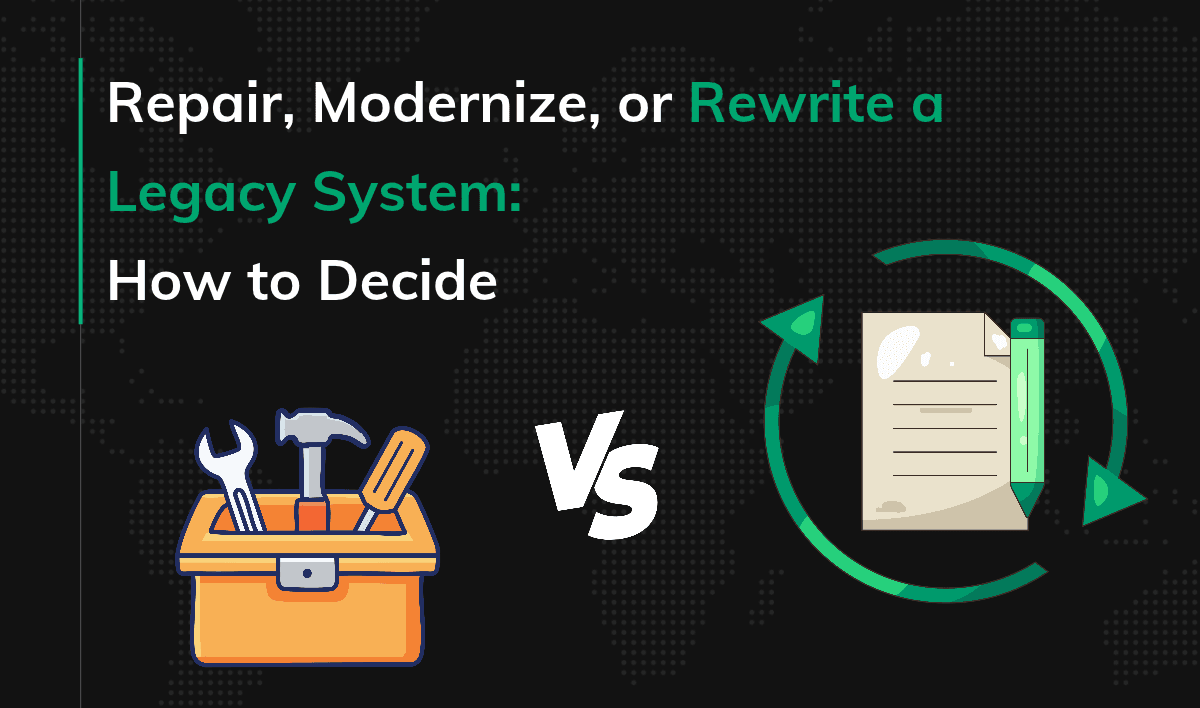
Repair, Modernize, or Rewrite a Legacy System: How to Decide
A business-critical system can keep running even as it increasingly holds the company back. When every change takes longer, costs more, and raises the risk of outages, the company’s leaders face a choice: keep fixing the current solution, replace the problematic modules, or rewrite the entire system.
Each path makes sense under different conditions. In this article, we explain when to choose each one and how to base the decision on system health, the economics of making changes, migration risk, and the company’s business context.
Key Points
|
Separate Legacy System Problems From Organizational Problems
The same delays can stem from the code, ways of working, or both. Start with one question: what is this system preventing the company from doing today? The answer should identify a specific constraint, such as a blocked integration or a new service that takes too long to launch.
Follow a feature request from the initial idea through the decision to build it. Frequent priority changes, a lack of clarity, and slow decisions can bring work to a halt even when the system itself is technically sound.
Before deciding whether to keep repairing the system, modernize parts of it, or rewrite it, analyze:
- the lead time from idea to release for a typical feature;
- the actual team-wide cost of delivering a single feature;
- the share of the IT budget spent on maintenance, incidents, and fixes;
- the number of regressions and the impact of incidents on customers and revenue;
- the workarounds users rely on outside the system;
- the state of the tests, documentation, and integrations, and the number of people who hold critical knowledge.
Waiting a week or two for a simple feature is a clear warning sign, although the threshold depends on the industry and the complexity of the solution. The trend matters more: are comparable changes taking longer over time?
Match the Scope of Modernization to the Root Cause
Choose the smallest scope that removes the business constraint and makes the system more economical to develop over time. A full rewrite is the broadest and riskiest option, so it requires the strongest justification.
Keep Improving the System When Its Foundations Are Sound
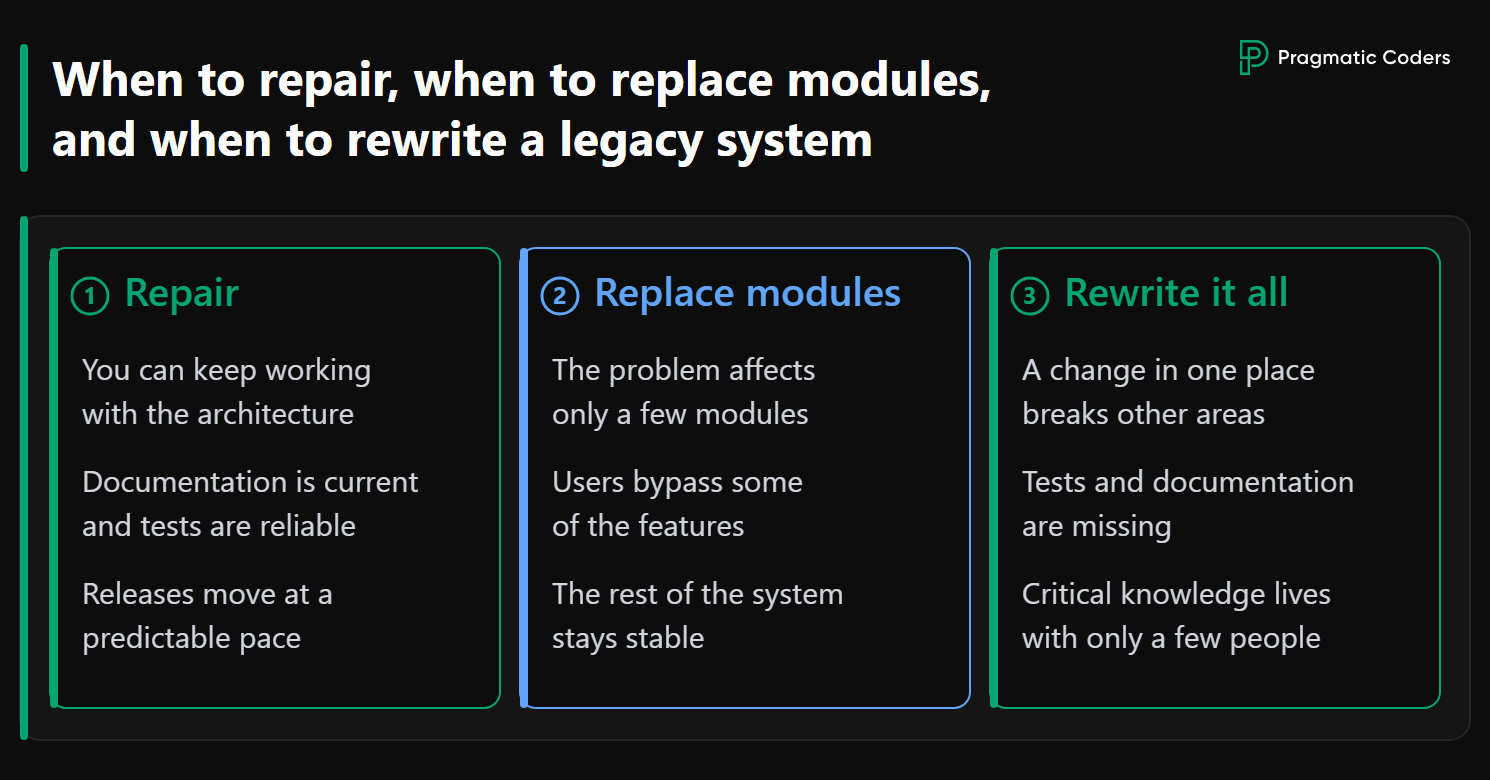
Incremental fixes make sense when the architecture allows the team to continue developing the system safely. The team understands the dependencies, has useful documentation, trusts the tests, and can deploy changes efficiently. Maintenance costs remain reasonable relative to the value of the processes the system supports.
Business impact should drive the decision, not the age of the technology or whether developers dislike working with difficult code. If the team can still deliver new features within predictable time frames, continuing to improve the system may be the most sensible option.
Replace Modules When Problems Can Be Isolated
Partial modernization works when weaknesses are concentrated in specific parts of the system. Arrange a system review to identify where most changes are made and which features users deliberately bypass. An Excel spreadsheet used in place of the application usually indicates that the relevant module no longer supports the actual process.
You can have a team isolate the module, rewrite it, and integrate it with the rest of the system. In a larger system, it is better to replace similar problem areas in stages. This limits the upfront investment and lets you validate the results quickly.
Rewrite the Entire System When the Constraints Are System-Wide
A full rewrite is justified when the entire system is difficult to change. Minor fixes take weeks, a change in one area breaks others, the tests provide no reliable feedback, and the architecture offers no way to isolate stable components. Sparse documentation and a low bus factor, with critical knowledge concentrated among only a few people, add further risk.
A full rewrite makes sense when the company already knows which processes and rules the system must support and how the product should work. If those requirements are still changing significantly, choose staged modernization or test the new direction on a small scale without changing the current system.
Before comparing the costs of repairs, module replacement, and a full rewrite, you can work through a six-step self-diagnosis of your IT project’s health. It will help you make sense of the signals from the business, product, and technology.
Compare the Total Cost of Maintaining, Modernizing, and Rewriting the System
Compare the cost of continued maintenance, refactoring, module replacement, and a full rewrite over the same period, such as two quarters. Only a longer-term cost comparison reveals which option actually costs less.
Include:
- the cost of the team’s work, infrastructure, licenses, and specialist support;
- the cost of developing features, regression testing, and resolving incidents;
- the cost of employee time spent on manual tasks and workarounds outside the system;
- the cost of migrating data, integrating with other systems, training people, and running the old and new versions at the same time;
- revenue the company forgoes when the current system prevents it from launching new offerings and integrations or taking on new contracts.
Prepare optimistic, baseline, and pessimistic scenarios.
Example: Rewriting Pragmatic Meet
Our experience rewriting Pragmatic Meet from scratch shows the kind of shift in project economics you can expect. Pragmatic Meet is our own product for organizing events for technology communities. The total time the team spent on a comparable user story fell from roughly 60 hours to about 18 initially, then stabilized at 15 to 16 hours. This brought the cost per user story down to roughly one-third of its previous level.
The team had about 18 months of experience with this medium-sized system. Four developers and a Product Owner had it production-ready in about seven and a half weeks, then spent one more week on fixes.
Decide Whether to Change the System at All, Then Run a Short Pilot
A cost comparison shows which path costs less, but cost is only part of the decision. Before starting a project, confirm that the current system is actually holding the company back and identify the root cause. You also need to determine whether the organization can carry out the change safely. You can conduct this assessment internally or hire an outside partner such as Pragmatic Coders.
Identify the Root Cause and the Right Scope
First, identify the specific impact the current system has on the business: slower launches of new services, rising change costs, lost revenue, or outage risk. Then determine whether the main cause is the architecture of the entire system, individual modules, or the way the company gathers requirements, sets priorities, and deploys changes.
The review should also cover data, integrations, security, migration risk, and access to the code, documentation, and people who understand the business processes. This shows whether the proposed change can be carried out safely and without unplanned disruption to operations.
Based on the findings, the review team should present a reasoned recommendation: leave the system as it is, simplify or refactor it, isolate or replace selected modules, rewrite the entire system, or change the way the organization works. The recommendation may conclude that a full rewrite lacks a sufficient business case.
A Pragmatic Coders Pilot Lets You Replace Assumptions With Data
Once you have chosen a direction, you can test the most important assumptions on a representative part of the system. A representative part should share the characteristics found across most of the system, including the same kinds of business rules, data, and integrations. A simple, isolated module will not tell you what working on the system as a whole will be like.
Before starting the pilot, set measurable criteria for deciding whether to continue: which features must be delivered and functional, delivery pace, cost per feature, test quality, migration risks, and launch readiness.
Pragmatic Coders offers a six-week pilot. During that time, the team rewrites a representative part of the existing system and measures the actual pace, cost, and quality of the work. Using these measurements, we can project the time and cost of the remaining work far more accurately than we could from estimates or an earlier audit alone. During the pilot, we write production code just as we would in a standard rewrite project. If we continue working together, that code becomes part of the final solution and the foundation for the rest of the rewrite.
AI Lowers Rewrite Costs, but the Team Still Owns Requirements and Quality
AI reduces the time from specification to working code, which accelerates a system rewrite and lowers implementation costs. Speed alone does not determine the quality of the result. AI can accelerate the implementation of both a well-designed solution and one based on incomplete requirements or flawed assumptions. That increased pace requires precise requirements and effective quality control.
In Spec-Driven Development, the team works from an agreed specification. It describes the expected behavior of the system, scenarios, and acceptance criteria used by both the engineers and the AI agent. Before implementation starts, the team must reconstruct the business rules, clarify the requirements, and define how to verify the result. In one of our teams, this stage took about 30% of the sprint.
Even a strong specification does not relieve engineers of responsibility for the architecture, security, quality, and final approval of changes. Code reviews, automated tests, architecture tests, and regular exploratory testing are essential. With these practices, the team verifies that the system being built meets the requirements and follows the agreed architectural principles.
Plan Migration From Day One
From the start, the project plan should cover data migration, rebuilding integrations with the systems and services that exchange data with the current solution, and the cutover approach. These tasks are as integral to the project as building the new system, so they belong in both the scope and the schedule.
Whether an in-house team or an external partner leads the rewrite, the people delivering the project should talk to users and observe their daily work. This will help them uncover undocumented operations, exceptions, and workarounds. The team must then agree on which system behaviors to preserve, improve, simplify, or remove. Changes to the interface or users’ workflows should be added to the scope only when they have a clear justification.
Before choosing a migration approach, ask the project leaders to compare the costs and risks of the options and recommend the best fit for this project. We switched Pragmatic Meet to the new version in a single cutover after testing. In a large system with clear module boundaries, a phased cutover may be safer. Running the same processes in the old and new versions in parallel makes sense only when the reduction in risk justifies the cost of synchronizing data and maintaining both versions.
Before the new system handles live business processes, you should receive results from a test data migration and from tests of the integrations and key processes. The migration plan should also define the conditions that trigger a rollback and explain how to perform it. Using the test results and rollback plan, you can assess whether the cutover can begin safely.
Conclusions
Start the decision process by identifying the root cause of the problem: the entire system, individual modules, or the way the organization works. Then compare the total cost of each option, test the most important assumptions on a representative part of the system, and plan the migration from the outset.
After deployment, measure the results against the same metrics that justified the investment. Check whether feature lead times, change costs, and incident counts have fallen and whether the company can now pursue goals that the system previously blocked. The results will show whether the chosen path was right.