Hybrid Work in IT: What Do Clients Gain?
In IT, it is easy to assume that if something can be done remotely, it should be done fully remotely. We worked that way during the pandemic too. And we know that working from home can be great for focus, analysis, and independent delivery.
But over time, we also saw the other side. In complex software projects, individual productivity is not enough.
You need a team that can share knowledge quickly, understand context, and solve problems together. That is why, we deliberately chose a hybrid work model at Pragmatic Coders.
In this article, we show how our hybrid model works and what we learned from an internal survey about office work and working from home. We also explain why a well-designed hybrid setup can improve communication, knowledge flow, and the quality of client collaboration.
Key Points
|
Why We Chose Hybrid Work After the Pandemic
Hybrid work is not a compromise between company expectations and employee convenience. For us, it is a deliberately designed operating model that supports delivery.
During the pandemic, we worked fully remotely. That period showed us that many tasks can be done from home without any loss of quality. Sometimes, the results are even better. When someone needs quiet, focus, and a longer block of uninterrupted time, working from home can be the best environment.
But software projects rarely consist only of individual tasks. The more complex the product, the more important shared understanding becomes. Teams need to clarify uncertainty quickly, challenge assumptions, exchange knowledge, and notice signals that do not show up in Jira.
That is why we partially returned to the office. We wanted a model that preserves the flexibility of working from home, while also helping teams collaborate when a direct conversation makes it easier to make a decision or solve a problem.
How the Hybrid Model Works at Pragmatic Coders
Our model is simple: 2 days in the office and 3 days at home. The important part is that office days are set at the team level, by the team itself.
This is not about everyone “checking off” office attendance on any random day. We set office days by team, so the whole team can meet in the office and work together on-site. If we need a workshop, a project meeting, or a joint scope clarification in a given week, we schedule it for an office day. This allows the team to discuss the topic in person, without turning every conversation into a separate call.
There are exceptions, ofcourse. People who live more than 15 km from the office and have stayed with us since the fully remote period can continue working remotely. They are already integrated with the company and understand how we work. They come to the office twice a month to work with the team in person.
New hires come only from Kraków and the surrounding area. This narrows the candidate pool, but keeps the model consistent. We deliberately accept that cost because regular teamwork in the office creates value we do not want to lose.
What Our Team Says About Office Work and Working From Home
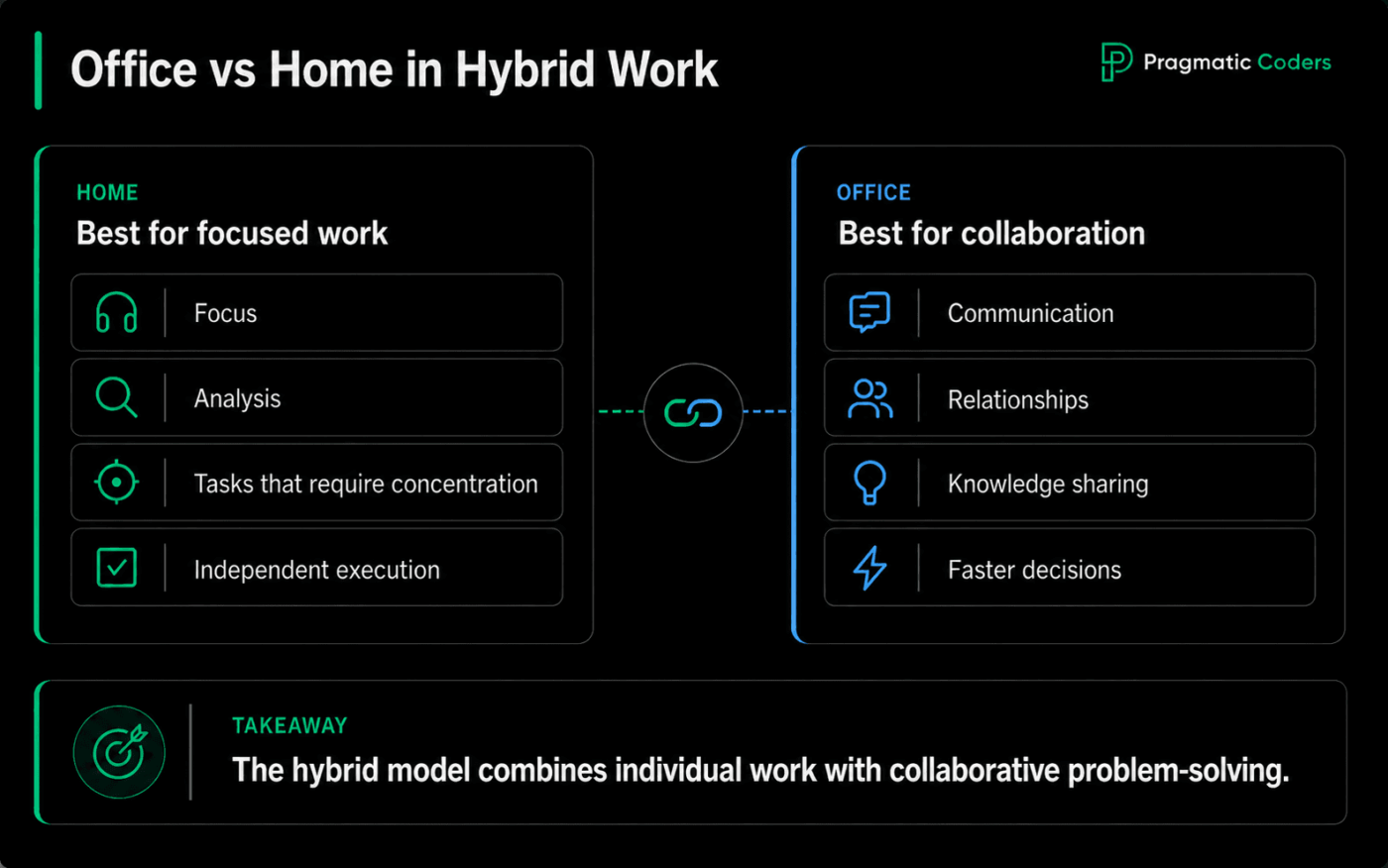
When we asked our team about the advantages of office work and working from home, the answers formed a clear pattern. Working from home works best when you need to focus, think through a topic calmly, and deliver a task without frequent interruptions. The office creates the most value when the team needs fast communication, shared context, stronger relationships, and easy knowledge exchange.
This distinction explains why we do not treat hybrid work as a compromise. Each mode has a different role in how we work. Home protects concentration. The office strengthens the parts of collaboration that are hard to capture in tasks, status updates, and scheduled meetings.
Kacper summarized it clearly: “home office for productive work, the office for team building and information exchange.” Darek put it even more directly: “Without relationships, there is no team.”
In IT, it is not enough for everyone to just do their own work. Shared context, trust, and the ability to share knowledge quickly are part of what makes a team effective.
Office Work Speeds Up Communication and Knowledge Flow
The office often helps with the small decisions that do not make it into the backlog but still shape the pace of a project. A quick clarification, an informal conversation, or a five-minute check before someone spends several hours implementing the wrong idea.
In the team’s responses, one theme came up often: knowledge shared “in passing.” The kitchen, coffee, lunch, foosball, a quick chat by someone’s desk. From the outside, it may look like “slacking.” In practice, it can save a lot of time.
Sometimes someone hears part of a conversation and adds context. Someone notices a risk that was not considered earlier. Someone says, “we did something similar in another project.” In remote work, these moments simply do not happen in the same way.
The office also supports faster iteration. When a team works together on-site, it is easier to test an assumption, ask about a detail, or spot a gap in an idea before someone starts implementing it. Konrad pointed to “easier and faster validation of hypotheses and ideas.” Krzysztof mentioned faster communication, fewer misunderstandings, and better knowledge flow “in passing.”
From the client’s perspective, these everyday clarifications affect both pace and quality. The team makes decisions faster, aligns on assumptions more often, and catches problems earlier, before they turn into several days of rework.
Working From Home Supports Focus and Independent Delivery
Working from home remains an important part of our model because good teamwork does not replace focus. Teams also need quiet and time for independent work on tasks that require concentration.
In our survey, the team valued working from home most for analysis and tasks that do not require much alignment. Ewelina wrote: “it is easier to focus, quieter, with less movement around you.” Krzysztof put it even shorter: “HO: better conditions for deep work.”
That makes sense. If a task is clear, well described, and does not require frequent synchronization, working from home can be faster. Fewer interruptions. Fewer conversations. More control over your own rhythm.
That is why we do not treat working from home as a concession. It is a full part of the system. In our model, the office strengthens collaboration, while home protects focus.
Remote or Hybrid Work: Why We Choose Balance
We do not think fully remote work is a bad model. It works in many companies and many teams. It also worked for us during the pandemic. Over time, however, we saw that in our way of working, it can weaken knowledge flow, reduce spontaneous collaboration, and make misunderstandings harder to catch early.
One response described that risk well: in remote work, you may wait longer for an answer, and problem analysis can become narrower because no one adds a counterargument at the right moment. Remote work can create additional communication friction, even when everyone involved is fully engaged.
Working only from the office has its limits too. In the same survey, some people noted that the office can mean more interruptions, conversations, breaks, and distractions. That is why we do not treat office days as the best mode for every type of work.
For us, the hybrid model works better than either extreme because it gives each mode a clear purpose.
How Hybrid Work Affects Client Delivery Quality
The client is not just buying developer time. They are buying the team’s ability to understand the problem quickly, make good decisions, and deliver solutions without unnecessary chaos.
This is especially important in complex, at-risk, or messy projects that need to be brought back under control. When a team lacks shared context, technology and business can easily drift apart. One person assumes one thing, another understands something differently, and the problem only surfaces after a few sprints.
In these situations, knowledge flow is one of the strongest safeguards. It helps the team identify the real problem sooner. It also helps clarify what needs to be simplified, fixed, or cut.
That is why this model is close to how we think about technology project rescue. When a project loses momentum, “more coding” is rarely enough. You need better decisions, shared context, and faster synchronization between people.
Why We Hire Only From Kraków and the Surrounding Area
Hybrid work has consequences. The biggest one is a smaller candidate pool, because we hire new people only from Kraków and the surrounding area.
Not every candidate likes that. And that is okay. We say it openly during recruitment because we do not want to create expectations we cannot meet later. We do not hire new people for fully remote roles because exceptions would quickly weaken the consistency of the model.
From the company’s perspective, this is a cost. From the client’s perspective, it is part of a working system designed to make collaboration more predictable. A team is not just a group of people who happen to work together. It should meet regularly in the same place, exchange knowledge, and build shared responsibility for the result.
We do not claim this is the only good model. We claim it is the model that works for us and supports the way we deliver products.
Conclusion
Hybrid work at Pragmatic Coders is neither a return to old rules nor a compromise between the office and working from home. It is a deliberate operating choice.
Working from home gives our teams space for focus, analysis, and independent work that requires concentration. The office strengthens relationships, communication, knowledge flow, and faster problem-solving. And in complex IT projects, you need both.
For the client, this means working with a team that does more than execute tasks. It understands context faster, clarifies misunderstandings more efficiently, and collaborates better on difficult decisions. In software development, these elements often determine whether a project is truly moving forward.