Unlocking VC Funding: Insider Tips from VC Partner Jarek Pilarczyk
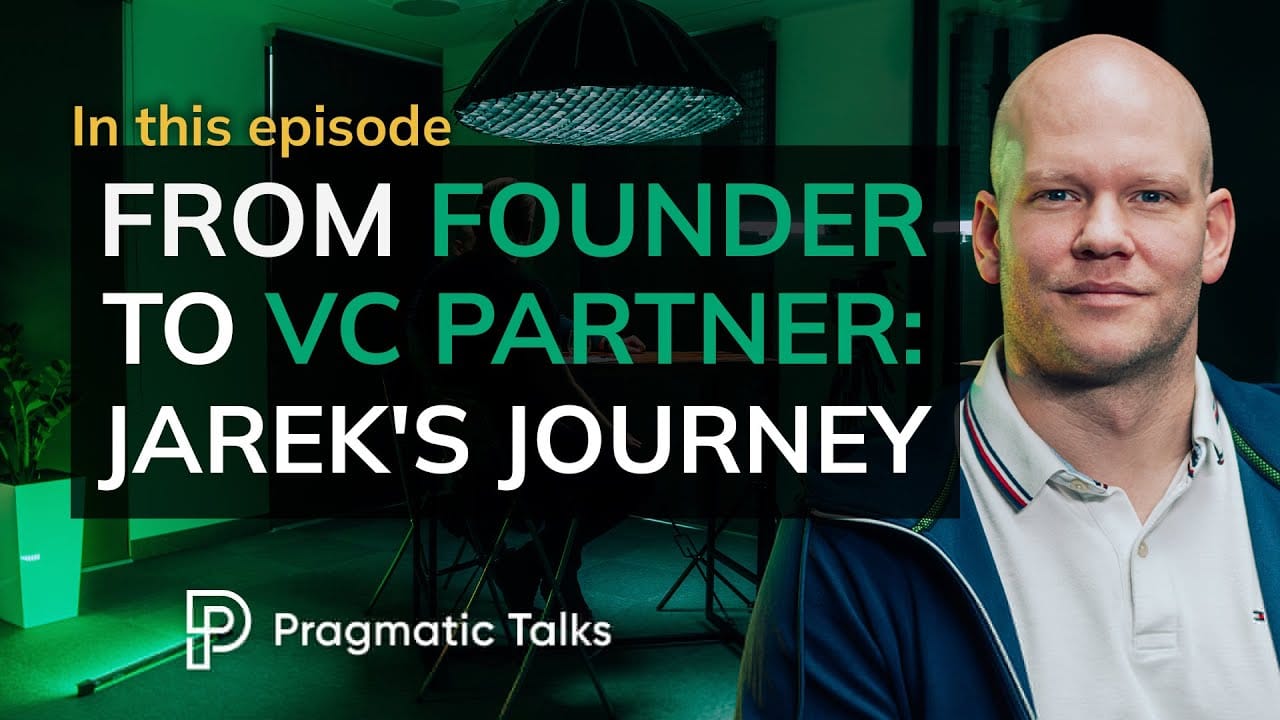
Here’s what you can learn from this episode of Pragmatic Talks:
From entrepreneur to investor: Jarek’s story
- Early Career & Entrepreneurship: Jarek Pilarczyk started as a tech entrepreneur during his university studies in Poland. He built a successful technology company focused on agile methodologies, which he sold in 2012.
- Second Exit and Angel Investing: He founded another company in 2015 and also began his journey as an angel investor. He learned valuable lessons through failures, such as not investing in industries he did not understand (like gaming). He successfully exited his second company in 2021.
- Transition to Venture Capital: Based on his rich experience as a founder and angel investor, Jarek decided to transition into the world of venture capital, where he is now a partner at a new VC firm.
Key criteria for startup investment
- Team is Paramount: Jarek emphasizes that the founding team is one of the first and most critical factors he evaluates. He looks at their background, their knowledge of the market, and their understanding of the problem they are trying to solve.
- Market and Problem Understanding: The second key factor is the market. He assesses whether the market is growing and if the founders have a deep understanding of the problem within that market. He learned this lesson after an investment in a startup using Bluetooth beacons, where the technology was hyped but the market did not grow as expected.
- Focus on Early Stages: Jarek primarily invests in pre-seed and seed-stage startups, as this is where his experience as a founder can bring the most value.
The difference between an angel investor and venture capital
- Beyond Just Money: A good angel investor provides not only capital but also knowledge and a market perspective. They often invest their own money.
- Different Mindsets: Jarek suggests a key difference in mindset. VCs, who manage others’ money, are “investing to win”– they seek massive returns and focus on how big a company can become. Angels, investing their own funds, are often “investing not to lose”– they are more risk-aware and may not focus as much on enormous scaling potential.
- Strategic Long-Term View: A VC takes a more strategic, long-term perspective. They must plan how a company will develop from one funding round to the next, helping to build a scalable business, not just a good product.
How a venture capital fund works
- General Partners (GPs) and Limited Partners (LPs): A VC fund is managed by General Partners (GPs), who make the investment decisions. The capital comes from Limited Partners (LPs)– individuals, family offices, or other funds who invest in the VC fund as an asset class.
- Decision-Making: The GPs are responsible for managing the fund and making the final investment decisions. LPs are passive investors and are not typically part of the investment committee.
- Skin in the Game: It is standard practice for GPs to also invest their own money into the fund to show they have “skin in the game”.
Introducing Balnord VC: Jarek’s new fund
- A High-Conviction Fund: Jarek is a partner at a new fund called Balnord. It operates on a “high-conviction” model, meaning it leads investment rounds (pre-seed or seed) and aims to invest a significant amount of capital to give founders leverage and security for future rounds.
- Investment Focus: Balnord focuses on deep tech and “data-driven software” startups in three main verticals: supply chain, fintech, and digital health.
- Geographical Area: The fund invests in startups from Poland and the Baltics (Latvia, Lithuania, Estonia), or in founders from this region who are starting companies elsewhere.
- Ticket Sizes: The average ticket size is substantial for the region: €600,000 for pre-seed and €1.2 million for seed rounds.
Investor red flags
- Problematic Cap Table: A major red flag is a messy capitalization table. This includes situations where very early investors have taken too large a stake, leaving founders with little equity and motivation, or an unequal split of shares between co-founders that suggests some are not true partners.
- Technology Over Market: Founders who are focused only on building a solution without a deep understanding of the market and the problem are a cause for concern. A great product without sales and marketing is less likely to succeed than a startup with strong sales and marketing that needs to improve its product.
- Lack of Founder Commitment: Founders who are not fully focused on the startup and are working on other projects at the same time represent a significant risk.
Post-investment: working with founders
- Hands-On Support: Jarek believes in being actively involved post-investment. He aims to have calls with founders at least twice a week, not for long meetings, but to stay close, offer support, and act as a mentor.
- More Than Formal Meetings: Beyond formal board meetings, he provides a sounding board for founders, helping them reflect on their decisions and avoid common mistakes. This support covers everything from sales strategy to mitigating co-founder conflicts.
- Preparing for the Next Round: A key role for a good VC is to help the startup prepare for its next funding round. Jarek has observed many startups fail because their previous investors did not guide them on what metrics to achieve to be ready for future fundraising.
The state of the VC market and final advice
- Return to Fundamentals: The post-pandemic market has seen a return to fundamentals. The era of easy money is over, and investors are now focused on capital efficiency. A business must have a path to profitability, not just growth at any cost.
- Focus on the Problem, Not the Solution: Jarek’s ultimate advice for founders is to focus intensely on the problem they are solving. Founders should ask: “Is this problem big enough to be worth solving?” A deep understanding of the problem is the foundation for building a successful company.
Full Transcript
Introduction to the episode
Jarek Pilarczyk: In this episode, making an investment decision and investing money is just the beginning of your work that you have to do: growing the company and then exiting the company, right? It’s not only about one round of investment. They have developed a great technology, but the technology itself is not going to create a successful company, right? So you also need a great business model. You’re in a business where you need to compete with others, so you need to be more efficient. If that were the case that the one that has the most money always wins, then the corporations that have a lot of money would always develop the best things, but that’s not how it works, right? They’re actually investing in startups because they know themselves that they cannot be efficient in building new things. If you would not take enough risks, you will not create those big returns because you will end up maybe with businesses that are, you know, maybe are even profitable, but they’re not really successful businesses. So you need to take th–
Wiktor Żołnowski: –e risk. You also need to go for more ambitious projects and more risky projects. Welcome to Pragmatic Talks, a podcast and video series where we discuss startups, contemporary digital product development, modern technologies, and product management. We believe that everyone should have equal access to knowledge about product development and entrepreneurship, and also everyone should have the opportunity to apply it in pursuit of making our world a better place. Through this series, we aim to create an impact on the future world. Today, we invite you to our interview with Jarek Pilarczyk. Jarek started his journey as a tech entrepreneur. He has founded several companies and has transitioned into a seasoned angel investor. Currently, he is a partner at a venture capital firm where he leverages his rich experience to nurture and invest in the next generation of innovative startups. We’ll be discussing the unique challenges and rewards of venture capital and gaining his invaluable insights on what it takes to drive in the competitive world of startup investments.
What you will learn in this episode
Wiktor Żołnowski: In this episode, you will learn:
What are investors looking for when searching for startups to invest in?
How do investors evaluate startups before investing?
What does a startup selection process look like from the investor’s point of view?
How could investors support startup founders after the investment?
How could you start investing in startups and become an investor on your own?
And now, ladies and gentlemen, please welcome Jarek Pilarczyk. Welcome to the next episode of Pragmatic Talks. Today, our guest is Jarek Pilarczyk. We’ve known each other for a couple of years. You started as a startup founder and entrepreneur, and then you ended up right now as a VC partner, and you’re building your own Venture Capital with a couple of your partners and colleagues. The first question, Jarek, is who is Jarek Pilarczyk, and what is your story? So please tell us more about it.
From entrepreneur to investor: Jarek’s story
Jarek Pilarczyk: Okay, so I was always answering this question that I’m an entrepreneur, and that used to be true for the last 16 years of creating different companies. But as you mentioned, right now, I’m kind of transitioning into the other world. But to tell the story– I was visiting the US while I was still during my studies and got inspired by technology and how things are developing, especially since those were still the times when the internet was in its early stages. I came back to Poland and decided, okay, I have to do something. So basically, I’ve decided to start a company while still during my studies. I was studying at a Technical University in the Silesia region and tried out to build something on my own. And of course, you know how it is in the beginning, especially when you have technical knowledge and not so much business knowledge, so it was not really successful in the beginning. But after a while, I kind of started to utilize the experience I gained building technology solutions, and I was really into agile methodologies, which at that time, that was like 2007, 2008, it was not really well-known yet. Now everybody’s talking about Scrum, Kanban, and everything, and it’s like a standard thing to do, right? So at that time, it was actually a bit of an advantage I was offering to partners, and I started to offer this as a service to companies from Scandinavia, which was my kind of the first international contracts, working with international companies. And based on that, I actually developed a quite successful technology company, which I sold in 2012. And after that, there was a bit of– I started a bit down two paths. One thing was that I started another company in 2015, but I also wanted to do more. I was inspired by the startup world and everything, so I also started a bit of angel investing. We will come to that, but with angel investing, I learned a lot. And as they’re saying, you’re learning through failures, and I failed a lot in that as well. But I then started to focus more on my second company, and I exited this company successfully in 2021 to a Finnish-based corporation. So then from that point, I also started to look, you know, what is next? And based on different discussions and so on, I decided that, yeah, I would like to try the VC world and see how it is from that perspective.
The first angel investment and lessons learned
Wiktor Żołnowski: Great. So today I would like to focus on your perspective based on your experience as a former entrepreneur, two exits, then an angel investor, and now a VC partner. I would like to focus on your perspective on investing in startups. But before we get there, I would like to learn a little bit more about your history. So let’s start from the beginning. So, the beginning of your investor’s history, let’s start from your first investment. So could you recall what was the first startup you invested in?
Jarek Pilarczyk: Yeah, I think that one of the first startups that I invested in was actually a startup in the gaming industry. I’m not going to bring up the name because it will probably not tell anything to anybody, but this was kind of a reflection of my own desires, like a founder from a technology company wanting to be in the gaming industry. This was one of the first lessons I’ve learned in investing: don’t invest in something you don’t understand. And of course, I could say that I was a gamer in the past and I knew how it is, but it was a completely different world than the kind of B2B software, enterprise software, that I used to work with, right? So of course, that was not so successful, but then I, of course, invested in a bit more companies. And the thing is, I was looking upon those companies not so much as an investor, but rather like an entrepreneur would, who would like to kind of develop them on my own, right? And I think that was one of the first mistakes because you can work on or develop one company, but you cannot be an investor in many and do the same thing. It’s not the same. There needs to be a different leader; there needs to be a founder that is responsible for the company. And as an angel, you can, of course, bring some knowledge, but you will not do it yourself.
Wiktor Żołnowski: Okay, so if not based on the idea that, “Okay, I would like to run this company on my own,” or “I would like to be a part of this company,” what are the factors or what are the criteria that you take into consideration or you took into consideration when you used to be a business angel? When you were choosing the companies to invest in? What did you learn, maybe that way? Like you said that you learned from mistakes, some of them at least, but at the end of the day, you’ve been pretty successful to the point that right now you’re working on a VC and you have some capital to invest, like bigger capital, not only your money, but you also convinced other limited partners to invest in your VC to actually invest in the startups that you are picking. What is your strategy in terms of choosing the startups to invest in, and what would be your recommendations to others?
Key investment criteria: team and market
Jarek Pilarczyk: Yeah, so from the perspective of learning about investment, I was investing as an angel investor, and at some point, I also started to work with a VC to kind of get the other perspective. I was kind of more of an advisor, seeing into the technology sides of the projects but also being able to see a lot of different projects. So this first lesson, of course, showed me that it’s not so much about the business itself, but it’s also about the team, right? So the team is important. And I remember that one of the investments that I’ve been participating in, it was called Everytap at the point of working with the VC, and it was about using beacons in the services for customer loyalty programs and so on. So basically, looking at this investment, I was already looking more into the team and thinking about technology as well because, of course, that was my background, but I was not yet looking that much into the market that they were in, right? And of course, at that time, Bluetooth beacons, that was like a hype, right? So everybody would like to invest in something like that. And actually, this investment has been exited, so it was, from that perspective, successful because there was an investment, and it was exited. But looking at what happened next is that they have not grown significantly because the market that they were trying to address was not necessarily growing just because of the hype. So I’ve learned that the second main factor about the investment is also the market and understanding of the problem. So I would say that now whenever I’m looking at possible investments, one of the two first factors I’m looking at is the team, a founder, and then the market and the understanding of the problem that there is in the market.
Wiktor Żołnowski: So what stages are you investing in right now? What stages have you been investing in in the past? Has it changed, or right now with a VC, are you looking for startups at the same stages as you invested in the past because you have a lot of experience at this stage, or maybe you are moving to later stages with the VC?
Jarek Pilarczyk: Yeah, it’s still about pre-seed and seed, so a very early stage. And myself, I really enjoy this beginning of a journey. I was there myself a couple of times, and I’ve also been kind of working with founders in those stages as well, so I really like the initial dynamics and so on. So I can say that most of my experience is in that area, right? So as we mentioned before, don’t invest in something you don’t know, so I don’t know that much about later stages other than kind of seeing how it is to get other rounds and what the investors from those other rounds are looking at, right? But I think that I can bring most of my knowledge and experience to those early stages, so that’s why I’m trying to focus on that.
The difference between an angel investor and venture capital
Wiktor Żołnowski: What’s the difference between a business angel and venture capital? We spoke about it a little bit before we started recording, and I know that you have your own definition of who is a business angel and who is not a business angel, or a proper business angel. So, yeah?
Jarek Pilarczyk: I don’t know if I want to distinguish that much between business angels, maybe just to show kind of my perspective of what I think a business angel can do and what is the difference from a VC, right? So my perspective is that a business angel is not the person that is actually giving only money. If I look at being able to be successful by just pouring money into the company, I would say that this is not the best way to succeed. I think that angel investors are really good when they can also bring kind of knowledge, a market perspective. So if somebody is looking for an angel investor, those would be the additional factors that they should take into consideration. When it comes to a VC, a VC is a bit different from the perspective of the level of money that they’re investing and the portfolio. And so basically, they are having a bit of a broader perspective of what they’re investing in and also have a much bigger benchmark of projects they can invest in, so they’re choosing the projects completely differently. I think that one of the things is, when I’m also kind of comparing people investing their own money and a VC– I think one of the biggest differences would be that the management, the GPs from a VC, are investing to win. And when you’re investing your own money as an angel, you’re more kind of investing not to lose, right? I would say so. I know it might be hard to understand in the beginning, but if you will kind of think about the perspective of evaluating a company, then you are thinking about it totally differently, whether you should invest in this project or you should not invest.
Wiktor Żołnowski: So do you mean that business angels, angel investors, are way more risk-aware than maybe the VCs are more risky in terms of making the decision of taking the risk?
Jarek Pilarczyk: Angel investors are not thinking that much about how far this business can be developed, right? So they’re kind of more thinking from the perspective of, “Okay, does it make sense? Is it like something that can succeed?” but they’re not thinking how far it can succeed, so how big this can go, right? And when you’re in a VC, you have to get that perspective. You really need to think about how this company is going to be developed. You know, do you see that it’s possible for this company to scale, right? Is the market big enough? Is that really a problem? How is this team unique compared to the other things that are going on, right? So you really have to take into consideration a more long-term perspective.
Wiktor Żołnowski: So you already mentioned that as a VC, you are looking more into the strategic– more into the strategy of the company and the potential strategy of the growth, etc. So what are other differences in this approach, the investment strategy maybe?
Jarek Pilarczyk: Comparing to what I was doing as an angel investor was that I was kind of looking at the things that I was excited about, trying to follow the things that I enjoyed more than trying to find out the things that make sense. And also when you’re in a VC, you’re also kind of taking this perspective that it’s not about, “I will put in money right now and then try to help and then see what will happen.” In a VC, you also need to kind of have this strategy of how you want this company to develop and how you’re going to help it get from one investment to another round. You know, what is important? So you really are more engaged in a more long-term kind of perspective in that way.
How a venture capital fund works
Wiktor Żołnowski: Okay. So maybe let’s talk a little bit more about how a VC works and also how angel investment works, yeah? I know that some of the people who are watching or listening to it are aware of how a VC works, how startup investment works, but I learned from many discussions, also with startup founders, that a lot of them have no freaking idea how venture capital works and who is the GP, who is an LP, what are the differences, and actually some of the startupers don’t even know where the money comes from. And in a VC, especially with business angels, angel investors, it’s pretty easy; it’s usually their own money, yeah? But in a VC, as you said, it’s not necessarily investing your own money, or not your own money only, right?
Jarek Pilarczyk: So basically, if you look at a VC, usually it looks like this: you have General Partners, right, which is the management side of the fund, and there are LPs, Limited Partners, which are the ones that are investing into the VC. So basically, you have a team that is responsible for managing the fund. And it is also a good practice, and that’s the practice, that GPs are also investing their own money, so they have skin in the game, right? But basically, what you’re trying to do is you’re trying to build a larger investment vehicle so you can, first of all, diversify, and second of all, have enough capital to build a model for your fund that can return the money to investors at the largest possible multiplier, right? So basically, you’re looking at what level of diversification do you need, what level of investments you will be doing within the fund so that you can create the biggest returns for the investors. And this is what the GPs are responsible for. They’re thinking about the returns to their investors, not only just finding a great project and great PR because they’re doing AI or anything. You really need to think about returns, not only the investment itself.
Wiktor Żołnowski: So what’s the role of LPs, limited partners, and what is the relationship between the GP and LP?
Jarek Pilarczyk: You know, it depends. Actually, we can discuss a bit more maybe who they can be, right? So this can be a private person that has money, and basically, the same as he’s investing in the stock exchange or something else, he’s investing in a VC fund, right? A VC fund is also an asset class, basically. And other than an individual person, this can also be like a family office, right, which is professionally managing the funds of one family or more families. This can also be so-called funds of funds. So basically, you also have funds which are not directly investing, but they’re investing in VC funds, right?
Wiktor Żołnowski: So sounds like a pyramid.
Jarek Pilarczyk: Yeah, but it’s not, it’s not actually a pyramid; it’s just the way it is. It’s just diversification and scaling up the resources that you have. Yeah, they can also invest in different types of funds. They can invest in VC funds, they can invest in kind of private equity. So this is basically a different model of how they’re investing their money, right? And also, it’s a much larger scale, of course. So basically, I would say that in the end, if you look at that, it’s all about creating diversification, but also, whenever you’re investing your own money, there’s a different leverage than when you have a larger pool of money that you’re able to invest.
Wiktor Żołnowski: Yeah, this is why a VC can do more, yeah. Like, so what’s the relationship between LP and GP? So who is making the decision at the end of the day? So you found a great startup to invest in. Is it your decision as a GP, or is there any conversation between LP and GP to make this decision about the investment?
Jarek Pilarczyk: You, as a GP, you’re responsible for the fund. You’re responsible for returning the investment to your LPs. So basically, you can work with some LPs, especially if they’re coming from the market that you are willing to invest in, and you can try to get some more kind of insights and so on. But in the end, the decision is yours. You’re responsible for it, right? So LPs, in that term, are more kind of passive investors. They will know about what you’re trying to invest in and so on, and they will have an exposition to that, but they’re not part of the committee to decide about the investment.
Introducing Balnord VC
Wiktor Żołnowski: I think it’s a good moment to do a little bit of advertising. So tell us more about the VC that you are currently building and what’s the name, if you can provide it already, and what are you investing in, and who can join you as a maybe an LP or who can apply as a startup?
Jarek Pilarczyk: Advertisement, you’re saying, right? Yeah, of course. So I’m currently starting a fund called Balnord. And this is a VC that is being created by five people, and four of them are actually coming from Black Pearls, which is a quite well-known fund in Poland for some successful investments and lately also a quite good exit that a lot of people heard about, probably Tidio. So I’m actually joining an experienced team, bringing another perspective into how they’re assessing the deals and how they’re supporting the portfolio companies. So I’m actually joining on the position of operating partner, which is a very specific thing because there is no other fund in Poland that has the same way of approaching VC investment. What is different in this fund and the strategy that it’s going for? So first of all, it’s a so-called high-conviction fund. So it means that normally if you look at the VC world and what a lot of funds are trying to go for, they’re trying to have a large portfolio of companies, and they’re trying to do an investment into different of those companies. And especially they really like if there’s another VC investor that kind of is proving that it’s worth investing, and they’re just adding additional money.
Wiktor Żołnowski: Like a leading investor, yeah?
Jarek Pilarczyk: Yeah, for example. In high conviction, we are always going to be the lead investor in pre-seed or seed. And not only that, but we are also going to follow on with the other rounds, basically. So our thesis and our thinking is that we want to give the best founders the leverage, first of all, of the size of the capital that they are capable of getting from us. And the other thing is also this security that if everything goes well, they will not have to spend more time, more effort to get another round because we are there to support them. And from our perspective, also looking at the experiences of the past investments and so on, we can see that this also works the best when it comes to returns to the investors and by actually getting also enough stake in the company that it actually makes sense for us also to get involved. And when it comes to the founders, what type of founders? So of course, we have some verticals that we’re interested in, and we’re looking especially at projects within the deep tech area and also what we call data-driven software. And maybe just to say what data-driven software is, because that might not be so much, from the name itself, it’s maybe not that clear. One thing is, either there’s a software that is capable of getting a lot of proprietary data, so basically something which is not that publicly available, because whatever is publicly available, it’s not that easy anymore to create this competitive advantage. And the other thing is when you have specific knowledge of how to process the data, right? So in many cases, it’s actually using an AI algorithm to help you process the data. So that’s the other thing. And we have like three main verticals that we’re trying to focus on. One of them is supply chain, the other one is fintech, and the third one is digital health. Why we’ve chosen those ones is because those are the ones where we have knowledge. We’ve been working in those verticals, and as mentioned before, do not invest in something that you have no idea about.
Wiktor Żołnowski: Yeah, exactly. Okay, perfect. So any regions of the world that you are interested in? Are you global investors, or maybe Poland only, or Eastern Europe?
Jarek Pilarczyk: Yeah, we are focusing on Poland and the Baltics, so Latvia, Lithuania, Estonia. That’s the geographical area that we’re investing in. But we’re also investing in founders coming from this region. It means that if somebody is starting a company in the UK and is from Poland or from the Baltics, this is also something that we’re going to invest in. And why we’re looking at that is because we want to be the best in town. So it means that you have to be the best in the place where you are. It’s really hard to be the best fund in the world because we cannot be that close to all of those founders. We want to be the first-choice investor for the founders from this region, the ones that we can really build a close relation with and really support them in building the company.
Wiktor Żołnowski: So what is the ticket size? You said that you’re investing on the pre-seed and seed level, so I can expect that it’s not like a couple of million dollars, but maybe I’m wrong. Yeah?
Jarek Pilarczyk: So what we’re looking at is an average ticket on the pre-seed of €600k, and when it comes to the seed round, it’s around €1.2 million, so it’s quite big.
Wiktor Żołnowski: It’s like a quite huge ticket for pre-seed and seed, exactly.
Jarek Pilarczyk: So it’s quite substantial. And this is also what I’ve said before, that this is also what we want to bring to the table, so the founder really has the capital to develop on the idea that he’s pursuing, and so he does not have to think about it all the time but can really focus on developing the business.
Wiktor Żołnowski: So is there any chance still to join your VC as a limited partner?
Jarek Pilarczyk: Yeah, when you’re in the VC world, you’re always looking for LPs. So there’s always a chance to take a discussion, to see what we’re doing, and invest. So if you look at how the VC world works, even if we are creating the first fund right now, we will create other funds in the future, so fund two, fund three. So we’re really thinking about it long-term. So we’re more like creating an investment company, an investment firm, not only doing it once, but we want to do it many times.
Wiktor Żołnowski: So maybe let’s also, like, not everyone knows how it works, so let’s also talk about how it works when someone would like to invest in the VC or invest in startups actually through the VC. So how does it work, and in your case, what’s the minimal amount of money that someone needs to invest, or actually declare to invest, at this stage?
Jarek Pilarczyk: Yeah, so if somebody is looking at investing in a VC, when it comes to individual investors, the minimum amount is €100,000 that somebody needs to be able to invest. When it comes to a more institutional investor, then it goes up to a million and beyond. And when you’re investing in a VC, not always all the money is kind of invested on day one, because as we’re investing, we’re kind of making capital calls. So we’re kind of getting the funds to make the investment, right? So this can also help to extend that in time how much money you have to put into a VC. And there is, of course, a management fee that you also call for at the beginning, or yeah, there’s a part of the money is also for the management of the VC because, of course, there are a lot of administration costs, like due diligence costs, and the management itself, right? It’s not happening for free, but that is covered in those capital calls that you have. Of course, there are different ideas how you can divide that, but basically, this is not that much a separate payment or something; this is included.
Wiktor Żołnowski: So if someone would like to learn more about your VC and if someone would like to contact you, what’s the best way to learn about it and what’s the best way to contact you?
Jarek Pilarczyk: I think the best way is to reach me on LinkedIn, me or one of the partners from the fund.
Wiktor Żołnowski: Okay, so as you heard, invite Jarek on LinkedIn. It’s the best way to contact him.
The ideal startup team characteristics
Wiktor Żołnowski: Okay, so let’s get back to the investment. You mentioned that the main factor that you named when investing, when making a decision about investment, is the team. What are the startup team characteristics that are required from your perspective to actually make the startup investable?
Jarek Pilarczyk: Yeah, so that’s of course a very good question. And I think that we will probably be discussing this, you know, on some kind of what are the characteristics, what we are analyzing, and how much of that versus the intuition, right? But in the end, what is intuition? Intuition is some kind of a pattern of the things you’re observing to take a decision, right? So the more you’re actually aware of this intuition pattern that you have, the better decision you can take. And this is one of the things we’ve been discussing a lot with the other partners: Marcin, Alek, Wojtek, and Hubert. I haven’t mentioned them, but those are the people involved in the fund. And basically, it’s a lot about thinking about the background of the founders, what kind of knowledge they have about the market that they’re trying to pursue or the problem that they’re actually trying to solve. I’m always looking right now to understand what the startup is going for. I’m always trying to dig into the problem that they’re trying to solve and how much they know, what they have done to understand the problem. So this is one perspective of looking at the team and the founders, but the other perspective is also the founder himself as a human, like what he was doing before, what kind of situations he had in life, whether he was traveling. And you’re also trying to learn a lot about the other person. You also would like to talk to the people that he worked with. So I think this is a kind of a combination of those two elements: the founder as a person and the founder as a person in the market that he’s pursuing.
Wiktor Żołnowski: You’re saying founder. Solo founders or a team of founders, which one do you prefer?
Jarek Pilarczyk: Yeah, so of course, it’s always better when there’s more than one founder, but there’s usually one leader, right? So you have to also be able to recognize that. And I think that one of the elements which is kind of important to look at from our perspective is whether this is a leader you would really like to work with because it is also about attracting good people into the business you’re doing, right? So I think that a solo founder is always a risk, but you need to have a leader that is also able to have co-founders that are also really very good people to involve more.
Wiktor Żołnowski: As a backup or more as a… their competencies need to match each other? Or like, there’s this idea of a hacker, hustler, hipster team of founders, which someone tried to prove was the best. At the end of the day, there were some research that showed that not necessarily, but the data showed after a couple of years of such teams that they are not necessarily much better than any other teams or solo founders. So what do you think about the team composition? Like what type of skills should the team, if there is a team, have? If there is a solo founder, usually when they are starting, they’re also hiring the first people, and who should those people be?
Jarek Pilarczyk: So I’m always telling this story about starting my first company, and then I had these three people coming from technical studies, being developers, right? So basically, I think that the team needs to be more diversified. But I’m not saying about diversity from the perspective of gender diversity or the countries they were coming from and so on. Sometimes that’s also an interesting value that you can have in the team. But first of all, there’s usually a person who is more technical, right, especially since we’re investing more in technology startups. And it’s good to also know who could be responsible for sales, marketing, and also kind of trying to manage all of that. So if you can actually develop a diversified team from the perspective of the knowledge they have and the experiences they have, it’s much, much better than if they’re just coming from one background or one company.
Wiktor Żołnowski: You said something very important, that very often it’s a story that three people, usually three guys from a Technical University, came together and started building a business. Of course, where they started is, “Okay, we will build the software.” What do you think about this kind of approach?
Jarek Pilarczyk: Yeah, this is the biggest challenge. And coming back to what I said before, in the beginning, it’s not about the solution; it’s about the problem. And usually, when you have the skills on your own to start developing, the best thing is to start developing, right? I did the same and failed because of that because I had no idea about the business and the market I was going for. It was all about actually creating a solution. So I think that’s the biggest trap they can fall into, is that they will directly start to develop something not knowing enough about the market and the problem they’re going for, right? So I haven’t yet come across a technology team, like a team where there are only technological guys, and that they can really succeed from that perspective. But of course, sometimes when you are developing a unique technology, I can imagine that this is also possible. Deep tech startups that you are investing in, yes, right? And usually, if you have done a lot of technology R&D and you created something unique, then it’s more of a question, “Okay, so how to turn that into a business?” And that might be the challenge they will come across, right? Because they have developed a great technology, but the technology itself is not going to create a successful company, right? So you also need a great business model.
Wiktor Żołnowski: On the other hand, it might be just a quick exit, like selling the technology. Yeah, but is that going to be a big exit, right? Let’s get back a little bit to the investor’s perspective, like a VC investor’s perspective. So you said that it won’t necessarily be a big exit, and as a VC, you’re actually looking for big exits. Yeah, you can tell a little bit more why. Because, you know, most of the startups, as you know, fail, yeah, and many of them will not exit at all, and your role as a GP is to actually find the startup which has the greatest chance to succeed and to exit later on and to return the capital that was invested, yeah?
Jarek Pilarczyk: And this is also connected to what we were talking about, diversification, right? Why you’re creating a fund to invest in more companies is because you want to diversify, and you also need to be aware that not all of those businesses will succeed. And what does that mean from the perspective of taking the investment decision? It’s that if you would not take enough risks, you will not create those big returns. Because you will end up maybe with businesses that are maybe even profitable, but they’re not really successful businesses. So you need to take the risk, you also need to go for more ambitious projects and more risky projects to find the one that can really kind of create the return for your investors. And when we look at creating the portfolio and also the direction that we’re going, coming back to the example that you were saying about selling the technology, of course, this is a thing that can happen, but this is like maybe limiting a bit the losses that you will have on this business. But if you want to create a winner, it’s not only the technology you should sell; you should develop the business that somebody wants to buy, right? And I would say that this is the big, big difference in that kind of thinking and how to diversify and build the portfolio correctly.
Investor red flags
Wiktor Żołnowski: Getting back to the team and to the startup itself, if there is too much focus on technology itself without any business thinking, without any market recognition, etc., that sounds like some kind of red flag for you as an investor?
Jarek Pilarczyk: Yes, of course, this is at least in many cases the typical one, yeah. Because if you look at successful projects in the market, right, I think that if you look at what is happening in the US and what is happening in Europe, I’m kind of observing that they are having a lot of projects that could be even successful in sales and marketing but in the end fail to deliver the product with the right quality.
Wiktor Żołnowski: This is why they’re carrying so many people from Poland, software houses from Poland, to actually deliver it, yeah?
Jarek Pilarczyk: Yeah, also that. And when you look at Europe and especially Poland, I’m observing a lot of very good products and quality products, but there is no sales and marketing. And if you would have those two, what is more likely to succeed? The one that has a great product but has no sales and marketing, or the one that has sales and marketing but just needs to improve the product? And if I’m seeing those two, I usually would say that actually the one with the sales and marketing will win.
Wiktor Żołnowski: If you sold it and you have money, you can buy the product and buy the product development, even from Poland, yeah, like that doesn’t matter. Okay, what are other red flags that you see sometimes when founders approach you and you see, “No way, I will not invest in that team”?
Jarek Pilarczyk: Yeah, a very common trap that we are observing is this way of thinking about the cap table, right, so who has how many shares and so on. So one thing is that, for example, very early-stage investors, like angel investors, are taking quite a large stake in the company. And basically, why this is not a good thing is that whenever you’re trying to get money for further investments, in some way, the founders will have very little. So are they going to be still motivated to really fight for the company, right? Or do they just decide at some point to leave because they don’t feel it’s their own company, yeah?
Wiktor Żołnowski: And of course, in this case, it might not be their own company at the end of the day because, for example, they could lose the chance to make any decision if they will be in the minority, yeah?
Jarek Pilarczyk: Of course, and at some point, it might happen, but at least the company has to be at the right level when it’s actually a growing business. But in the early stage, this is one of the red flags we’re seeing and observing. And the second thing is also how the shares between the founders are being split, right? A lot of teams have this situation where there’s a leader that we were talking about, the leading founder, let’s say, and he’s having a lot of shares and he just gives a bit to the rest of the co-founders. And then we are asking ourselves the questions, “Okay, so are those really co-founders that will fight for the company, or are they just kind of employees that have a bit of shares, right?” And this is also a kind of a red flag we’re looking at. You really want in the beginning to have this kind of team that is really there for the company. It is something they’re focused on. So also when you have this situation where somebody’s working with a company but is doing something else, that’s again a risk, right? And so, a lot of those elements are from the perspective of the cap table. And the second thing is what we were talking about: the market. So if we’re observing that this is mainly thinking about the technology but not so much about the market and no understanding of the problem, no unique insights about what they’re trying to do, that would be a red flag as well.
Wiktor Żołnowski: But you said that it’s all about the market, but you still have been talking about the startup itself, the way they are approaching the market, the problem. What about the market size, for example, at all? How do you recognize if the market is big enough for investing in the startup that is trying to conquer this market?
Jarek Pilarczyk: Yeah, I wouldn’t say that there is a specific number that you’re looking at. I’ve met people who said that, yeah, they are doing the math and they’re saying, “Okay, the market value is like this, 1% from that will be this and that. If I will give, let’s say, 10 million right now, then the return if 1% will be covered, then the return should be this and that.” Yeah, of course, you can play those number games and try to figure out basically whether the market itself, how big is the market, how much of the market you can grab and so on. And I would say that there are two different approaches in the VCs that we’re also observing from that perspective. There are those financial guys that are playing numbers and they’re thinking only about numbers, and there are more like the people that have been doing businesses and they have an understanding of what is important to build a business. Because of course, you can recognize if the problem is too small because, for example, you have those situations where the problem is a local problem. It’s not a problem that is repeatable in all different countries. Or you have a problem that is actually happening in all of the countries, but it’s not so repeatable, so it means you would have to adapt every time you’re trying to get into other countries. So I would say I would look more from the perspective of how scalable this is than how big the market itself is. What is important from a market perspective is it should grow. It should definitely not be a declining market, right? So you’re looking at markets that are growing. And the second thing you’re looking at is whether the approach that you’re taking is going to be scalable so you can actually generate a big business from it.
The investment process and due diligence
Wiktor Żołnowski: Okay, let’s assume that you found a startup, or a startup found you, that you would like to invest in. Like, you see, okay, there is potential, the team is okay, the market looks growing, looks great, etc. What is the next step? How do you perform due diligence? What are the next steps that you are performing when you want to make a final decision, sign a contract, and invest in the startup?
Jarek Pilarczyk: Yeah, so talking to the founders, doing all of the things that we’re talking about here, it’s already a due diligence that you’re doing. And in the end, you have to go through a more formal process of gathering the data, kind of looking into the things, trying to mitigate the risk that you’re observing. And in the end, when you’re kind of collecting all the information and you’re kind of listing down all the risks, you’re going into the committee, and then the discussion starts with all the people involved in the investment committee to verify whether the risks that you have identified are crucial, how they can be mitigated, and what’s the kind of risk versus outcome in that particular project, whether this is one of the projects that we’re really investing in because we believe that it can be a winner, right?
Wiktor Żołnowski: You mentioned the contract. So how does this contract look like? We are recording this for people who are usually making their first steps, they are trying to start their first startups. I would like them to learn a lot from this episode. So sometimes there is an established LTD company before people are approaching the investors, or sometimes it’s just one person who is building something somewhere in the garage, and then it needs to be formalized. So how does it look from your perspective, from your investor’s perspective?
Jarek Pilarczyk: I would say that in most of the cases, the company is already incorporated. So from that perspective, it’s easier to kind of go into a contract. And I think that these days, it’s also not that hard for the founders to learn more about how the contract should look and what are good things, what are the bad things because there are even some VC funds that are just opening up their investment contract, right, so you can really see what are the market standards. So I wouldn’t say that there’s anything that we’re trying to do in the contract itself that is something very specific, because in the end, it’s all about the trust between the fund and the founders, right? And you definitely don’t want to create a situation where the founder starts to feel like they’re a prisoner in somebody else’s business.
Wiktor Żołnowski: Actually, that is pretty often. I’ve met a lot of founders who feel like that, who complain that after, especially after the second round or something like this, or the third round, they feel that they are again working for someone else, not working on their own business, because they are in a trap and they can’t resign and do anything about it. That’s pretty sad. Fortunately, I haven’t heard so many stories from startups who were invested in by Polish VCs that way, but from other countries, yeah, I’ve heard a lot of stories like that, so it’s pretty common actually. I hope you will change it. And also for all the startup founders– when you are choosing, I think it’s good advice, when you are choosing and you have to choose a venture capital or investors you want to work with, it cannot be– it’s also a two-sided contract, and you need to be a part of this, and you are eligible to make this decision as well. And you can reject some VCs if you see some red flags and something that is not okay. So also beware who you are letting into your company and who you are allowing to invest in you, because that will determine the future of your work and your life as a founder, yeah.
Jarek Pilarczyk: And of course, you can always talk to somebody that has been working with those people, right? Because I’m always saying that it’s not B2B; it’s B2H, right? So it’s always about humans working together, and you’re usually in contact with one of the people from the fund. So you can get to know the person that will probably be responsible for your project in the fund. You can also talk to people that are working with those people, right? So it’s not like a mystery, and you cannot learn anything about the future people or the fund that you’re going to work with. It’s just some kind of homework that you need to do yourself and to find out what it’s going to be like.
Wiktor Żołnowski: Okay, you’ve mentioned the market before and growing the market. So how important at this early stage, because we are talking about early-stage startups, how important for you as an investor is the growth strategy? Like if the startup has a growth strategy and how much are you investigating it and checking, verifying it before you make a decision about investment?
Jarek Pilarczyk: Yeah, I think that it will definitely depend on the stage where the company is. Because when you will, in the pre-seed stage, talk a lot about growth strategy, I think that they might not have yet enough data to actually build a proper growth strategy, right? So then it will be more about the market, the problem, and the team. When you will go into the seed stage, yeah, that’s already somewhere where you can start discussing the growth strategy and how to develop the growth strategy because one of the elements of actually succeeding in raising Series A after a seed round is actually being able to have the data to know how to develop this growth when you get the Series A, right? So I would say pre-seed is not so much about growth strategy yet, seed is about searching for the growth strategy, and Series A becomes about implementing the growth strategy.
The market state in early 2024
Wiktor Żołnowski: Right, starting scaling and starting scaling, yeah? Okay. So how does it… because it’s changing, like the stages of the startups that are in and are investable by different kinds of investors are changing in time. Like I remember that, let’s say in 2009, there was a lot of money on the market and a lot of investors were looking for opportunities, and actually startups, even founders who had just an idea, could find someone who would invest at least some small amount of money for some significant amount of shares. Later on, COVID happened, everything stopped, and all of the investors were like, “No follow-ups, no anything else.” Then 2022, COVID ends, let’s say the pandemic ends, and again, there was a rush for startups. And again, anyone with a good idea and a lot of hype around, I forget what was hyped at the time, maybe AI? No, not AI yet, like different things and digital economy, whatever. So people were like, it was easy again to raise capital. Then 2023, recession started, or sort of recession, and everything stopped and like a lot of funds ended. And again, what investors… it’s January 2024 when we are talking today, and right now I see that the market looks like this: investors are looking more for startups that already have traction, have some money, that users are paying for their services or products, yeah? So how does it look from your perspective?
Jarek Pilarczyk: Yeah, so definitely what happened during the pandemic was an anomaly, right? But actually, all the things happened already before even the pandemic. So there was this hype for making VC investments, for startups, and so on. And I feel that everybody forgot about one crucial thing about building a successful business, and this is capital efficiency. It means that you need to spend money in a way that it actually makes sense, not just to spend it to get the next round. And I think that happened because too many people from the financial world started to be in the VC world and were thinking about the numbers game. So they were more like, they were saying something like a VC factory line. So they were kind of taking a possible IPO valuation and thinking about how much we can get for that company on IPO, and then breaking it down into all of those rounds. You know, we heard about Series A, Series B, Series C, Series D, and they’ve just been pouring money into the company because if the revenue was on the level they thought it would be enough to go on the IPO, then they were just going for the IPO to get the money back, right? But in the end, what happened is that a lot of those companies that were getting too much money were not that really successful after the IPO because they forgot about capital efficiency, right? And sometimes they received so much money, and actually, it wasn’t possible to invest that money in a way that would actually increase the company value, so a lot of companies started to be overfunded. And really, investors forgot about this element that being able to turn profitable, the unit economics in the company, so that in the future it can become profitable, is also an important factor. And that’s what I’m saying, like being an entrepreneur before, you’re actually understanding what it is to build a profitable business. That it’s not like you can spend all of the money you have just for marketing, because if you spend a lot of money on marketing, you will be successful, right? It’s really about understanding how you can spend this money so you can develop an advantage over others because that’s what it’s all about, right? You’re in a business where you need to compete with others, so you need to be more efficient, right? If it were the case that the one that has the most money always wins, then the corporations that have a lot of money would always develop the best things, but that’s not how it works, right? They’re actually investing in startups because they know themselves that they cannot be efficient in building new things.
Wiktor Żołnowski: Don’t you think that what you said, that for the last couple of years, startup investment was mainly a numbers game, don’t you think that was caused by the pretty long time since we had the previous crisis? Like I remember the previous serious crisis we had was somewhere in 2008, and then a few years later it ended, and then we had prosperity and growth for the next couple of years. And that was actually the time that there were a lot of startups that rose. Of course, before 2008, there was the dot-com bubble, etc., and again, also some period of prosperity. But actually, startup investment is something pretty new in humankind’s history. And okay, we can say that even in ancient Roman times, there were people who were investing in others, etc., etc. But startups themselves, especially internet startups, software, it’s pretty fresh, pretty new, and we don’t have a lot of data. And actually, what those finance people tried to do, they tried to extrapolate on the data that they had from the long period of prosperity, usually a lot of data came after 2008, 2010, and they tried to extrapolate it into the future where, you know, there is this cycle on the market. And actually, their prediction would work if the future would be as it used to be in the past 10 years, yeah?
Jarek Pilarczyk: I would say that when it comes to VC, this way of investing in a company actually started in Silicon Valley, and it actually started already in the 80s and so on, so it’s not that new. But one thing that was obvious for maybe financial investors and so on was that actually this VC world is outperforming other asset classes, like shares and other areas of how to multiply money. And but they did not understand the game. So then you started to have a lot of purely financial investors in that world who were playing the numbers game. They didn’t really know that it was more about the experience of those early investors, entrepreneurs being able to open doors, having the knowledge of how to do it, and so on because that’s basically how it used to work. And then it started to become a lot of money and just trying to fund as much as possible, diversify, having large portfolios, and somebody will become a unicorn and then it will return the whole fund. I think that’s always the same case. When you look at when the market is growing, then everybody is pretty positive that this will work. But when it’s a downturn, they’re saying, like, if you drain the water from the swimming pool, you will see who’s swimming without pants, right? And I think that’s exactly what happened. Suddenly, the market conditions changed, and then this was a pure verification for all of those startups out there whether they’re just spending money or they’re building an efficient business.
Wiktor Żołnowski: Also, you know that the amount of money that was invested, I’m not saying about the investors and VCs and GPs, but I’m saying about the LPs that you mentioned, like among them, there were a lot of investment funds, like I mean capital investment funds. You also said family offices. Yeah, all of them are diversifying their portfolios, and startups are usually just a small chunk of their total investment. But when there are other opportunities, like for example, government bonds with a pretty high percentage and very, very low risk compared to, okay, maybe a high return on investment on startups, but the market is like a snowball, deciding, “Okay, we are not investing here because we are investing in bonds or other options.” Like those investment funds, number game people, they were moving their capital from risky assets to more stable assets that were still pretty profitable, of course, under inflation, but much less risky than investing in startups, yeah.
Jarek Pilarczyk: Of course, of course, this has an impact because it’s always about the risk they’re willing to take to earn money. And if the bonds are very good at that point, so maybe they don’t want to risk and just want to wait and see what will happen. But I also think that when it comes to the VC world, what happened is that there was too much capital compared to not enough experienced managers to know how to invest this money. And then basically, if you have a successful VC, it’s probably already like, they have their own LPs, and usually, those LPs want to invest in the further funds and so on. So that means that if you haven’t been in the VC game and you don’t understand it, you’re trying to invest in somebody new. And the ability for you to know whether this is going to be a successful VC or not, this is the risk, right, for a proper due diligence and understanding of how this team is actually thinking about investing and what they’re doing. So I would say that part of the problem was coming from there being too many VCs that were not really knowing what they’re doing, right? So yeah, because if you look at the best VCs, the ones that are closer to the companies, because the crisis happened, it may be more problematic for the startups to grow, but it doesn’t mean that they were suddenly going down because what they’re doing makes no sense.
Valuation and investment terms
Wiktor Żołnowski: Okay, let’s get back to the startups and investment in the startups. So you’ve made the decision, “Okay, we are going to invest in the startup.” You run this due diligence process, you check the numbers, you talk with the committee, the committee decided, “Okay, it’s a good moment to invest in them.” How do you evaluate the startup? So let’s talk about the money. What are the factors that determine the startup’s share price and the amount of shares that you’re aiming for when you are investing?
Jarek Pilarczyk: Our perspective is that we’re really thinking how far this startup can develop and what can be the kind of exit valuation that we could see within this project. And we think more from the perspective of our investment versus the return from the investment, right? And also, we have to take into account other elements of how much equity we can get from the investment because we have to take into account what are going to be the next rounds, and we want to create an investable company. We don’t want to get a company that we have 70% of and the founders have 30%, which already creates a lot of problems. So I think that those are the two main factors. So one, we’re thinking about, “Okay, how far can it go, and what could be the return for us?” So how much do we have to secure from our perspective of the fund and the returns to the investors? And the other thing is how it is going to develop so that we can allow this company to get financing for the next stages of its development.
Wiktor Żołnowski: So typically, what percent of shares are you aiming for at pre-seed, and is it different in the seed round?
Jarek Pilarczyk: Yeah, so our sweet spot is to secure at least 10% in the company, and then we’re trying to follow on with good projects so that we can really secure this level because when we want to be engaged, it needs to be on a level where it makes sense for us when we look at future returns.
Wiktor Żołnowski: So, like, I’m doing the math right now. You said that it’s around half a million Euro or €600,000 on the pre-seed for 10%, so you already valuated the company at 5 million, yeah?
Jarek Pilarczyk: It depends on the company. I said it was the average ticket; it’s not that we always have the same ticket, right? So it very much depends on the situation. So it actually requires you to find startups that have a really huge potential. Like, there must be a lot of startups that you’re rejecting right now. Yeah, actually, if you look at the deal flow, you’re screening like 2,000 startups, and then you need to choose a few that you’re going to invest in. So this is kind of a tough job from the perspective of finding the right project to invest in. And going a bit back to the valuation topic that we’ve been discussing, when I’m talking about raising next rounds for the project you’re investing in, you can also create a situation where the valuation becomes too high at the stage where you’re investing because it will create a bit of a problem for you to fundraise the next round, right? Because somebody will not agree that the valuation on the next stage is above something you’ve invested in previously. So, yeah.
Wiktor Żołnowski: So how do you look at other investors, like co-investors in your case? Like you said that you’re aiming for being a leading investor in this investment. But okay, it’s an average ticket size, average valuation, but through that, you’re actually telling others, “Okay, there must be huge potential in that since we evaluated the startup for a couple of million already at this stage.” But it also causes a problem for many other smaller VCs or VCs who have a different strategy, like a more diversified strategy, smaller tickets, etc., on a lower valuation because they would consider such a startup as uninvestable for them. Did you consider that, or maybe you’re only aiming for the best startups, best co-investors, and you don’t care about the rest?
Jarek Pilarczyk: It depends on which stage we have to consider a co-investor. Because our strategy is we don’t have to consider co-investors at the pre-seed and seed stage. The co-investors start to come, actually, they’re not so much co-investors, but they’re coming after us in Series A, right? So basically, the reason for us to consider co-investors on the early stages would not be really the money that they need to put in. We would be more thinking about what besides money this investor is bringing to the table, right? So from that perspective, what we have to think about is the next investor and the valuation that we will be expecting at that time, not our own investment when we are a lead investor, yeah.
Wiktor Żołnowski: And actually, I see some advantages of it. I recently spoke with a friend of mine; she is running a medical startup as well. At some point in time, before the Series A, she already had like 28 shareholders. Most of them were investors who did some bridge rounds, etc., etc. 28 investors. And that was actually, it doesn’t mean that they had a majority of shares; no, they were still in the minority. But still, having so many people where everyone has good advice, a good idea, and is trying to pull in some direction or trying to convince the founders to do something– she said that that was a nightmare. Fortunately, she found a huge investment fund that invested in them in the Series A, and they actually bought out most of the shareholders and cleaned up the cap table. She was pretty lucky, but she said that that was a nightmare. So I believe that in your strategy, you’re actually avoiding a lot of these kind of problems by maybe not blocking, but limiting the number of other VCs or investors who would follow you in the investment.
Jarek Pilarczyk: Yeah, especially when we want to kind of get engaged and help this project to succeed. So why should there be somebody else that should benefit from our work, right? So we rather look at it like, okay, if we’re investing, we’re going in, then it really needs to make sense to get another co-investor that brings something more than money. And that’s why we’re not creating the situation. And I agree, when it comes to those red flags you were discussing before, having too many investors is also a bit of a problem, yeah.
Post-investment: working with founders
Wiktor Żołnowski: Okay, so you made a decision, you have an evaluation, you sign a contract, money flows to the startup. What are the next steps? How do you work, or do you work, with the startups after investment? I’m pretty sure, knowing you, that you are at least a little bit involved. What is your involvement in the startup’s day-to-day work, or how does the cooperation with the startup founders look after the investment?
Jarek Pilarczyk: Yeah, so usually what you’re creating, you’re creating a board, right, which doesn’t have to be a very formalized board. It’s basically the place where you share information with the investors and the founders, and you’re kind of looking into what is happening. And depending on the stage and what is happening in the company, you can meet either monthly or quarterly. And then, of course, there is a person from the fund that is responsible for the particular investment. And then from my perspective, what I’m doing is that I’m trying to get calls with the founders at least twice a week and just trying to kind of be there to really support them in what they’re trying to do. Because it is really important whenever you’re doing anything, just having a reflection of what you’re doing and having somebody that was going through those stages before, has experience from other companies, and also has insight into other companies that he’s working with, right? So exchanging this knowledge between the portfolio companies, bringing in a different perspective, trying to kind of help the founders understand what they’re doing is really important, and that’s what I’m trying to do. So one thing is a more formal way of following and seeing what’s happening in the company, like the board meetings and taking more kind of long-term decisions and so on. And the other thing is supporting the founders on a more constant basis. And of course, the thing is that they can always call me and discuss whenever they have some struggles or there is an important decision to make. So that’s my understanding of working with a company.
Wiktor Żołnowski: Actually, twice a week sounds pretty often. Can you provide some example of how this kind of call looks like when you call one of your founders that you invested in, yeah?
Jarek Pilarczyk: So I would say, yes, twice a week might seem like a lot, but it’s not all the time we’re taking like an hour or something. It’s more like really to check in, just have a discussion whether there are any topics that are worth discussing and do we want to kind of go into details on something else. And it’s more like really being close to the company and to the founder. They know that you’re there, you’re supporting them, you know what is happening in the company, and this is more important than actually spending a long time in discussions because I don’t want to take too much of their time. Those are also busy persons, and I will not do it for them. But I would say this kind of mentorship idea, that there is someone more experienced that has seen different things, can really ask you sometimes very good questions so you don’t make so many mistakes. Because in the end, people will make mistakes; they will have to learn from their mistakes as well. But at least you can somehow try to avoid the most obvious ones.
Jarek Pilarczyk: Especially, yeah, the most obvious ones that you’ve made yourself or you’ve observed somewhere else, and this is it. And basically, also from the perspective, I’m also talking a lot about this kind of mental area and the mental perspective of being a founder. A lot of things are happening, and I think it’s also about being there, supporting that person, that also helps from that level.
Wiktor Żołnowski: So any examples of how this… like, do you have any recent story, maybe, that you helped a founder with something, or a founder approached you with some problem that they had and you helped them solve it, yeah?
Jarek Pilarczyk: So I’m currently working with a few companies, and basically, one of the main struggles is, for example, sales, right? So how to approach sales, how to approach marketing? And I’m not saying that in all cases I will have, I will be the best person to help them, but I might be able to connect them with the right person to help them, right? And in another case, for example, when there are some kind of problems between the founders and there is a conflict, and the person comes to you and says that there’s a conflict and so on, you can step in and help to mitigate this conflict. And when there is, for example, discussions about the next rounds and the investors that have approached the company, you know, is it good timing right now to engage, how to engage? And so those are just a few examples of the things that are being discussed between me and the founder.
Wiktor Żołnowski: Actually, it sounds pretty impressive. Like, I’ve met a lot of VCs, a lot of business angels, and not everyone is doing what you do. Like some of them just provide money, and then they are just often making some small or bigger pressure on you to actually follow the plan or realize the strategy and the goals. And then they are not actually doing anything more or not adding anything more. But what you describe is actually something that I believe many startup founders, especially those who are doing this for the first time or even those who are doing it as serial entrepreneurs, could use and could benefit from. So sounds great, yeah.
Jarek Pilarczyk: And just when it comes to what you said, that a lot of investors are not doing that, we are also observing this. Because we’re coming across interesting companies, and they already have a VC in their cap table. And then when we look at what’s happening, we really say, “Okay, why have they not told them what they have to achieve to actually start fundraising the next round?” Because you’re getting money from one VC, and if that VC is only going to give you money once, then you obviously will probably have to go for another round and get money from another VC. So if that investor will not really help you to get prepared, then it means that you will burn the capital and you will try to get another round, but you will be completely not in a position to secure the next round. And we’re constantly observing this situation. And sometimes, these are really good projects, but it’s like you don’t want to put your investment just to kind of do again what was supposed to be done in the previous round, right? Because it’s like you’re investing not into the future of developing the company, but you’re kind of investing to fix the problem, yeah.
Wiktor Żołnowski: That’s very important. So how should they approach business angels and how should they approach VCs? What are the differences from the founder’s perspective? How should they behave, what should they present to business angels or angel investors, and is there anything else that they should show to the venture capital, yeah?
Jarek Pilarczyk: So I think that when it comes to business angels– and of course, I can imagine there are also different types of business angels, the ones that are less experienced, the ones that are more experienced– in the case of business angels, it’s more about finding also the person that can bring something besides the money. Right? So it’s a person either from the market that you’re going to develop something in or has some kind of knowledge that can really help you get to the next stage. When it comes to the VC, then when you’re going for the VC, you need to be much more aware of where you’re actually already going. It’s not like you’re in the research stage where you’re kind of still don’t really know, you haven’t developed the team yet. Because I’m constantly seeing this kind of pitch deck where there are people coming out of a big company and saying, “Oh, if we will get money, we will do it,” right? But you need to show that you have skin in the game, you did something, you invested in it. You convinced somebody else, like business angels that know about the market, that it can work, and they are also able to risk, to invest. So if you want to go for VC money, you need to be much more prepared and do something before you’re going to start raising money.
Advice for new investors
Wiktor Żołnowski: What about the people who already have some capital? Like, they were working in a software developer position for four companies at once for the last five years, and sorry, they have so much capital that they would like to invest in startups. So any advice for them to what to look for, how to start investing in startups, yeah?
Jarek Pilarczyk: So you mean like from the perspective of the people that want to do it themselves, yeah?
Wiktor Żołnowski: Let’s say that I have €100,000 right now, and how could I invest it? Or in another case, like someone else has €2,000 and they are thinking about investing in startups, yeah?
Jarek Pilarczyk: So I think that you need to ask yourself a few questions. First thing is, how much do you want to get involved beyond money in those startups? How much is your idea… yeah, or it depends because if you, as we mentioned, if you are doing angel investment, it’s probably more about what you can bring in than just the money to get it to succeed. And the other thing is also that you should ask yourself, “Okay, so am I able to actually find the best startups on my own to invest in, right?” So you have to take into account those two factors: whether you’re capable of doing it alone and what is your idea for the investment, whether you are considering this purely as a financial investment or you just want to be really involved, right, like being with the company that you’re investing in.
Wiktor Żołnowski: So if I don’t want to be involved, like I said, I’m a software developer, yeah, and what could I bring to the startup? Yeah, I can code for them. No, come on, it’s not what I want to bring to any business anymore. So I would like only to invest my capital in startups, maybe in some specific startups or some, I don’t know, I’m very passionate about space technology, so I would like to invest in startups in the space industry. What could I do with my money to actually start being a part of the startup ecosystem, yeah?
Jarek Pilarczyk: So if you have, as I mentioned before, you need to take into consideration that this is some kind of a financial asset class, right? So if you have very specific needs when it comes to investing and so on, then you probably will go more for searching for such companies and going to different events and so on, and then maybe get involved in some kind of angel investors network or something. So that would be the path. If you’re thinking about how you can earn money and don’t spend that much time, like a more passive kind of investment, then you would more look at a VC, right? But I don’t know if we’re talking about software developers having a lot of money, I don’t know whether they have so much money that they’re kind of willing to spend that.
Wiktor Żołnowski: Some of them, you know, like they invested in Bitcoin and do have a lot of money or other cryptocurrencies, whatever. In terms of investing in a VC, you mentioned that it’s an asset class. Like when you invest in stocks, there’s a bunch of advice and protocols that you can go through to actually pick the right companies to invest in. Any advice on how to choose the VC to invest in? I assume it’s not like, “Take any VC from the market and you will succeed.” I don’t believe it works that way. I’m pretty sure that some VCs are failing as well, and as you mentioned, not all of the VCs had experienced managers and not all of them proved that the money that was invested actually provided enough return on investment to satisfy the investors. So how to pick the right VC? And of course, yours is the one, yeah, but how to pick any other VC?
Jarek Pilarczyk: It would be more like we’re going from analyzing the startup to analyzing the VC, and how different would it be? Of course, you have to look at the team, right, their experience, their track record, the things they did in the past. And then basically, you have to also look into their strategy and their way of thinking. So one thing is that you’re also assessing the management team, right, and to see how successful this team can be and what is their experience and what is their thinking and so on. And the other thing is also the strategy and the market they’re going after, right? Those are the two elements that you would probably also assess in the case of a startup that you would look at. So I would say that those two are the first things to look into. And one thing, maybe a kind of important thing which everybody’s forgetting about with VCs, and this is a common trap because this VC world seems to be like almost a fashion show sometimes, right? That the VCs are showing great startups, great valuations, great big rounds, and everybody’s forgetting about one thing which is a bit different in our case. It’s good that the companies are growing in valuation, it’s great that they’re getting the next big rounds, but how much capital goes back to the investors, right? So how many exits do they have, how much cash they’re paying back to their investors? This is really what VC is about in the end, right? If you’re an investor, you want to get your money back, not only have a great set of startups that are valued super high. And we all learned lately that even the valuation is not constant, right? So I think that’s the one important factor you should look at, yeah.
Wiktor Żołnowski: And also, it’s very important that the valuation is just a valuation, just a number. This is the number that, okay, you can print the valuation of your portfolio as an LP and see how it works and put it on a wall, and this is all you can do with this. You cannot actually, I can imagine it’s pretty hard, if possible at all, to sell your shares in the VC or your position. It’s almost illiquid. So until the exit, you just put your money somewhere, and those money need to work on their own, and there are people who are working on making it even bigger. But it does not always work, yeah. Like there is a high risk. So again, for everyone who wants to invest in startups, remember that there is a risk, and you need to do your own assessment of the risk and decide if this is something that is good for you. Especially if you haven’t invested your money in anything before, it might not be the best idea to start with investing in startups directly, and also it might not be the best idea to invest even in a VC itself, yeah.
Jarek Pilarczyk: And I think that everybody thinks about VC that it’s all about making an investment. And I would say that making an investment decision and investing money is just the beginning of your work that you have to do, growing the company and then exiting the company, right? It’s not only about doing one round of investment, and this is a really kind of different perspective that we have in our fund.
The future of VC and the impact of AI
Wiktor Żołnowski: So let’s talk a little bit about the future. How do you foresee the VC market in the next 5 to 10 years, or even, VC is long-term, 10 to 25 years from now? And how do you think artificial intelligence will impact it? It will impact the decision-making, data mining, all a lot of things that are happening right now. How will those changes change the ecosystem right now, yeah?
Jarek Pilarczyk: I think that, as in all kinds of markets, everybody’s trying to start utilizing AI to help in taking the right decisions, right? And we can imagine that when it comes to stocks and the stock exchange, there are already a lot of algorithms and a lot of technology being used to earn money on that. And I’m kind of thinking that, of course, I’m observing the same thing starting to happen in the VC world, right? There are companies that are collecting a lot of data from that market, from the private market, like DealRoom, PitchBook, and Carta, which are trying to develop different algorithms. I think that there’s one factor which is a bit more specific, and this is the founders and the team. And just collecting the data about the verticals, rounds of investment, and so on might not be enough to be successful in that. But I can imagine that at some point, somebody will also kind of start to dig into understanding the founders and being able to kind of assess who needs to be there and so on. And you mentioned yourself that a lot of research is not really saying that you should have a diversified team, and then you have researchers that are saying this is not necessarily going to take place. So how long it will take for AI to be able to assess that, I don’t know. But I can definitely say that VC is becoming more data-driven. It’s not just doing the investments; it’s thinking about your VC model, like how you’re actually going to build the portfolio, how the company might be developing. It’s more using data from the market. It’s more looking into how the company is being developed, also using a data-driven approach. So the more data we’re going to be collecting, the more likely in the end AI will also be able to utilize that data, right? And the question is how much of that data is going to be public and available and how much of the data will be a specific criterion that the VC company is going to collect and evaluate for themselves, right? Because in the end, this is your unique knowledge and unique approach, those elements that you’re observing and you’re trying to figure out which of them create a successful company.
Wiktor Żołnowski: Are you already working with VCs on collecting the data and trying to start analyzing it and digging into it and seeing some patterns, yeah?
Jarek Pilarczyk: So we are already digging into data, even from the perspective of how we’re modeling the fund. What companies we’re investing in, what size of rounds we have to invest in, and so on, how much equity we need to secure in the company. This is not anymore just case-by-case. We have a developed model, and we have also developed different scenarios of how this can be developed. So already we’re using a data-driven approach, even from the perspective of how to make investments. And also looking at the other perspective, we talked about the market and we talked about the team of the founders, we also are starting to collect more information about the founders in a way that we want to turn our intuition into more data-driven decisions. So we are already doing that.
Wiktor Żołnowski: Great. So if we are already talking about the future, what trends in startups, in technology, do you see and foresee that might be the next big thing in the startup ecosystem? Like we had blockchain, currently we are in this AI trend that many companies are trying to use AI, there are a lot of new tools appearing on the market. What will be the next big thing, yeah?
Jarek Pilarczyk: That’s a good question, what is going to be the next big thing? I would say that one of the things definitely is quantum computing. When that is going to be on a level where we will see more and more publicly available implementations of using quantum computing, I think it will change a lot. And it’s probably already changing a lot in the cybersecurity space and all of that kind of thing. So I would say that we will definitely see a big change when that will happen. And of course, I’m also looking into this more kind of biotech, right? I think that that is something that is coming and will create a lot of big changes from the perspective of, like, even creating biocomputers. So the combination of technology, biology, chemistry, and so on, I think that will create a huge, huge market. And of course, there’s already this transition happening in energy production and so on, and we are seeing that already energy storage is a huge thing, right? There are so many companies working on it, and when somebody will really crack it, that will create a really big business.
Wiktor Żołnowski: So what you’re actually saying is something that I also observed, that right now, the next big thing will be about mainly combining a few different science areas together, like biology, chemistry, medicine, and IT in the case of biocomputers or something like this. By the way, in one of the previous episodes about AI with Dr. Dziubiński, we’ve been also talking a lot about biocomputers and this trend and how this is evolving and how it’s impacting artificial intelligence development. And biocomputers and AI might also be some kind of trend. Quantum computers are also physics and engineering and a lot of stuff like this. Energy, again, physics, engineering, software, IT. So I have this… when I’m looking at the education system, especially here in Poland but also across Europe and also in the US, like you mentioned before, usually the startup team that came to you are those three technical guys who finished the Technical University. And okay, they had a chance to meet some biology students, maybe more often physics students, like in Kraków, but they never met anyone from sales, marketing, management, etc. Do you think that the education system needs to change to actually follow, cope with these challenges and these new trends?
Jarek Pilarczyk: Yeah, one thing I was always saying and observing is that when you have these universities, they are created like, there is a Technical University, there is a Medical University, there is a financial University, right? What would really happen if you would start to combine those environments? And I think that there was a great example actually coming from Finland when they put together artists and the tech guys, and then the gaming industry started booming. So I would say that this is a flawed model that we’re trying to divide those areas instead of allowing them to actually work together. Because in the end, we would have much more interesting projects if you would have somebody from the Medical University, somebody from a Technical University, and maybe even somebody from a Financial University or a Management University and so on. But if they don’t get connected and they don’t create trust and they’re not exchanging ideas and so on, it’s much harder to achieve that.
Final advice for founders
Wiktor Żołnowski: Yeah, yeah. So this is, I think that’s something that would be great if it would change, maybe here in Poland as well. So two last questions. First one, Jarek, why did you start investing in startups, yeah?
Jarek Pilarczyk: I guess that I was always… I really always liked this dynamic, early stage of company development. I’ve been developing my companies and also different projects, and also been involved in developing projects for my customers. So basically, I really like the dynamics, you know, fast decision-making, the culture of creating something new. This is something where I feel like a fish in water, if everybody was saying that this is an area that I really like. And from the perspective of me being after a second exit, I was kind of thinking I can start another company, but I’ve also been able to kind of observe what’s happening on the VC side, and it’s really nice to see all of those people that are so enthusiastic about developing something, right? There are so many different interesting things, and I decided, okay, so maybe instead of being involved myself in one thing this time, I can kind of support other people to succeed. And also, it was kind of something that was inside me that I was thinking, “What would I have achieved having the right investor, mentor, that would kind of help me in my journey?” And that’s what I would like to give to somebody, the chance that I didn’t have myself.
Wiktor Żołnowski: I really admire this level of pure self-awareness and your introspective thoughts that you had about what you could do that would help you in the past, or a person like you in the past. That’s something really great, and I believe that the people who are working with you as founders are really lucky that they have such an investor. So finally, last question. What type of ultimate advice would you give to startup founders today, January 2024?
Jarek Pilarczyk: Ultimate advice, right? So I would say that definitely don’t focus on the solution. Find out about the problem that you’re trying to solve. I’m always saying this: Is this problem big enough to be worth solving? Because this is the thing that will impact the whole business, the whole company that you’re going to build. And if you focus too much on the solution, that’s one of the first things to fail. And that’s what happened to me as well in my past.
Wiktor Żołnowski: Sounds great. Anything else you would like to add?
Jarek Pilarczyk: I don’t know, there’s not so much else. I’m kind of looking into maybe having a talk at some later stage, and we can discuss a bit more specific projects and investments and share a bit more.
Wiktor Żołnowski: Definitely, definitely. There are a lot of topics that we can discuss together, and I will definitely invite you in the future and see how it is going with your Venture Capital. Thank you very much, Jarek. Thank you, everyone, for watching it, for listening to it. Of course, don’t forget to subscribe to our YouTube channel and Spotify and Apple Podcasts as well. Let us know in the comments how you liked it, if you have any other questions that we should ask our guests or any other people that we are going to invite any time soon. Just please put it in the comments or contact us. We will take it into consideration and try to ask this question. So thank you, Jarek, and thank you, everyone.
Jarek Pilarczyk: Thank you. Thank you, Wiktor, for the talk. Thank you.
Wiktor Żołnowski: Pragmatic Talks is delivered to you by Pragmatic Coders, the first-choice software development partner for startup founders. Be sure to catch all new episodes. Subscribe to our YouTube, Spotify, or Apple Podcast channels. And if you are thinking about building your own startup or struggling with product development, contact us and find out what we can do together.