What a VC Fund Checks in Technical Due Diligence
Technical due diligence is not an exam you pass or fail. The fund looks for risks that undercut the growth promise in your pitch deck and estimates the cost of addressing them. A weak result rarely kills the deal on its own, but it can weaken your position in valuation negotiations. So instead of polishing code for the audit, find those risks before the fund does and have a plan to mitigate them.
Key Points
|
Who Commissions Technical Due Diligence: a VC Fund, Not an Angel
A detailed technology review is mainly a tool used by an institutional VC fund. The fund invests other people’s money and answers to its own investors for the risk it takes. Someone investing personal savings answers only to themselves, so they rarely commission and pay for a full audit.
An angel investor may ask a trusted programmer for a short conversation with the team, look at a demo, or ask architecture questions. That is not the same process as a formal audit of code, infrastructure, the team, and documentation.
At seed, the product is often too early for the current code to say much about the future company. Leo Polovets, a VC investor and former engineer, notes that deep Tech DD at that stage often wastes both sides’ time. It usually becomes more important from Series A, when the fund is financing not only an experiment, but also a promise of rapid growth.
Tech DD can also appear in a later round, especially when a large new fund comes in. Existing investors know the company better and may approach the review differently, but do not assume the next round will automatically skip an audit.
There is also no single universal checklist. A fund will check one set of risks when the capital is meant to fund a tenfold increase in users, and another before you enter a regulated market. A standard list of documents needed for a VC round covers corporate matters and intellectual property, among other things. A detailed technology review is a separate area, and the fund starts that work only when it considers a detailed review relevant to the investment decision.
How Weak Tech DD Lowers Your Round Valuation
Tech DD is not the first screening step. It confirms a decision already made. By then the fund already knows your product, market, and team. You are usually also discussing the preliminary investment assumptions. The fund can still change the terms if the audit reveals a cost it did not include in its calculations.
Suppose the pitch deck promises a fast entry into three new markets. Meanwhile, the audit shows that the system cannot keep customer data in-country where local rules require it, every integration needs changes across many modules, and only one person understands the infrastructure. The fund translates that into extra months of work, new hires, and a budget that will go into rebuilding the system instead of sales.
So the most common outcome does not sound like “we’re ending talks.” The more likely result is a remediation plan, an extra closing condition, or an argument for a lower valuation. The fund may also build the remediation costs into its use-of-funds plan.
Nobody will give you a reliable percentage for how much valuation drops in that situation. The size of the cut depends on how badly the risk threatens the round’s goal, how much it costs to remove, and who has the stronger position in negotiations. A problem that does not affect growth for the next two years weighs less than architecture that blocks the main promise in the pitch deck.
A weak result can make the fund walk away if it already had serious business doubts, or if it discovers the company hid a material risk. That is an extreme scenario, though. A pristine repository will not save the deal either: it will not make up for the lack of a market, sales growth, or sound product economics.
So you are not preparing to earn a premium for engineering excellence. You are protecting your valuation and negotiating position from costs the audit is likely to uncover the audit will find anyway.
What a Fund Checks Beyond Code Quality
The auditor is not looking for perfection. They look for risks the founder does not know about, cannot price, or cannot tie to the plan the round is funding.
Code quality itself can be measured with tools, and your team can run those checks itself before anyone asks for repository access before anyone asks for repository access. The harder questions start where the state of the technology has to be translated into time, money, and risk to the company’s plans. The five areas below come up most often in those conversations.
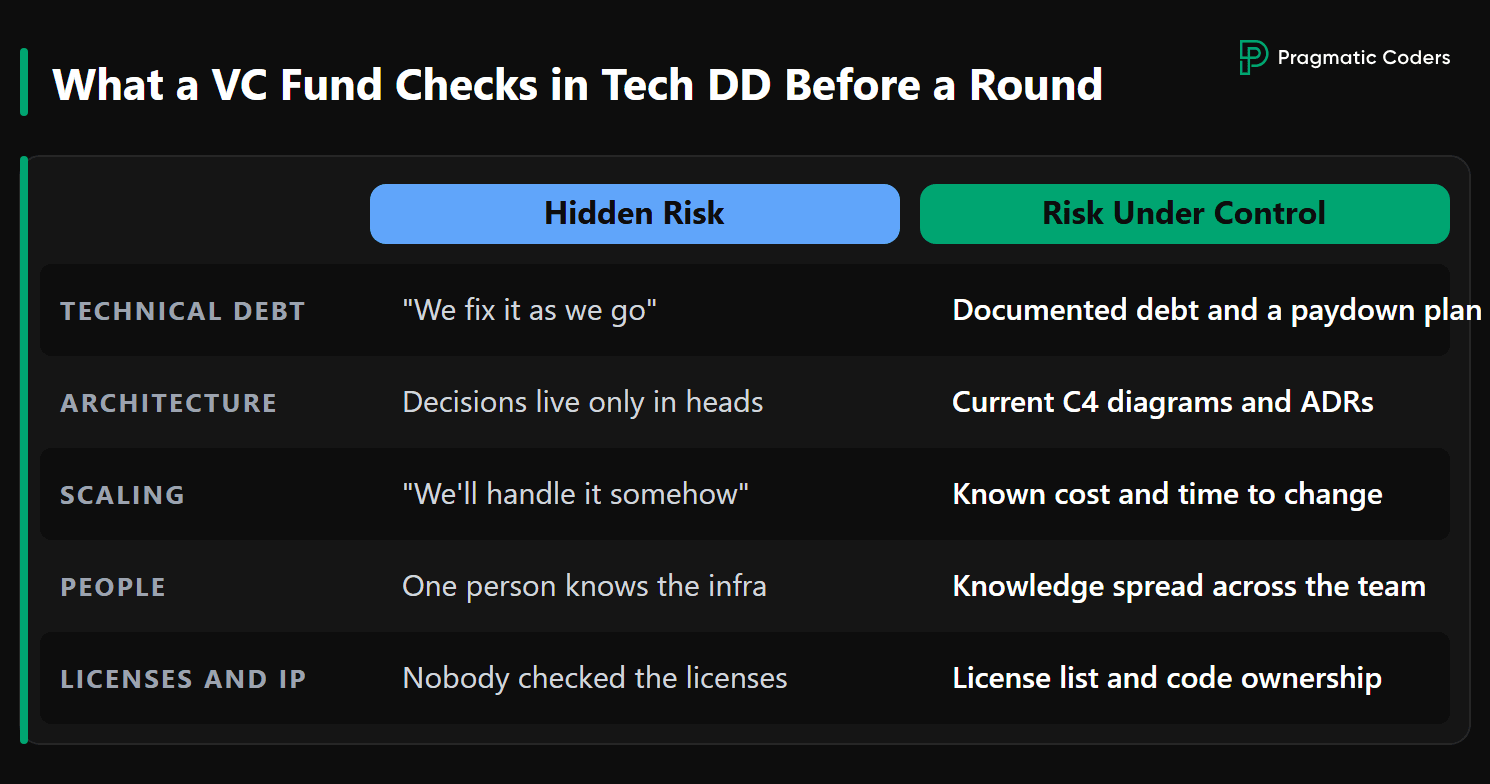
Technical Debt Without a Plan Is Not a Bug Backlog
Technical debt is not, by itself, a red flag. Every team sometimes chooses a faster solution on purpose, to test a hypothesis or ship an important feature.
The problem starts when nobody knows which parts of the system carry that debt, why it exists, and when it will start blocking development. “We fix bugs as they come up in sprints” does not show control, because bugs and technical debt are not the same thing.
A credible team can point to specific areas, the consequences of the trade-offs, and a rough paydown plan. It does not have to promise a system with no debt. It should be able to say which risk needs four sprints of work, which risks can be knowingly accepted, and which threatens the goal of the round.
Architecture and ADRs: Who Made the Decision
Missing documentation will be noted as a gap that needs explanation or action. The auditor wants to see not only the current architecture, but the reasoning behind the key decisions.
Up-to-date C4 diagrams and ADRs (Architecture Decision Records) help here: short records of architectural decisions, their context, and their consequences. They show why the team chose a given database, split the system a certain way, or accepted a particular dependency.
This is also where basic questions about infrastructure security come up: access, secrets management, internet-facing components, and known vulnerabilities. That does not automatically mean a full pentest or a compliance audit. The fund still wants to know whether basic security hygiene matches the product’s risk profile.
Can the System Support the Growth You Promised Investors
Scalability only matters in the context of the business plan. The system does not have to handle a hundred times more traffic today, but the team should know what has to change, how long that will take, and how it will affect costs.
The auditor will compare the promise in the deck with the architecture and infrastructure. They will check whether growth requires resources to scale at roughly the same pace, or drives a disproportionate increase in costs. They will also ask whether you can grow right away, or whether you first have to stop product development and spend several months rebuilding the foundations.
Bus Factor: How Many People Would Have to Leave Before the Product Stalls
The fund is also investing in the team’s ability to maintain and develop the system. If one engineer’s vacation stops deployments, the product is not ready to grow. That is true even when the code works perfectly.
That risk is what bus factor describes: how many people would have to leave before the team lost critical knowledge. The auditor may check who knows the most important parts of the system and who can recreate the infrastructure.
The point is not that everyone should know the whole system. The point is to name the places that depend on a single rockstar, and to have a plan to transfer that knowledge or hire for the missing skills.
Open Source Licenses, IP, and Vendor Lock-In
An external library or service can hide a larger cost than the technical debt in your own code. The fund will check which external libraries and services the product uses, whether they are kept up to date, which licenses apply to them, and whether the most important vendors could be replaced.
A copyleft license, including AGPL, used in a SaaS product can entail legal obligations. That is a different problem from an outdated package. Separately, you need to confirm whether the company has the rights to code written by founders, employees, and contractors. VC due diligence documentation lists IP assignment and licenses as a standing legal review area.
Vendor lock-in risk grows when a key feature depends on a single vendor, and the integration is deeply embedded across the system. An outage, a price hike, or new compliance requirements can then force an expensive rewrite of the product. External SaaS becomes risky when nobody has identified or priced in the resulting vendor lock-in.
How to Prepare Your Team and Documentation Before the Round
Your job is to have the materials prepared and make sure the team compares the state of the technology with the goal of the round. You can start the five steps below right away.
- Name the business goals that depend on the system. Specify whether the round is meant to fund hundredfold growth, a new sales channel, entry into another market, or serving large customers.
- Ask the team to assess the technology against those goals. Present the plan and ask directly what about the technology, process, and skills could get in the way. Do not just ask whether “we can handle it.”
- Have the team update the documentation. You need a picture of the current system, for example C4 diagrams, plus a list of the most important ADRs. A slide of the target architecture does not replace a description of the system as it is. If an external software house is developing the product for you, check what documentation to require from a vendor.
- Check dependencies and licenses. The team should know the versions of libraries and frameworks, their licenses, and who is responsible for updates.
- Tie infrastructure to the economics of growth. Ask for a current infrastructure diagram and a cost forecast for the goal in step one. Today’s cloud invoice on its own does not tell you much.
Your team can do this work. You do not need an outside firm to start. If the answers are incomplete, do not hide the gaps from the fund. Assign owners, estimate cost, and set the remediation priorities. A known risk with a reasonable plan is easier to defend than a surprise the auditor finds.
Assess Your Product’s Technical Health Before You Bring in Help
Check the technology itself first. Bring in outside help when the company lacks someone who can connect the review findings to cost, risk, and the plan for the round.
You can start with the free Technical Health Checklist. It covers architecture, testing, CI/CD, observability, data, and security, among other areas. Walk through it with the team before the fund’s auditor gets there. At least then you will know what the auditor will find.
If the gaps are already named, but nobody in the company can set the order of fixes or say how much each one costs and what it buys you before the round, consider technology project support. An experienced Tech Lead or Interim CTO will rank those gaps by impact on the round’s goal, show the cost and time to fix each one, and tell you plainly which gaps are worth fixing before you talk to the fund, and which can wait.
Conclusions
The fund is not assessing how clean your repository is. It is checking what delivering the growth you promise in the pitch deck will actually cost, and whether you already know that cost.
So what costs you the most is not a long list of audit notes, but a risk the fund discovers first, one nobody in the company can price. That is when you lose credibility and room to negotiate. Identify those risks earlier, compare them with the goal of the round, and decide which to reduce before diligence begins and which to knowingly accept.