AI Doesn’t Lower Code Quality. It Exposes Process Gaps
I keep hearing that AI-generated code is simply lower quality. That models produce a mess, and quality drops as the line count climbs. That is a convenient diagnosis. And usually a false one. Quality does not depend only on who wrote the code. It depends on requirements, architecture, tests, and working standards. AI speeds up implementation, but it does not automatically speed up decisions, feedback, or hypothesis validation. It does not create process gaps. It only makes their consequences surface faster.
Key Points
|
AI Moves the Bottleneck From Coding to Requirements and Decisions
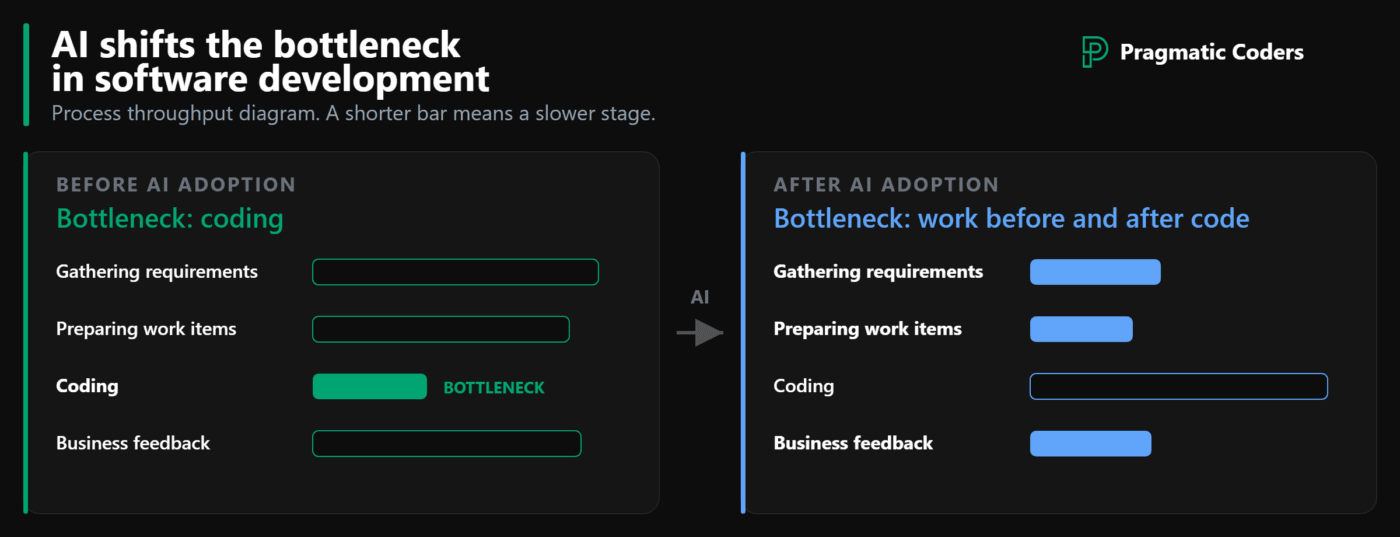
Coding stops being the main constraint. AI lets you build the next pieces of a system many times faster, so the bottleneck shifts to requirements, product decisions, and the pace of feedback. We covered that more broadly in our piece on the real constraints in AI-era delivery. Here I want to focus on something else: what that shift does to the cost of being wrong.
Same Mistake. Much Higher Cost
In the past, three user stories would grow around a wrong product assumption over two weeks. Today twenty or thirty can. Every additional feature, integration, and test starts depending on that assumption. By the time someone notices the mistake, you are no longer changing one endpoint. You are changing a whole slice of the product. The mistake stayed the same. The opportunity cost skyrocketed.
Time spent unwinding a bad direction no longer goes into product development. In that same period, far more valuable changes could have been built. So you lose more than the time it takes to fix the error. You also lose everything the team could have delivered instead.
An implementation bug hurts. It is worse when a bad product or architectural decision has already grown another layer of AI-generated code around it. That is why talking about “the quality of AI-generated code” is too narrow if it leaves out decision quality and how fast those decisions get verified.
How Refinement Shapes the Quality of AI-Generated Code
Caring for code quality has to begin before implementation — at the moment someone defines the problem you are solving and how you will know it is solved.
When coding with AI, developers rarely start from a blank prompt. The backlog has a user story and usually a few acceptance criteria. The problem is that requirements or business context are often incomplete: why the feature should exist, which exceptions apply, and what success looks like. AI will not leave those gaps empty. It will lean on what it has at hand: patterns from the codebase, similar features, and typical assumptions from training. Some of that will be sound. Some of it will miss the mark completely. During code review it is easy to overlook, because the code looks “tidy,” even though important decisions were never closed with the business.
That is why developers should not simply pick up ready-made tasks from the Product Owner. They should work with the business to lock down the feature’s goal, rules, exceptions, acceptance criteria, dependencies, and risks. Time spent on refinement should increase several times over: the faster AI codes, the more attention you need to put into preparing the work. Spec-driven development is a good example here: a precise specification comes first, and only then the code. The same specification becomes context for people and for AI agents.
Work in Small Iterations
When AI speeds up delivery, a longer sprint quickly stops matching the pace of work. There are too many changes, and review and acceptance cannot keep up. Adjust sprint length and review frequency to the new coding rhythm.
In our teams, two-week sprints stopped working. Changes piled up so fast that it was hard to discuss them sensibly in the time set aside for review. Meetings stretched to 4–5 hours. So we shortened sprints to one week. That made it easier for the business to keep up with the volume of changes shipped in a sprint.
Shorter sprints also help you spot misfired initiatives sooner. The earlier you stop them, the less it costs to unwind them. And do not keep adding features just because the team can produce them faster than the business can evaluate them.
AI Doesn’t Kill Agile
Some teams draw the opposite conclusion: if AI codes faster, why bother with sprints, reviews, and ceremonies. Just prompt and merge. That is tempting. And it usually ends in a bigger mess than before the tools arrived.
Agile was never an answer to slow coding. It was an answer to uncertainty: bad assumptions, shifting priorities, and feedback that arrives too late. AI does not remove that uncertainty. On the contrary: it speeds up the rate at which uncertainty turns into code.
After AI adoption, agile practices matter more than ever. You need short iterations, frequent feedback, the ability to reprioritize quickly, and the right to stop work before a bad decision becomes too expensive to unwind. Not because a Scrum textbook says so. Because at the new delivery pace, the only cheap moment to course-correct is still before the feature ships.
Without those practices, faster coding does not create an advantage. It only creates faster mistakes. And when code appears at that pace, agility alone is not enough: you also need quality controls that can keep up with delivery.
How to Test AI-Generated Code: System Behavior, CI/CD, and Code Review
Tests should run every time, for every new piece of code. At the pace AI enables, test automation is no longer optional – look how the costs of writing tests stack up against the cost of skipping them. Manual testing is simply too slow to keep up with the volume of changes.
Check Whether the System Does What the User Expects
Acceptance, functional, end-to-end, and integration tests deliver the most value. They verify real user paths and business rules, not only whether a single function in isolation returns the expected result. Unit tests are still needed, but they are not enough on their own. If AI writes them solely from existing code, the tests will lock in whatever is already in the implementation, including the bugs. The build will pass without raising an alarm, and the organization will get a sense of safety without real protection.
AI will help write tests. But people on the business and product side have to define what the system should do, and what it should not.
Require Solid CI/CD and Change How You Do Code Review
With AI in delivery, CI/CD with automated checks stops being a “nice-to-have.” Without it, the team cannot keep up with the pace of change: nobody will manually process that much code.
Automation will not replace code review, though. It will change its shape. In a well-tested system, review will focus on test completeness, logic, and architectural decisions. In legacy, banking, and regulated or critical systems, you will still need a deeper review of changes, and often additional audits as well.
How Good Architecture and Documentation Improve AI-Generated Code Quality
AI works best when it gets a small, unambiguous task and only the context it truly needs. Hidden dependencies, tangled modules, and undocumented rules raise the risk that a local change will break something elsewhere. A fix in one place can then topple something three directories away.
Clear ownership boundaries and smaller modules reduce that risk. AI does not then have to analyze the entire codebase on every change. A well-scoped task keeps the model inside one context instead of letting it guess at dependencies beyond the assignment.
Documenting Rules and Decisions Is Context for AI, Not Formality
Business rules, exceptions, acceptance criteria, and architectural decisions should be written down, not held only in the team’s heads. Without that, AI will reconstruct intent from the code alone and fill the gaps by guesswork. The same documentation will also speed up onboarding and reduce dependence on knowledge locked inside a few people’s heads.
In greenfield, you can build those conditions from day one. In classic legacy, you usually first have to reduce complexity, fill in tests, and put documentation in order. When the debt is systemic and continuing in the old shape becomes too expensive, a better move is to rewrite from scratch: with product knowledge, but on a new architecture.
For years, many experts advised against that kind of rewrite. Kent Beck, Robert C. Martin, and Martin Fowler said it plainly: do not rewrite a system from scratch. The risk was enormous, and the benefits uncertain. Today AI changes that: with a solid specification and modular architecture, it lets you run a rewrite at a pace previously not considered realistic. Rewriting legacy is no longer as clearly a bad decision as it once was. It can be faster and safer than continuing to patch old code.
A good example is Pragmatic Meet, our own product. The old version was a classic legacy system and increasingly hard to develop. Instead of patching it further, we rewrote the product from scratch with AI: smaller context, clear module boundaries, and spec-driven development. In our webinar on that rewrite, we show what it looked like in practice.
Check Whether Your Process Is Ready for AI
Before you judge “AI code quality,” judge the process in which that code is produced.
- [ ] Do user stories clearly describe the goal, business context, and acceptance criteria?
- [ ] Does the team spend substantially more time on refinement than it did before AI adoption?
- [ ] Are sprint length and review frequency matched to the pace at which the team ships changes?
- [ ] Can the business keep up with feedback on product changes before the team ships the next ones?
- [ ] Do acceptance, functional, end-to-end, and integration tests protect critical user paths?
- [ ] Does every code change go through CI/CD with automated checks?
- [ ] Do modules have clear boundaries, and are business rules and architectural decisions documented?
If the answer to some of these questions is “no,” the problem is not the language model. The gap is in the team’s working foundations.
What to Do Next
If the checklist above exposed gaps, address them before you roll AI out across development teams at a systemic level. Incomplete stories, thin refinement, feedback that cannot keep up, missing automated tests, weak CI/CD, and undocumented decisions are not side issues. They are the conditions under which AI either accelerates delivery or deepens the chaos.
When those foundations are in place, properly adopted AI will genuinely accelerate delivery without sacrificing quality. When they are not, adding tools alone will not fix the process. Our project rescue experts can work alongside your team to introduce and maintain the standards needed for effective AI use in software development: clear priorities, shared quality rules, automated checks, and a delivery cadence that can keep up with faster coding.
Conclusions
AI does not lower code quality by itself. It only shows whether the organization’s process can withstand faster coding: whether requirements are refined, context is written down, automated tests work, and feedback keeps up with delivery. Without those foundations, AI is just an engine powering the growth of chaos.