How to Take Over an IT Project from a Previous Vendor Effectively
Taking over an IT project from a previous vendor rarely starts with clean documentation, an organized backlog, and a stable production environment.
More often, it looks different.
There is a system that “works” – but only as long as nobody touches a few fragile elements. There is documentation, but it is fragmented or outdated. There are implemented features that work on the happy path but fail a real production test. There are business processes that were supposed to move to the new system but in practice still require the old tool. There is a client team that has heard many promises already and does not want another presentation with a recovery plan. They want to regain control.
That is why an effective project takeover is not about a new vendor “stepping in and delivering faster.”
The first goal is to understand what was actually taken over.
We do not start with development. We start by regaining control
The biggest mistake in takeover projects is that the new team tries too quickly to prove value by shipping new features.
That is understandable. The client is often under pressure. The backlog is waiting. The business wants to see progress. The previous vendor did not deliver, so the new one should “finally get things moving.”
The problem is that if the system is unstable, every new feature can increase chaos.
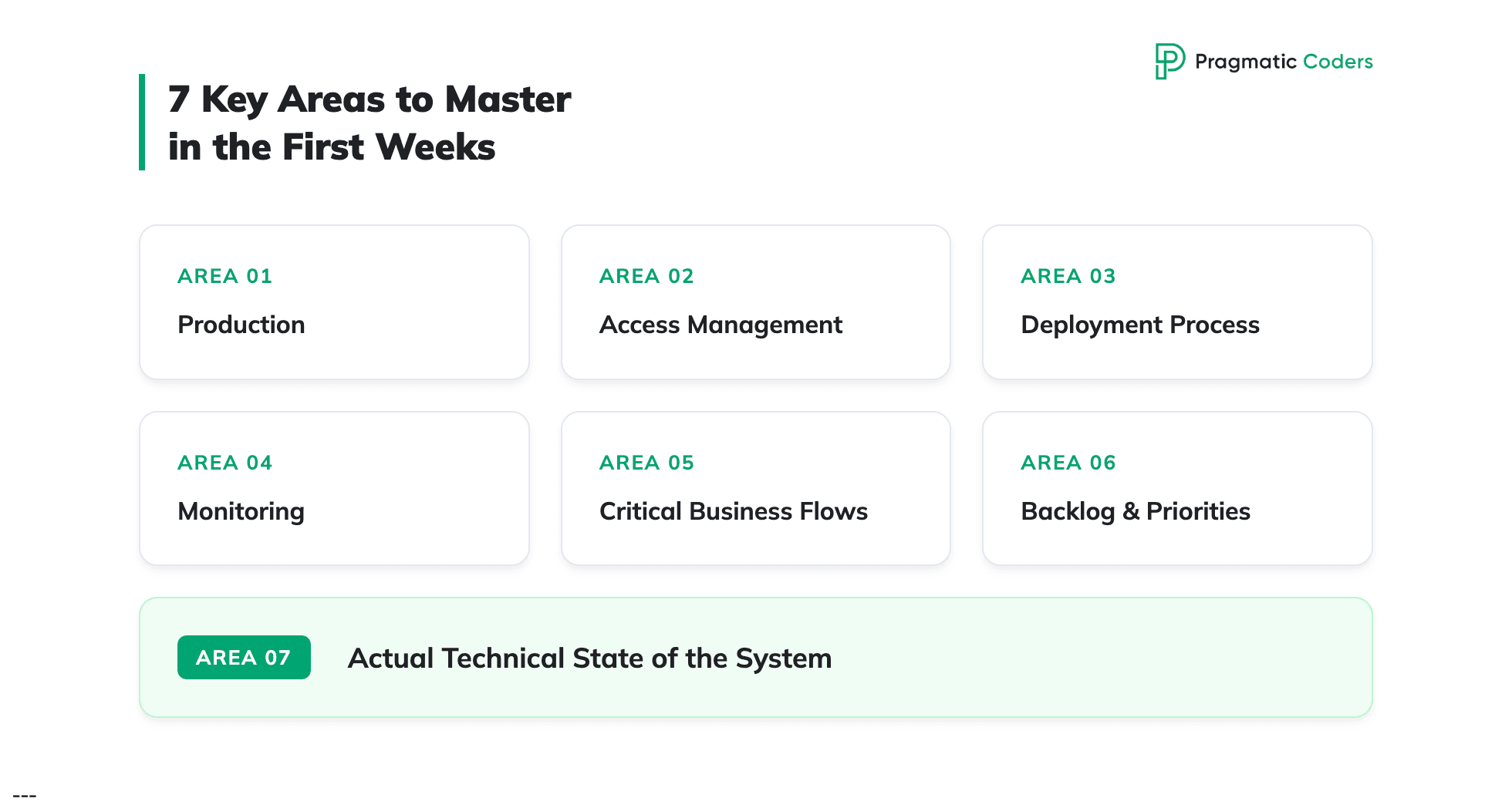
In practice, the first weeks should be spent regaining control over several areas:
- production,
- access,
- the deployment process,
- monitoring,
- critical business flows,
- the backlog and priorities,
- the real technical state of the system.
Only then can you responsibly talk about a roadmap.
Without that, a roadmap is a wish list based on incomplete knowledge.
A good takeover starts with diagnosis, but does not end with a report
A technical audit is necessary, but the report alone does not solve the problem.
In projects after a previous vendor, diagnosis must be operational. It is not just about answering: “what is wrong?” It is about answering: “what could stop the business tomorrow morning?”
That is the fundamental difference.
A report that says the system has technical debt adds little. Almost every older system has it. What matters more is identifying which elements of that debt actually block development, increase maintenance cost, or create production outage risk.
For example: missing documentation is a problem, but its business consequence is slower analysis, more expensive onboarding of new people, and greater risk of wrong decisions when making changes. Logic spread across many microservices is not just an architectural problem. It means one business change may require modifications in several places, testing many dependencies, and a larger budget. Missing monitoring is not just a missing tool. It is a situation where the team learns about an outage from users instead of detecting it earlier.
Good diagnosis translates technology into business consequences.
You need to separate three things: stabilization, development, and debt reduction
In a taken-over project, everything competes for the same team time.
The business wants new features. Operations reports bugs. Developers see technical problems. Stakeholders ask about deadlines. The client wants cost predictability.
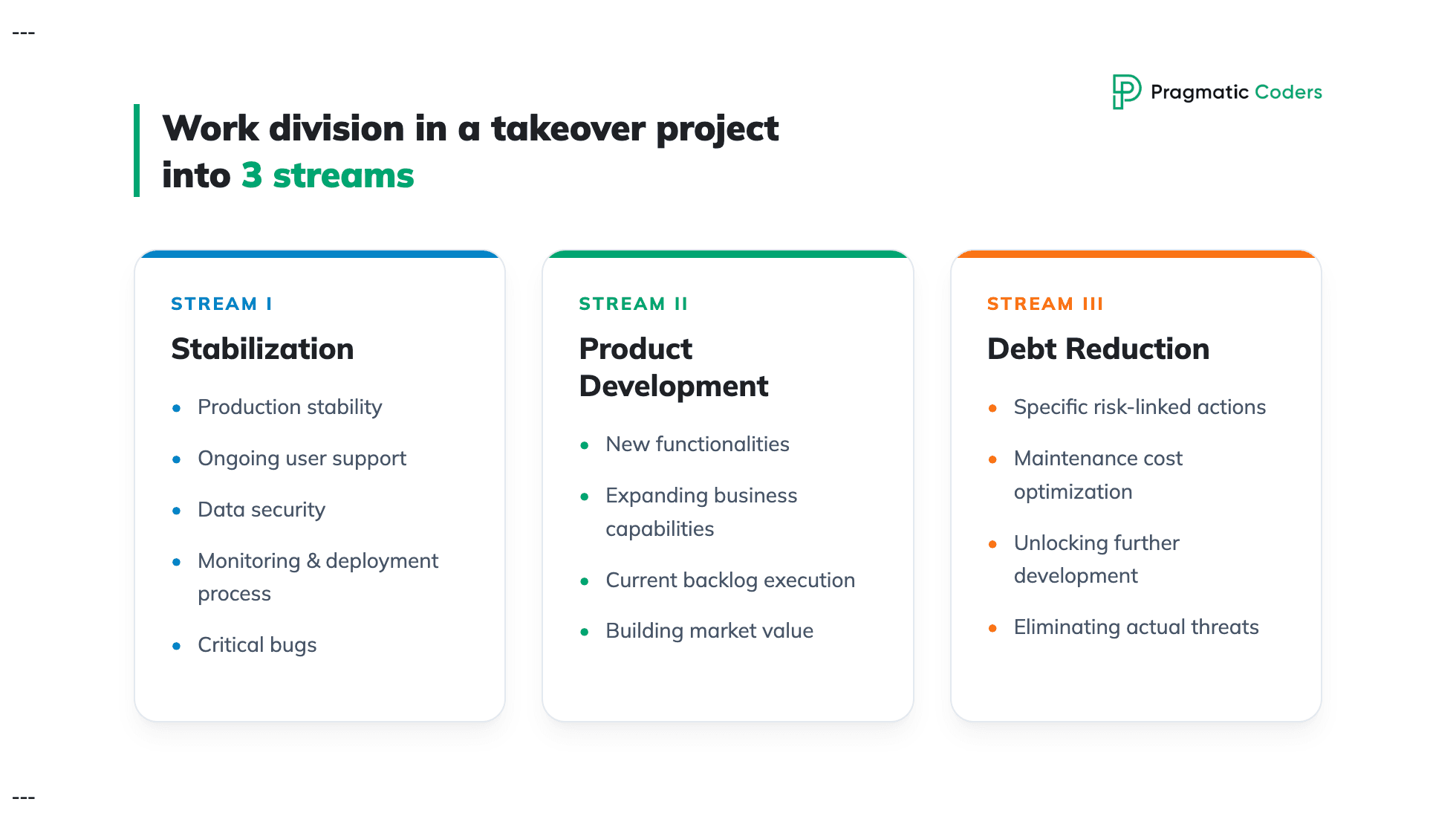
That is why it is worth splitting work into three streams.
- The first stream is stabilization. This is where things go that affect production operation, user support, data security, monitoring, the deployment process, and critical bugs.
- The second stream is product development. This is where features go that genuinely expand the system’s business capabilities.
- The third stream is technical debt reduction. Not as abstract “refactoring,” but as concrete actions tied to risk, cost, or the ability to keep developing.
This separation matters because it allows an honest conversation with the client.
Not every day of team work will mean a new feature. Sometimes the greatest value is removing a risk that in a month could stop operations or double the cost of the next change.
Transparency must be greater than in a normal project
In a takeover project, trust is usually lower. The client has a difficult experience behind them. They have often already heard “just a little longer,” “it is almost ready,” “the problem is on the infrastructure side,” or “it is just a small fix.”
The new vendor should not try to win this situation with declarations.
They should win it with transparency.
That means very concrete practices:
- all work visible in Jira or another tool,
- separate labeling of incidents, hotfixes, and development work,
- regular communication about risks,
- clear visibility into how much time outages consume,
- documenting technical and product decisions,
- short, frequent demos instead of big presentations once a month,
- joint prioritization with the business.
Transparency is not about producing long status updates. It is about the client understanding where the budget goes and why a given decision makes sense.
In the first weeks, you need to build a map of the system
In many taken-over projects, documentation does not describe the real system. Sometimes it describes the planned state. Sometimes fragments from several months ago. Sometimes it does not describe the most important exceptions, because those were known only to the previous team.
That is why one of the first tasks should be creating a practical map of the system.
This is not academic documentation. It is about answering questions such as:
- which processes are critical for the business,
- which components participate in those processes,
- where the failure points are,
- which data has a single source of truth and which is duplicated,
- what the deployment process looks like,
- how to reproduce a production problem,
- which features are complete and which are only partially implemented,
- which elements still depend on the old system,
- where tests, monitoring, or logs are missing.
Such a map quickly changes the conversation with the client. Instead of a general “the system is complicated,” you can say: “this process is risky because it depends on three services, has no monitoring, and in case of failure we have no automatic state recovery.”
That is concrete.
Not everything needs to be fixed right away
A project takeover easily turns into an endless renovation.
The technical team sees bad practices, workarounds, unreadable code, missing tests, inconsistent naming, manual deployment processes. The natural reaction: this needs to be fixed.
But the client is not paying for technical elegance. The client is paying to regain control over the product and the ability to develop the business safely.
That is why every larger fix should pass through a filter:
- Does this reduce operational risk?
- Does this lower the cost of future changes?
- Does this shorten incident response time?
- Does this unblock an important business direction?
- Does this improve data quality or operational decisions?
If the answer is “no,” it is probably not a priority for the first phase of the takeover.
First, you fix what stabilizes the system and increases predictability.
The client needs a plan – but a plan with boundary conditions
After diagnosis, you need an action plan. It cannot, however, be a classic feature roadmap for several months, detached from the state of the system.
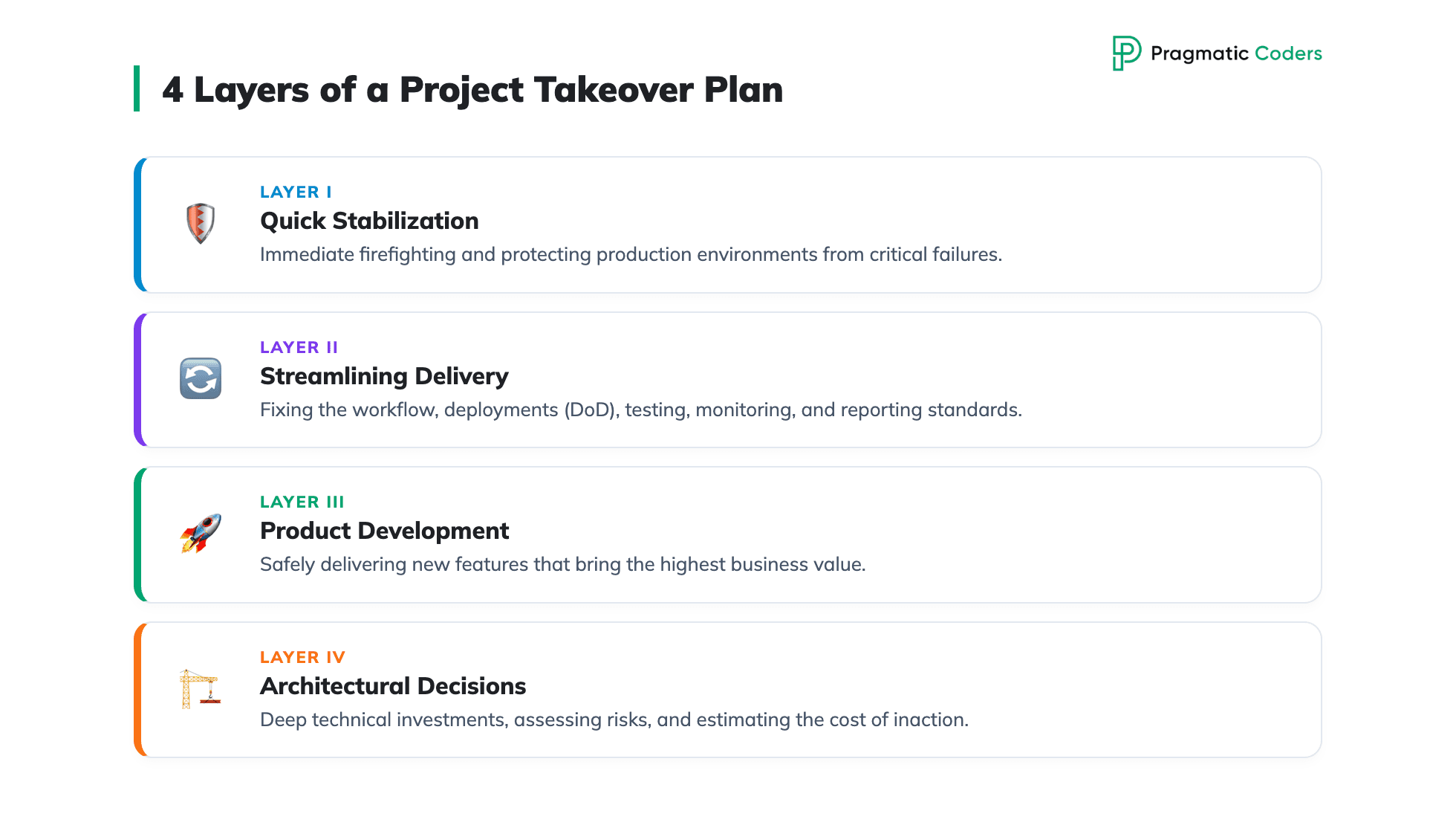
A good takeover plan should have layers.
- First layer: quick stabilization actions. What we do immediately to reduce outage risk and improve production support.
- Second layer: organizing the delivery process. How we change workflow, definition of done, tests, environments, monitoring, deployments, and reporting.
- Third layer: product development. Which features have the greatest business value and when they can be implemented safely.
- Fourth layer: architectural decisions. What requires greater investment, what the alternatives are, what the cost of not making changes is, and what risk is accepted.
This matters because in a taken-over project, not every decision is “do we want this feature?” Often the decision is: “do we accept continuing to develop the product on an unstable foundation?”
The best vendor does not promise miracles. They provide control.
In rescue and takeover projects, the client often wants to hear that things will now be faster, cheaper, and simpler.
A good vendor should not promise that too early.
An honest answer is: first we need to regain control over the system, then we can increase pace.
That is not hedging. That is responsibility.
An effective takeover of a project from a previous vendor requires technical, product, and communication skills at the same time. You need to be able to read code, but also understand the business process. You need to be able to name technical debt, but also translate it into risk and cost. You need to be able to tell the client that the next feature should wait if shipping it could worsen system stability.
The greatest value of a good takeover is not that after two weeks everything looks better in a presentation.
The greatest value is that after a few weeks the client knows:
- what they have,
- what works,
- what does not work,
- what is risky,
- what needs to be fixed,
- what it may cost,
- and what decisions they need to make.
Only then does the project stop being a black box.
And that is the first condition for it to become a product that can be managed consciously again.
Want to quickly see what you actually took over?
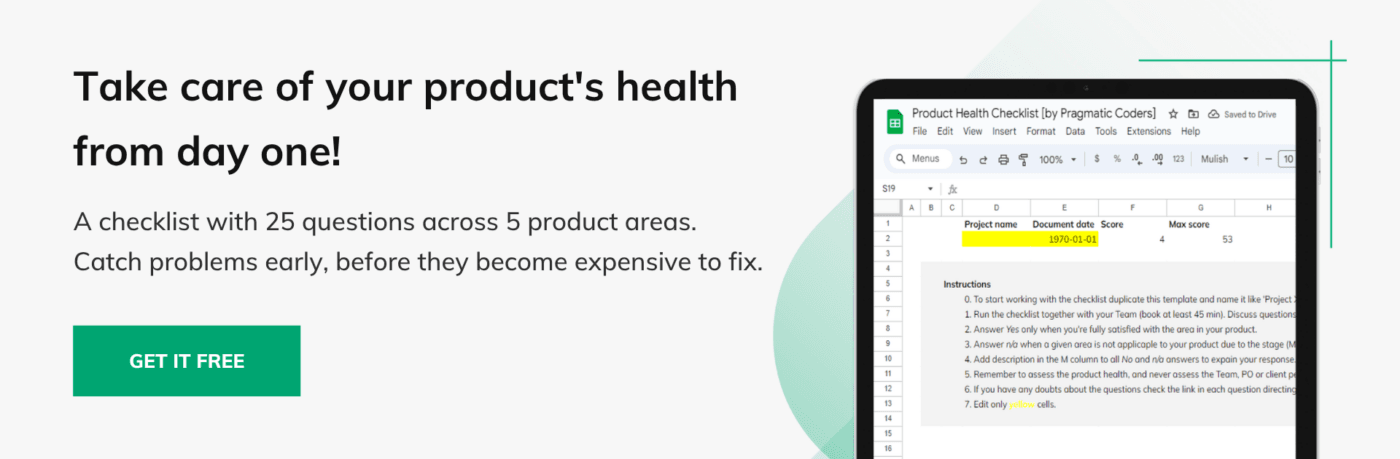
Diagnosis in a takeover project covers not only code, but also product strategy, discovery, delivery, stakeholder alignment, and how the team works. The Product Health Checklist is 25 questions across 5 areas – each with verification criteria and named risk, helping you turn a vague “something is off here” into concrete gaps to discuss with the client.
Download the Product Health Checklist and go through it with your team in the first week of the takeover.