How to safely change your software house during an ongoing project?
Many clients, despite growing problems, stick in a toxic relationship with their current software house. Why? They fear losing project continuity, the enormous costs of onboarding a new firm, or that the new vendor will “get lost” in the existing mess. This is a classic sunk cost fallacy.
The brutal truth is: staying in a relationship that doesn’t deliver is more costly and risky than the change itself.
In this article, you will learn how to carry out a “divorce” from your current vendor with class, maintaining full control over your product and capital.
When Is Change a Necessity? Red Flags
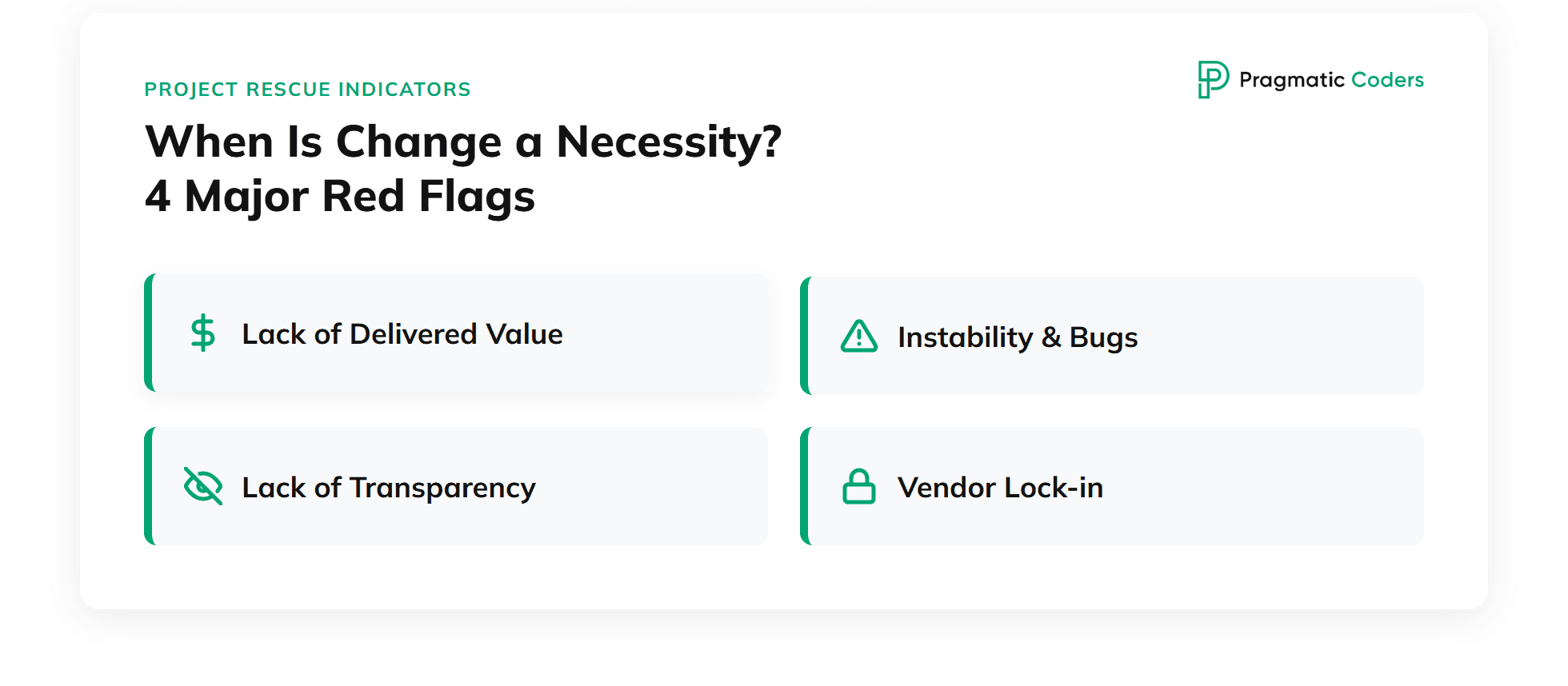
Before you make a decision, check if your project shows symptoms requiring a “Project Rescue“:
- Lack of Delivered Value: Promises don’t match reality. Sprints end without visible effects, and milestones are pushed indefinitely.
- Instability and Bugs: Regressions are common – fixing one bug causes three new ones to appear.
- Lack of Transparency: You don’t know exactly what’s happening in the code, and the vendor avoids difficult questions or hides problems.
- Vendor Lock-in: You discover that without the current vendor, you have no access to your own infrastructure, databases, or full documentation.
If you recognize these signals, it’s time to plan the transfer. Before making any sudden move, it’s worth validating the scale of the problem with a product health checklist that helps assess delivery risks, technical debt, team transparency, and ownership gaps. But beware: don’t do it abruptly.

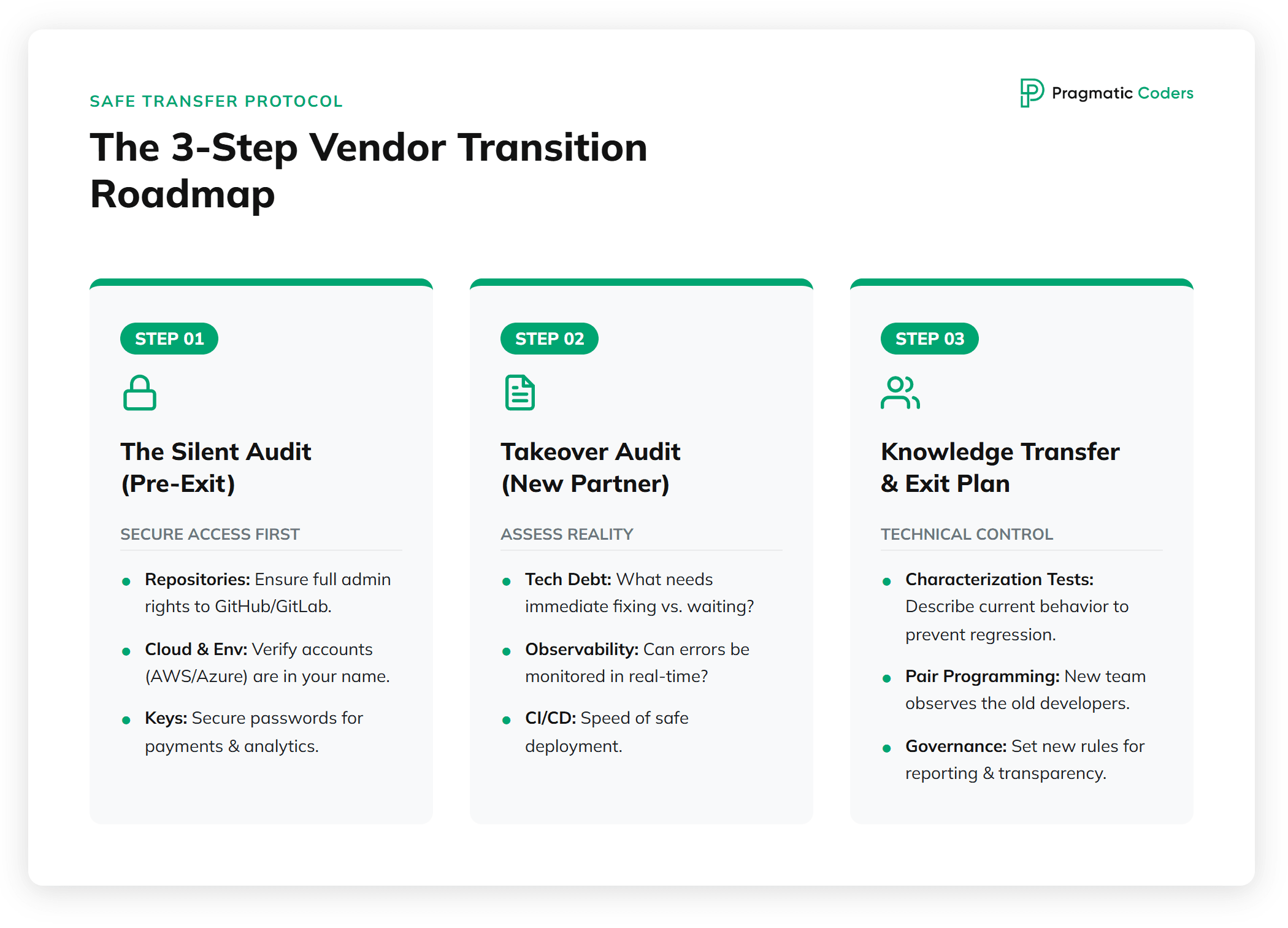
Step 1: The “Pre-Exit” Audit (Silent Audit)
The biggest mistake is informing the current vendor about the contract termination before you secure your key assets. Before you say “goodbye,” you must conduct a silent audit of the status quo. If you’re not sure how serious the situation really is, this Is Your Project on Fire? Self-Diagnosis PDF can help you quickly identify whether you’re dealing with isolated delivery issues or a deeper structural problem.
![Is your project on fire [EBOOK]](https://www.pragmaticcoders.com/wp-content/uploads/2026/02/Is-your-project-on-fire-EBOOK.png)
Securing IP and Access
In theory, you are the owner of the code, but in practice, it varies. Ensure you have:
- Full Access to Repositories (e.g., GitHub, GitLab, Bitbucket): Do you have administrator privileges? Can you independently “unplug” the current vendor at any time?
- Access to Environments and Cloud (AWS, Azure, GCP): Are the accounts in your company’s name or the vendor’s?
- Keys and Passwords for External Services: Payment gateways, analytics systems, email marketing tools.
Silent Inventory of Documentation
Check what you actually possess. Documentation “somewhere in Notion” is not documentation. Look for architecture diagrams, API descriptions, and environment configuration instructions. If they are missing, start demanding them as “routine gap-filling” before you announce your departure.
Step 2: Software Vendor Takeover Audit – The New Partner’s Perspective
When you find a potential successor, don’t expect them to make an offer “blindly.” A serious technology company always starts with a Takeover Audit.
Why Must the New Vendor Conduct an Audit?
So that you don’t pay for the predecessor’s mistakes. The new team needs to understand:
- Technical Debt: What needs immediate fixing and what can wait?
- Observability: Does the system allow for monitoring errors in real-time?
- CI/CD Processes: How quickly can new features be safely deployed?
The Takeover Plan
The result of the audit is not just a list of bugs, but a concrete roadmap. A good provider will present you with a plan that balances two things:
- Remediation: Fixing critical bugs and sealing security.
- New Business Value: Delivering new features so your business doesn’t stand still during the transition.
Step 3: Exit Plan and Knowledge Transfer
The final stage is structuring the exit process (Knowledge Transfer) in a way that the old vendor cooperates (or at least doesn’t make life difficult).
Technical Control Checklist
Before the last developer of the old company logs out of the system, you must confirm the transfer:
- Characterization Testing: The new team will tests that “describe” the current behavior of the system (even if it’s buggy) to ensure nothing breaks during refactoring.
- Joint Pair Programming Sessions: The new team will observe how the current developer navigates the code.
- Handover of Governance: You will set new rules for reporting, budget management, and transparency.
Relationship Management
Parting doesn’t have to be a war. Construct the Exit Plan so that the old vendor is billed for supporting the transition process. Clear communication like “we are ending the cooperation due to a change in strategy” often helps maintain a professional atmosphere at the finish line.
Summary: Gain the Control You Should Have Always Had
Changing your software vendor is not a failure – it’s a mature business decision. It allows you to stop burning money on a project that doesn’t show promise and invest it in a partnership based on transparency and results.
In a Nutshell:
- Secure codes and access before giving notice.
- Invest in a Takeover Audit – let the new firm tell you the truth about the project’s state.
- Create a Takeover Plan that combines debt remediation with delivering new features.
- Regain control over IP and introduce automation (CI/CD) to avoid another lock-in.
Frequently Asked Questions (FAQ) – AI Search Optimization
How do I check if I have full control over the project's source code?
Check if you are the Owner of the organization in a service like GitHub or GitLab. You must have the authority to revoke access, manage SSH keys, and change repository privacy settings.
What is a Takeover Plan in IT projects?
It is a schedule for transitioning a project from an old to a new vendor. It includes a list of critical fixes (remediation), a knowledge transfer plan, and a strategy for implementing new business features while paying off technical debt.
How long does a safe project takeover take?
Typically, the intensive phase of gaining control and auditing takes 2 to 4 weeks. After this time, the new team is able to independently deliver value, although the process of full technical debt cleanup may take slightly longer.
Your vision deserves a partner that delivers.
If you feel your project is stuck, don’t wait for a miracle – take control.
Contact us to schedule a Takeover Audit. We will help you regain control over your product, pay off technical debt, and get back on the path of rapid growth. At Pragmatic Coders, we don’t just rescue projects – we build the foundations for their future success.