IT Project Delays: A Framework for Exec Talks
Project problems are common enough that every software manager will eventually face one. Velocity slips for a few sprints. A deadline that once felt comfortable starts to look tight. Questions come up that you can’t answer with confidence. Nothing has failed yet, but the patterns are worrying. You’re unsure whether to raise it now or wait for more clarity.
You’re not alone. Large IT projects run 45% over budget and 7% over time on average, while delivering 56% less value than expected. These conversations happen all the time. The difference isn’t whether problems appear, but how they’re communicated. Too often, managers wait until the situation is obvious, then approach defensively, trying to justify delays instead of enabling decisions. Raising issues earlier and framing them correctly leads to better outcomes.
In this article, I offer a structured way to communicate project problems while preserving your credibility. I’ll explain what decision makers actually expect, how to frame issues without losing trust, and how to propose responses that match the severity, including when an independent audit makes sense.
Key Points
|
Why Staying Silent About IT Project Problems Is Riskier Than Speaking Up
Hesitation is natural, but delaying the conversation usually makes things worse.
Your fears are real. Will the project get cancelled? Will heads roll? What happens to your team, your bonus, your next promotion? I get it. But poor communication is a leading cause of project failure. Silence doesn’t protect you. It just delays the reckoning while problems compound.
There’s no script that guarantees a positive outcome. But a well-prepared conversation beats improvisation every time.
What Decision Makers Really Want When You Report Project Problems
Execs want to understand the situation well enough to act. They don’t want technical excuses or premature reassurance.
Remember: you’re not there to justify delays. You’re there to deliver the information executives need to make a decision. They want to know what’s actually happening, what the risks are, and whether someone competent is handling it.
What they actually expect comes down to three things. First, clarity about what’s happening. Not spin, not hedging, just a clear picture of the current state. Second, a shared understanding of the risks involved. They need to know what could go wrong and how likely that is. Third, a sense that the situation is being handled responsibly. They want to see that someone competent is on top of it.
What they don’t want is equally important. Deep technical justifications waste their time and signal that you’re deflecting. Optimistic assurances that paper over real problems erode trust when reality catches up. Vague status updates without actionable insight give them nothing to act on.
Professional communication frameworks consistently highlight three qualities that separate credible updates from damage control: transparency about the situation, accountability for the path forward, and solution-oriented framing. Leading with these qualities demonstrates the kind of ownership that builds trust.
How to Frame IT Project Problems Without Losing Credibility
The four-part talk works best when you already know where the strain shows up: roadmap, ownership, quality signals, or stakeholder alignment. Use the Product Health Checklist to pressure-test those areas before you walk into the room.

A simple, fact-based structure helps you communicate without self-sabotage. Your goal is to give decision makers a clear picture of reality they can act on.
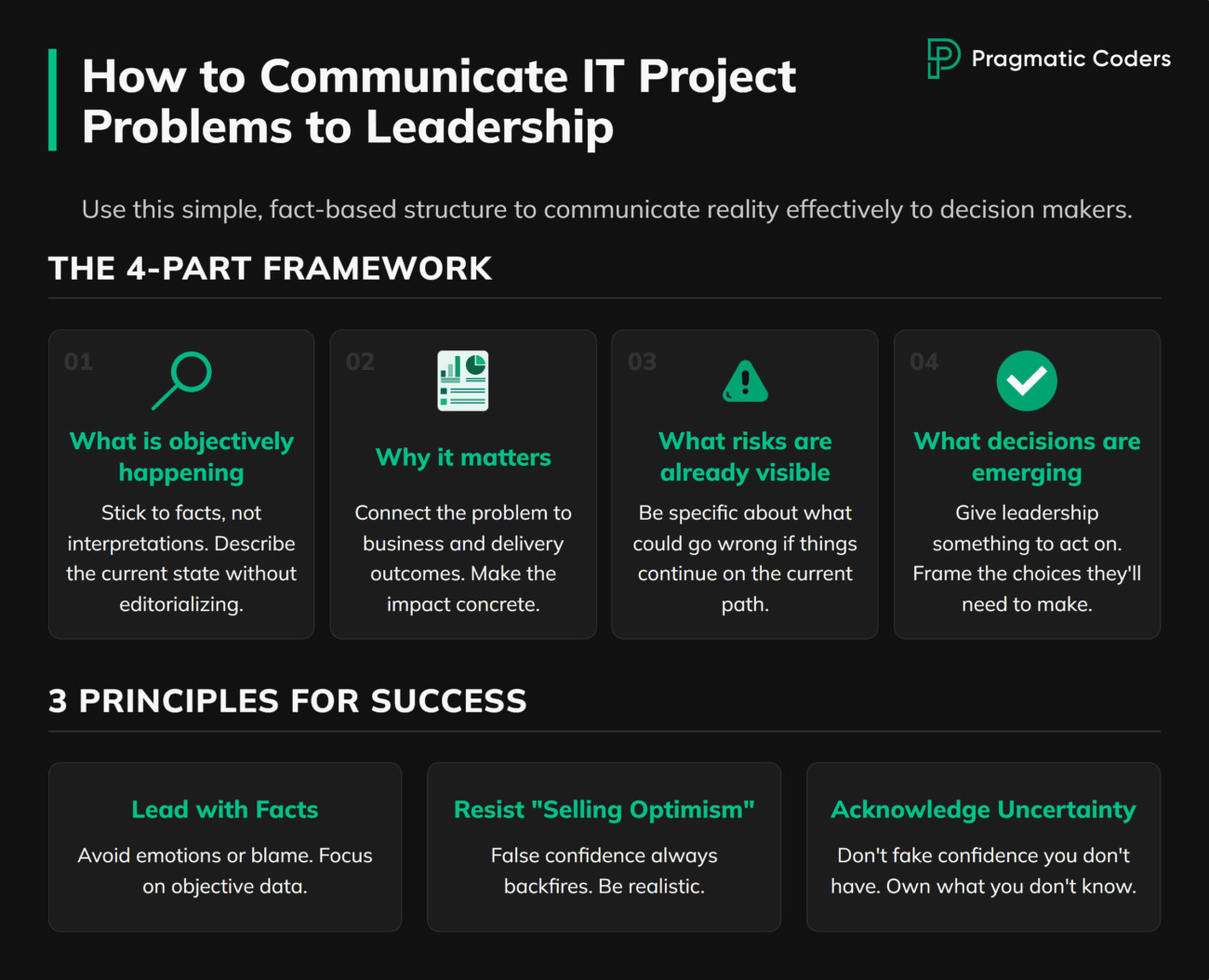
Use this four-part framework to structure the conversation:
- What is objectively happening. Stick to facts, not interpretations. Describe the current state without editorializing.
- Why it matters. Connect the problem to business and delivery outcomes. Make the impact concrete.
- What risks are already visible. Be specific about what could go wrong if things continue on the current path.
- What decisions or trade-offs are emerging. Give leadership something to act on. Frame the choices they’ll need to make.
Three principles make this framework work. Lead with facts, not emotions or blame. Resist the urge to “sell optimism” because false confidence always backfires. And acknowledge uncertainty where it exists. Don’t fake confidence you don’t have.
Example: What This Sounds Like in Practice
Over the last two sprints, delivery has slowed by about 20 percent, and the remaining scope is no longer aligned with the original timeline. The immediate impact is that the current release date is at risk. If we continue on the current path, the most likely outcome is a four-to-six-week delay.
We see two viable options. We can reduce scope and preserve the date, or we can keep the scope and accept a later release. We’re working to stabilize delivery either way, but I want to align on which trade-off makes sense before we commit further.
Responding to IT Project Problems: What to Propose at Each Severity Level
Executives expect you to come with options, not just complaints. But the proposed response has to match the actual severity. Overreacting looks as bad as underreacting.
Early Warning: Manageable Risk
At this level, the project is under strain but not yet endangered. You might see delivery slowing down, predictability slipping, or quality signals deteriorating. But the fundamentals still appear sound.
The right response here is incremental. Propose tighter reporting and increased transparency so decision makers can track progress more closely. Focus improvements on common problem areas: automated testing, CI/CD reliability, infrastructure stability, or unclear ownership.
The message you’re sending: “We see early risk and we’re addressing it before it compounds.” This shows awareness and proactive management.
Serious Risk: Decisive Intervention Needed
At this level, the project shows clear signs of poor health. Delays are compounding. Confidence is eroding. Different stakeholders have conflicting views of what’s actually happening. Incremental fixes are unlikely to be enough.
Two responses make sense at this level. The first is to pause feature development and redirect the team’s effort toward identifying and fixing the underlying problems. This works when the root causes are already understood and the team has the capacity to address them. The risk is that the same dynamics that allowed the situation to develop may still be in play. Internal efforts can miss blind spots or underestimate systemic issues.
The second option is to commission an independent, structured audit, bringing in an outside team to diagnose root causes, identify material risks, and assess whether recovery is realistic. This brings fresh perspective and removes the pressure of self-assessment.
This 5-step playbook for stabilizing troubled projects can help you understand what intervention looks like in practice.
Critical Situation: Viability in Question
This is the hardest scenario to navigate. It’s often faced by managers who are new to the project or overseeing an external vendor. The situation may have been obscured, intentionally or not. The current trajectory suggests the project may not succeed at all.
Here, the most responsible options are stark: stop the project outright, or commission a deep diagnostic audit to determine whether it’s salvageable. The auditors aren’t there to save the project. They establish, without sugar-coating, what a realistic recovery would require and whether continuing the investment makes sense.
The stakes at this level are real. 17% of large-scale IT projects are so troubled they threaten the very existence of the company.
If you are not sure whether this is “early strain” or a real crisis, pause. Is your project on fire? Self-diagnosis walks through warning signs in plain language. It does not replace your exec framework, but it can help you pick the right severity and options.
![Is your project on fire [EBOOK]](https://www.pragmaticcoders.com/wp-content/uploads/2026/02/Is-your-project-on-fire-EBOOK.png)
After the Executive Conversation: From Alignment to Action
Once decision makers are aligned on the situation, the focus shifts to execution. What happens next depends on the severity level you’ve established.
Early Warning: Deliver What You Promised
The path is straightforward: implement the improvements you proposed, track progress against clear metrics, and report back at the cadence you agreed on. The conversation was about getting visibility and buy-in. Now you deliver.
Serious Risk: Act Thoughtfully
The decision determines the next step. If you’re pausing to fix internally, define success criteria and a timeline for reassessment. If you’ve agreed to bring in outside help, move quickly. Delays at this stage compound the problems you’ve already identified.
Critical Situation: Act Decisively
If the decision is to stop, manage the wind-down responsibly. If it’s to commission a diagnostic audit, you bring in an outside team to establish why the project derailed, identify real risks, and clarify viable options. The goal is evidence to base decisions on, not a promise to save the project.
At Pragmatic Coders, we have over 11 years of experience diagnosing troubled software projects in exactly these moments. Our rescue services help leadership understand what’s truly happening before making irreversible decisions.
Conclusion
Communicating IT project problems to executives is high-stakes, but it’s manageable with the right structure. Focus on enabling decisions rather than justifying the situation. Frame facts without blame. Match your proposed response to the severity.
The conversation itself is only the first step. Once alignment is in place, execution determines the outcome. Whether that means delivering on incremental improvements, pausing to fix root causes, or commissioning an independent audit, the key is moving from talk to action with clear criteria for success.
Is that conversation still ahead of you and you’re not sure where to start? Document the facts using the framework from this article. If the situation is serious, consider an outside partner to help you diagnose. Get in touch, we’ll help you prepare.