9 ‘Minimum’ Product Frameworks for 2026 Explained (MVP, MLP, MMP, MAC…)
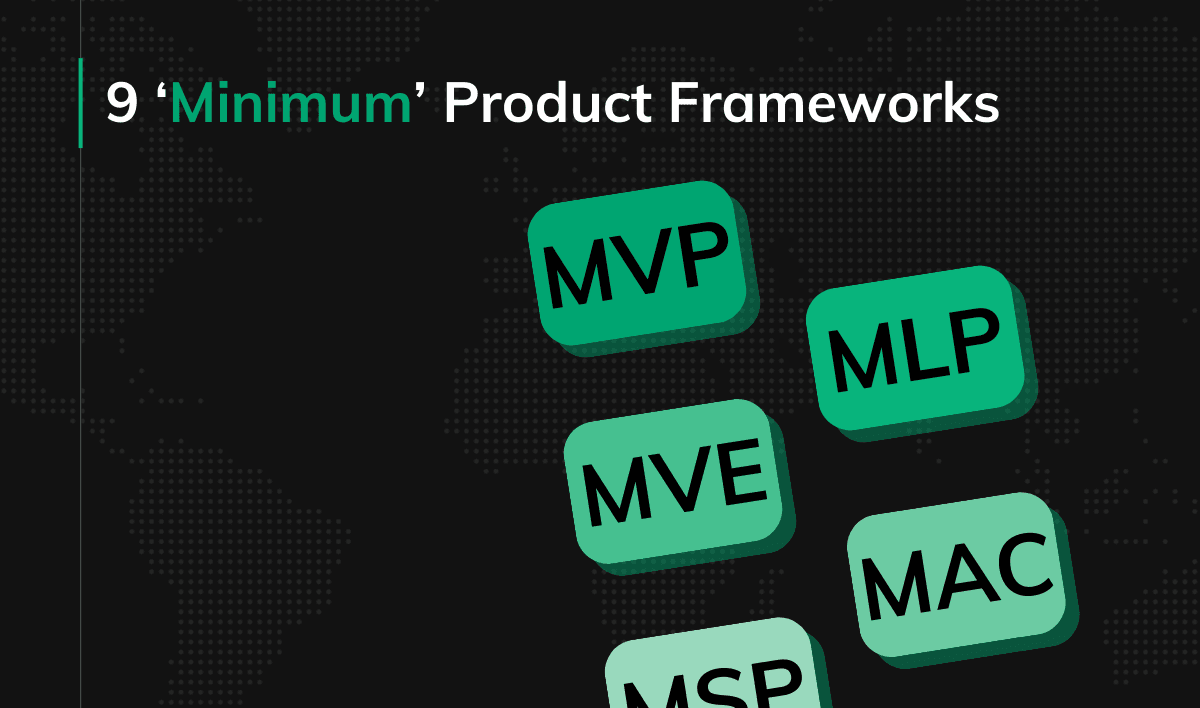
If you’ve been in product management for more than five minutes, you’ve likely felt the acronym fatigue. It started with MVP (Minimum Viable Product) – the gold standard for years. But recently, the “minimum” family has exploded. We now have MLP (Minimum Lovable Product), MMP (Minimum Marketable Product), MAC (Minimum Awesome Component), and even RAT (Riskiest Assumption Test).
Why do these frameworks keep multiplying? Because in 2026, “viable” is a dangerously low bar.
We are building in an era of AI-native products, agentic workflows, and lightning-fast release cycles. The cost of building software has dropped to near-zero, but the cost of getting attention has skyrocketed.
- If you launch a “bare bones” MVP for an AI agent, users will trust it once, get a hallucination, and never come back.
- If you launch a generic MVP in a crowded market, you’ll be ignored.
Choosing the wrong starting point isn’t just a semantic error; it’s a strategic one. By the end of this guide, you won’t just know what these acronyms stand for – you’ll know exactly which one to use to avoid burning months of runway on the wrong type of “minimum.”
The Problem With ‘Just Build an MVP’
For a long time, “MVP” was the answer to everything.
- “We need to test this new feature.” -> “Build an MVP.”
- “We need to launch a new product line.” -> “Start with an MVP.”
- “We need to see if people will buy this.” -> “MVP it.”
The problem is that MVP became a catch-all phrase for “the first version.” It lost its nuance. Teams started using MVP to describe everything from a non-functional prototype to a fully polished V1 that just lacked a few bells and whistles.
The Cost of Being Wrong
Using the wrong “minimum” leads to specific, expensive failures:
- The “Too Big” Failure: You build a scalable backend for a product nobody wants. (Should have used RAT).
- The “Trust” Failure: You launch a buggy AI tool to prove it “works,” but users churn because they don’t trust the output. (Should have used MVE).
- The “Indifference” Failure: You launch a functional product in a Red Ocean market, and nobody cares because it lacks a “wow” factor. (Should have used MAC).
- The “Revenue” Failure: You build a functional product to test viability, but stakeholders judge it on revenue, which requires a Marketable Product. (Should have used MMP).
To fix this, we need to unbundle “MVP” into three distinct categories: Validation, Build, and Commercialization.
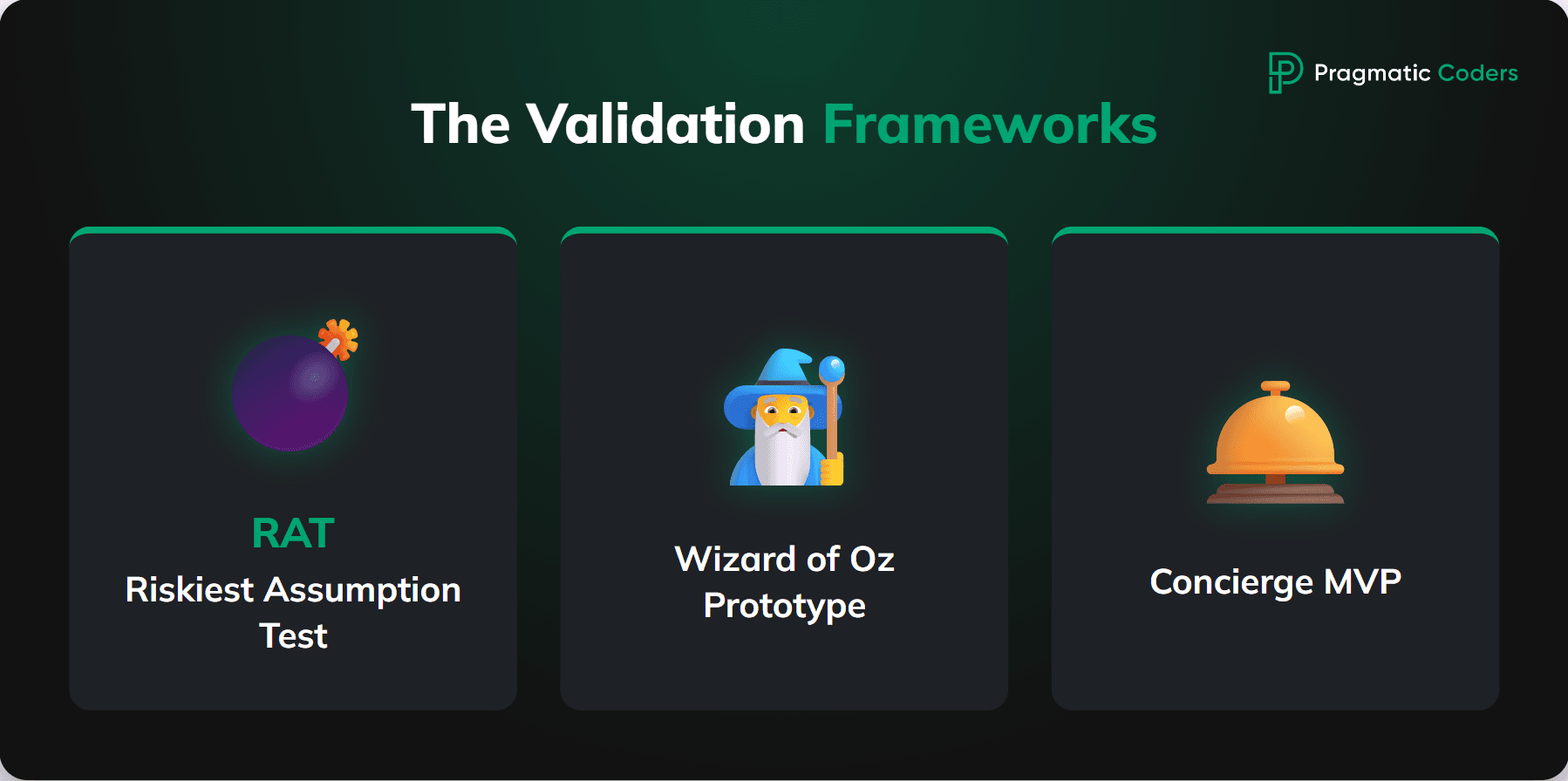
The Validation Frameworks (Before You Write Code)
Goal: Learn if you should build it. Speed: Hours to Days.
Sometimes, building any product is a waste of time. These frameworks help you test assumptions without engineering.
1. RAT – Riskiest Assumption Test
What it is: A test focused solely on the one thing that could kill your business. It is not a product; it is an experiment.
Best for: Very early-stage validation where the risk is “Will they want it?” not “Can we build it?”
The Method: Identify your riskiest assumption (e.g., “People will pay for this”). Design the smallest experiment to test only that.
Example: Instead of building a full course platform, run a Facebook ad to a landing page. If nobody clicks “Buy,” you saved yourself 3 months of recording videos.
⚠️ Cost of Being Wrong: If you skip this and build the product, you risk solving a problem nobody cares about.
2. Wizard of Oz Prototype
What it is: A product that looks automated on the outside, but is operated by humans on the inside.
Best for: Testing complex AI or algorithmic products without building the tech first.
Why it matters for 2026: AI development is expensive and non-deterministic. Before you spend months tuning a model, be the model yourself.
Example: You promise an “AI Scheduler.” Users email you their availability. You manually check their calendar and send the invite. To them, it feels like magic. To you, it’s manual labor—but it proves the value.
⚠️ Cost of Being Wrong: If you build the AI first, you risk spending months engineering a solution for a workflow that users don’t actually want.
3. Concierge MVP
What it is: You manually deliver the service to a few customers, with no product interface at all. The user knows it’s you, and they pay for the outcome.
Best for: High-touch B2B services where you need to learn the workflow.
Difference from Wizard of Oz: In Wizard of Oz, the user thinks it’s automated. In Concierge, the user knows it’s a service.
Example: A founder personally managing onboarding and configuration for early clients to understand their pain points before automating the process.
⚠️ Cost of Being Wrong: If you automate too early, you risk baking bad processes into code.
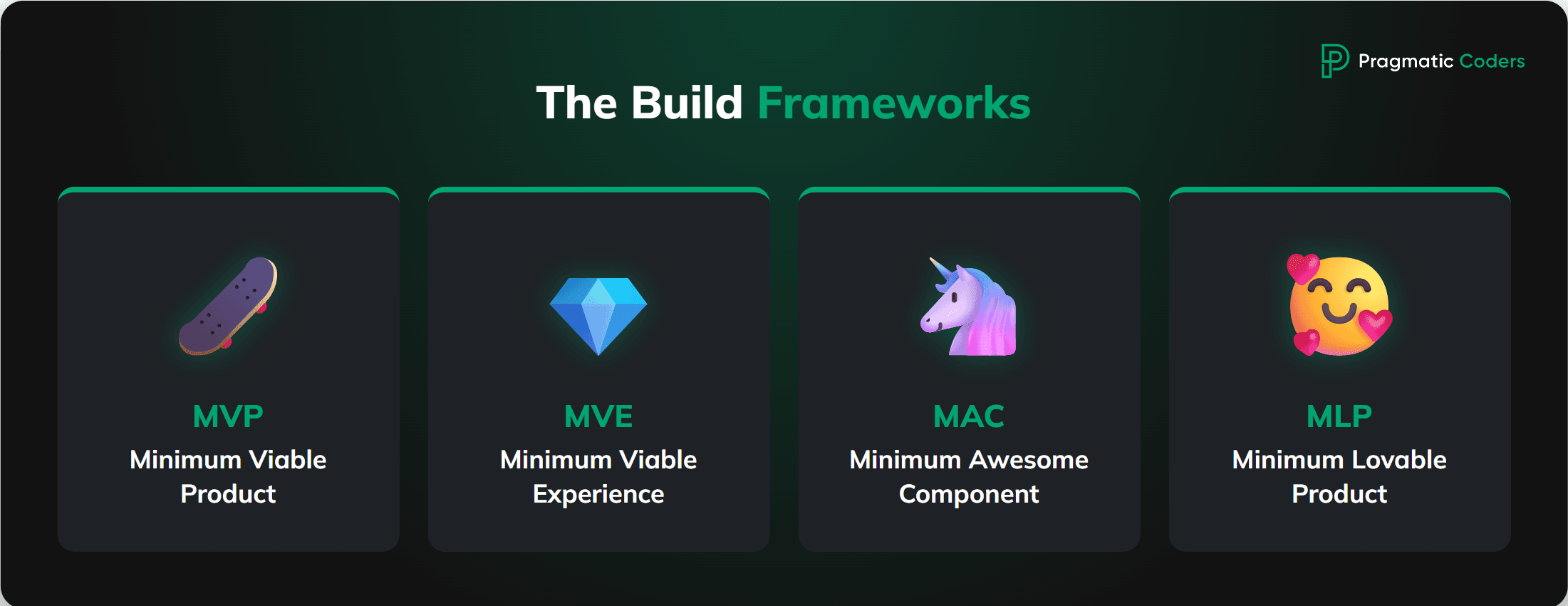
The Build Frameworks (What You Actually Code)
Goal: Build the right thing for the market context.
Speed: Weeks to Months.
This is where most confusion happens. Let’s distinguish them using a Travel App as a running example.
4. MVP – Minimum Viable Product
What it is: The smallest version of a product that can prove or disprove a specific hypothesis about value.
Focus: Functionality & Learning.
Best for: Validating if the product should exist in a Blue Ocean (new) market.
Travel App Example: A simple form where users input dates and get a list of 5 flights. It’s ugly, but it proves people want flight data.
⚠️ Cost of Being Wrong: If you use this in a crowded market, users will ignore you for being “too basic.”
5. MVE – Minimum Viable Experience
What it is: A version where the experience is complete and smooth, even if features are missing.
Focus: Trust & Comprehension.
Best for: AI products and complex workflows where “confusion” equals “churn.”
Why it matters for 2026: If your AI agent works but is confusing or frustrating, users won’t blame the “beta” tag – they’ll just leave.
Travel App Example: The app only books flights to one city (London), but the chat interface is flawless, handles errors gracefully, and sends a beautiful confirmation email. It builds trust.
⚠️ Cost of Being Wrong: If you ignore experience, users will blame the AI for being “dumb” when it’s just the UI that’s confusing.
6. MAC – Minimum Awesome Component
What it is: A product that does one thing significantly better than anything else on the market. The “Wow” moment is the product.
Focus: Differentiation.
Best for: Crowded markets and AI products where differentiation is key.
The Strategy: Don’t build a Swiss Army Knife. Build the sharpest knife in the world.
Travel App Example: An app that only predicts flight price drops with 99% accuracy. It doesn’t book flights, it doesn’t show hotels. It just does that one magical thing perfectly.
⚠️ Cost of Being Wrong: If your “awesome” feature isn’t actually awesome, you have a one-trick pony that nobody rides.
7. MLP – Minimum Lovable Product
What it is: A version that users don’t just tolerate, but actually enjoy. It prioritizes “delight” over “completeness.”
Focus: Emotion & Retention.
Best for: Word-of-mouth growth and retention.
The Strategy: Take your MVP, cut half the features, and polish the remaining ones until they shine.
Travel App Example: It books flights and automatically creates a Spotify playlist for your destination. It feels personal and fun.
⚠️ Cost of Being Wrong: If you focus on delight before proving value, you build a “beautiful ghost town.”
MVE vs. MLP vs. MAC
The distinction between these three can be subtle. Here is the sharpest way to define them:
- MVE (Minimum Viable Experience): Focuses on Usability. It removes friction so the user trusts the product.
- MLP (Minimum Lovable Product): Focuses on Emotion. It adds delight so the user enjoys the product.
- MAC (Minimum Awesome Component): Focuses on Differentiation. It adds one “killer feature” so the user chooses you over competitors.
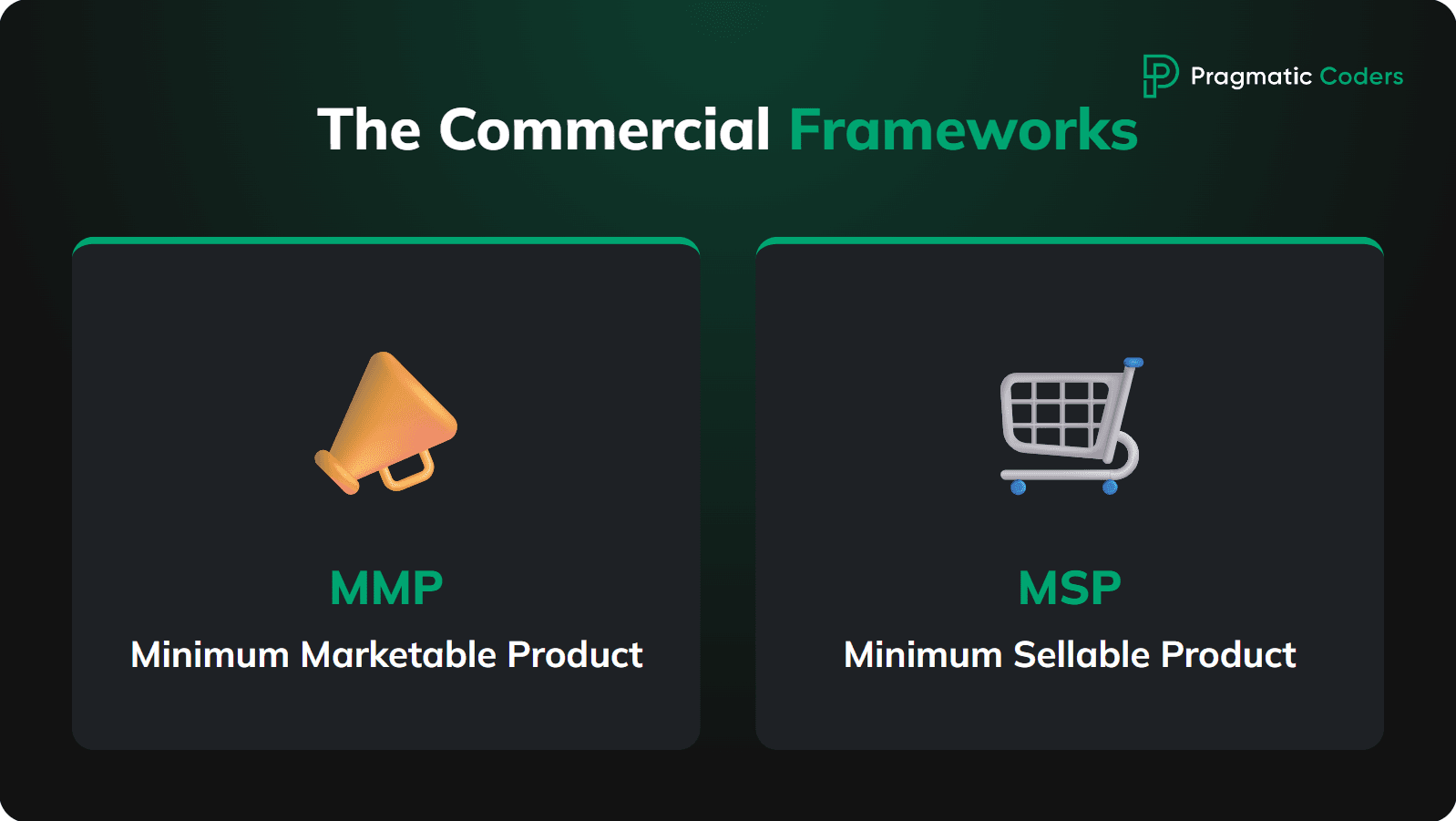
The Commercial Frameworks (When You Need to Sell)
Goal: Scale and Monetize.
Speed: Months.
Once you’ve validated the idea (MVP), you need to think about the market.
8. MMP – Minimum Marketable Product
What it is: The smallest feature set that marketing can credibly promote and sales can sell.
Best for: Launch campaigns and early sales alignment.
Why MMP ≠ MVP: An MVP might be a clunky tool that solves a problem. An MMP needs a value proposition, a pricing page, and enough polish to not embarrass your brand.
⚠️ Cost of Being Wrong: If you market an MVP as an MMP, you will burn your brand reputation with early adopters who expect polish.
9. MSP – Minimum Sellable Product
What it is: The minimum version you can legally and commercially sell, especially in regulated industries.
Best for: Enterprise B2B, Healthcare, Fintech.
The Reality Check: You can’t “move fast and break things” if you’re handling patient data. Your MSP might require SOC2 compliance, SSO, and 24/7 support before you can sign a single contract.
⚠️ Cost of Being Wrong: If you sell before you are compliant, you risk lawsuits and being blacklisted by enterprise procurement.
6. How to Choose the Right ‘Minimum’ (Decision Scenarios)
Don’t just pick one. Pick the one that matches your resource constraints and market phase.
Scenario A: The Bootstrapped Founder
- Context: No money, just an idea. You need to validate before you run out of cash.
- Path: RAT (Validate demand with ads) -> Concierge (Deliver manually to get cash) -> MVP (Automate the manual work).
- Why: You can’t afford to build something nobody wants.
Scenario B: The AI Disruptor
- Context: Building a complex agent in a new space. Technical risk is high.
- Path: Wizard of Oz (Test if the output is useful without building the model) -> MVE (Build a smooth interface so users trust the AI) -> MAC (Add one “magic” feature).
- Why: AI requires trust. A buggy MVP destroys trust.
Scenario C: The Red Ocean Entrant
- Context: Entering a crowded market (e.g., another To-Do list app).
- Path: Skip MVP. Go straight to MAC (One unique feature) or MLP (Better design/vibes).
- Why: An MVP here is suicide. Users already have “good enough” solutions. You need to be “awesome” or “lovable” to switch them.
7. Quick Comparison Table
| Framework | What it is | Best for | Effort & Speed | Main Risk | Example |
|---|---|---|---|---|---|
| MVP | First working version that proves value | Validating if product should exist | Medium effort, medium speed | Building the wrong thing | App with 1 core feature |
| MVE | Min version where experience makes sense | Adoption & Retention | Higher effort, slower | Over-polishing | Clear onboarding flows |
| MAC | One standout “wow” feature | Crowded markets / AI | Focused effort | Feature nobody cares about | AI that nails one task |
| MMP | Smallest version to market credibly | Launch campaigns | Medium-high effort | Marketing misalignment | Polished sales landing page |
| MSP | Min version to legally sell | Enterprise / Regulated | High effort, slow | Long lead times | Contracts & Compliance |
| MLP | Min version users enjoy | Word-of-mouth | Medium-high effort | Optimizing delight too early | Smooth UX + delightful details |
| RAT | Test of riskiest assumption | Early validation | Very low effort | Misleading results | Waitlist landing page |
| Wizard of Oz | Looks automated, actually human | Simulating complex logic | Low tech effort | Hard to scale ops | Manual email scheduler |
| Concierge | Manually delivered service | Deep learning | Low tech, high labor | Not scalable | Founder onboarding users |
← Scroll to view more →
8. Conclusion
The era of “just build an MVP” is over. It’s a lazy instruction that leads to vague products.
Success in 2026 requires precision. It requires knowing whether you are testing a risk (RAT), building a business (MMP), or crafting an experience (MLP).
The right “minimum” saves you money, reduces risk, and gets you to market faster. So, before you write a single line of code for your next feature, ask yourself: “Which minimum are we really building?”