How AI Boosts Personal Productivity
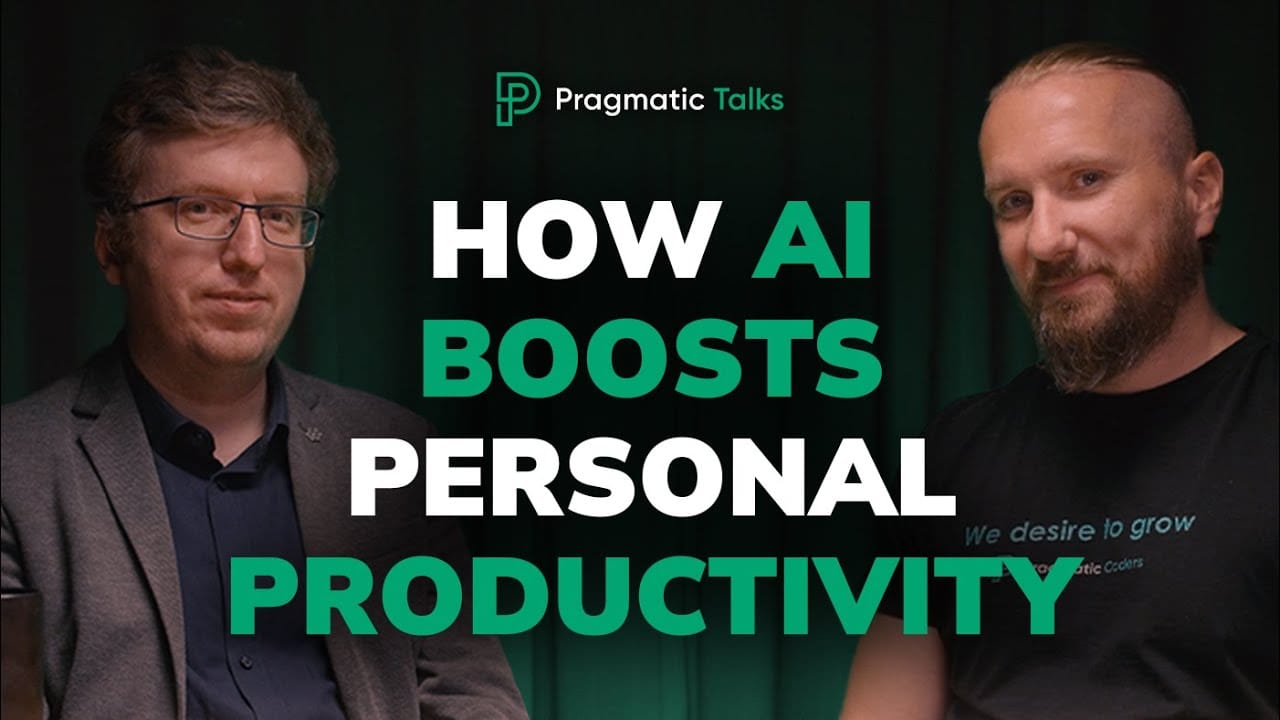
Here’s what you can learn from this episode of Pragmatic Talks:
Choosing the right tools and defining use cases
- Avoid tool overload: Konrad Głowacki advises against trying every new AI tool. The sheer number of options can be confusing and counterproductive. He suggests selecting a small set of tools–no more than three–and mastering them.
- Define your needs first: Before choosing a tool, understand the specific problem you want to solve. This helps you find the right solution faster.
- Example – a real-world use case: Konrad’s architect friend used Google AI Studio to analyze 60–70 pages of legal documents before bidding for a contract. This saved her several hours of unpaid work on each bid, something that was not possible with the standard version of ChatGPT at the time.
The need for multi-modality and multi-agent systems
- Beyond simple text: A major limitation of many AI tools is the lack of true multi-modality. You can input a Google Doc, but you get back unformatted Markdown text, not a styled Google Doc.
- Multi-agent systems are more powerful: Tools like Manus AI can work with multiple files of different types simultaneously (e.g., text documents, spreadsheets). These systems use different “agents” to handle complex tasks.
- Example – massive time savings: Konrad used Manus AI to create a new database and prompts for a hotel chatbot. The task, which would have taken 2–3 hours manually, was completed in just 3 minutes.
- Building custom agents: Wiktor Żołnowski shared his experience using n8n to build a custom AI agent on Slack. This agent has access to client documentation and company knowledge, allowing him to quickly get answers about leads and projects.
The challenge of staying up-to-date
- The pace is overwhelming: It is impossible for one person to keep up with all the new developments in AI. Konrad notes that what used to be 3–5 significant updates per week has now become about three per day.
- Focus on starting, not perfection: The most important step is to start using a tool that helps you now. Don’t wait for the “perfect” tool, as a better one might be available in a few weeks anyway. The goal is to begin saving time and simplifying your work immediately.
Deciding what to automate
- The “assistant test”: Konrad suggests a simple rule: “If I had a human assistant, would I delegate this task to them?” If the answer for tasks like calendar management is no, it might not be worth automating with AI.
- Partial automation is also valuable: You do not need to fully automate everything. For example, instead of having AI write emails from scratch, use it as a helper to draft or rephrase sentences.
- Example – improving communication: Wiktor uses AI to write more diplomatic emails, especially in difficult situations. By providing cultural context (e.g., communicating with people from the US vs. Asia), the AI helps create a message that is polite and effective, which improves relationships.
How AI is changing custom software development
- Specialization is less critical: With AI, software companies can gain deep domain knowledge much faster. This means they can build products for various industries (finance, logistics, etc.) without decades of prior experience in that specific field.
- Custom software is cheaper than ever: AI tools for coding (like Cursor AI), prototyping (like Locofy), and workflow automation are making development faster and more affordable. Wiktor advises that if you thought custom software was too expensive a few years ago, you should ask for a new price now.
- Better communication with clients: A client of Pragmatic Coders used an AI tool to build a clickable prototype of his application idea. This allowed the development team to understand his vision in a single one-hour meeting, avoiding weeks of miscommunication.
Tips for boosting personal productivity with AI
- Start small and focus: Choose one tool and dedicate a small amount of time, like two hours per week, to learning how to use it for small, specific tasks.
- Invest in good tools: A paid subscription of €20 for a tool like ChatGPT, Claude, or Gemini is a good investment that will pay for itself in saved time.
- Review your subscriptions: Konrad puts a monthly reminder in his calendar to check if he is still using his paid AI tools. If a tool is not providing value, he cancels the subscription.
- Reduce decision fatigue: Use AI for low-stakes decisions. Konrad uses Perplexity to get dinner recipes based on ingredients he has at home, which saves mental energy at the end of the day.
- Build a habit: It takes time to build the habit of turning to AI first. Wiktor explains it took him months to stop Googling first and instead ask ChatGPT, which often provides a direct answer much faster.
Predictions for the next 12–24 months
- Deeper integration: More tools will be integrated directly into major platforms like ChatGPT, Gemini, and Copilot. Users might be able to manage their tasks, documents, and calendars inside a single AI interface.
- The rise of “AI Experience” (AIX): The focus in user experience design will shift. Instead of just designing for humans, companies will need to build systems with interfaces that AI agents can easily connect to and use.
- Consolidation of tools: Major platforms may begin to offer features that are currently provided by standalone apps like Notion or Trello. This could lead to a consolidation in the market, similar to how Google expanded from search into maps, email, and news.
Read the Full Transcript
Wiktor Żołnowski: Welcome to the next episode of Pragmatic Talks. Today our guest is Konrad Głowacki. Konrad is a former startup founder and software engineer at Google. Today we are going to talk about personal productivity boosted by AI. So welcome, Konrad.
In this podcast, we talk to founders and experts to share real stories and lessons from building and scaling digital products and companies. Pragmatic Talks is for those who want to understand how digital products are really built and grown. No fluff, no buzzwords, just honest conversations.
As every one of you knows, I am a huge fan of using AI in my everyday job, and I’m also doing this for private stuff and at work as well. But Konrad is way more advanced in that, from what I heard. So Konrad, if you could tell us a bit more about how you use AI to boost your productivity. Or maybe there is some use case, like one big use case where AI is truly boosting your productivity. We can talk about what is boosting my productivity.
Choosing the right tools and defining use cases
Konrad Głowacki: Hello. Productivity, but first of all, I would say what is not boosting my productivity. For me, the biggest problem with all the AI tools is that there are so many of them that I don’t know which of them I should use. And when I was trying every single AI tool, I just got confused about which task I should do with this or that tool, and switching is quite problematic. So the first thing first is to define a small set of tools; don’t go beyond, like, three of them because otherwise, you can get really confused. So that’s the first thing for me: just the selection of a few AI tools. And second is to define what you really can do with the tools.
For example, I talk quite a lot with my friends about how they use AI. They use AI usually not so much beyond Chat GPT. And when I tell them, “Okay, you have this problem,” for example… maybe I will start with not my example, but my friend that she’s an architect. For her job, she needs to analyze quite a lot of legal documents before she can draft the design for a building or for a road, for example. And for her, the most important thing is to be able to analyze a big set of documents to find what is relevant and just read what is relevant for her job, for this particular project. And without AI, she had to go through like 60–70 pages of documents without getting paid because it was the thing that she needed to do before she could even bid for a contract. So right now with AI, she can get the right path way, way faster, and it saves her a few hours each time she wants to make a bid.
But what tool should she use? She said, “I can’t load this amount into Chat GPT.” In the past, she couldn’t; right now, Chat GPT has improved. But when we were discussing it, I just said, “Okay, just go to Google AI Studio and you have what you need right there.” And of course, AI like Chat GPT adjusted themselves and they can do it now, but it was not so easy for people at that time. And there are more and more tools like that showing up, and not everyone is testing them. Some of them were, for example, closed for usage, like Manus AI, that has been open for only like two or three weeks now, which are giving more opportunities to work better, I would say. But you need to learn how to use them and why you would even use them at all.
So for this example, I would say the biggest problem for me with most of the tools is there is no real multi-modality. So you have a chat, you can give it some data, and some of them will understand it, but even if it understands, it will not give you back the information in the same form you delivered it. So you can give them a Google Doc or Google Sheet as a source of knowledge, but you will not get it back in the same form. And then, okay, the AI is helping us in some form of transforming the data; like, they will return a CSV file for a spreadsheet or they will return Markdown for Google Docs, but it won’t be a Google Doc or the spreadsheet. It will not have a style, it will not have icons, it will not be in the same template. And I think it will change over time, but there’s a big, big road ahead of us to get it from the main players.
Wiktor Żołnowski: Yeah, but that’s about Chat GPT. But Gemini is already doing this; like, Google is already doing this. So they are better because they own the ecosystem of other stuff, but still, it’s not the best.
The need for multi-modality and multi-agent systems
Konrad Głowacki: Yeah, that’s true. I would say no, like, I’m still happy with what Gemini delivers in that form. Like, okay, it can get more data, but still, the generation of the document and the lack there is quite significant. So it’s doable, but the styling is not there, I would say. For me, also, the problem is that, okay, I can get one file, like some analysis or some report, but who works right now just with a single file? We always have different sources of data, and then we have different ways we deliver this data later and we want to use them. So that’s why, for example, I started testing Manus AI because it says, “Okay, this is a multi-agent system, so it can do a lot of different stuff.” It can run a virtual machine and download the tools they need and install them and try to use them. So I said, “Okay, let’s try.” And I was astounded by what happened there because I could just provide five different files of different types; it would parse them, and then I could get three different files for other usages.
So I think the nicest example is with a chatbot for hotels that we are working on for our customers. I said, “Okay, I want to have this version for a different hotel. How much time will it take for me to build a database about this hotel, to adjust the prompts for that hotel, and get it back to production to test how it works?” And with Manus AI, it took me 3 minutes.
Wiktor Żołnowski: Wow. Yeah.
Konrad Głowacki: At least, I would say it’s like two or three hours of manual work, at least. Yes, yes, yes. And of course, I could do it in like 15–20 minutes with some other tools, going one file by one file and verifying that it’s synchronized between the files and it understands it properly. But with this tool, I just put in what I want, and it just tries to deliver. Is it always right? No, you need to check it. But overall, the experience is completely different. And then it’s more about working on, “Okay, what kind of question, what kind of prompt do I need to give to Manus to get exactly what I need?” And the really nice thing there is that Manus tries to learn by itself. So it just gives some recommendations, like, “Okay, add this to my knowledge base.” So for example, if I ask for some specific adjustment of a prompt that I want to make sure the structure is the same, or that if I have a different prompt and data, the data and prompt are always synchronized and it speaks the same language between these two files. And it does it automatically; you just need to accept this, I think it’s called a ‘step’.
Wiktor Żołnowski: Okay. So multi-modality is one thing that you are looking at when you’re choosing the tool to use, and the second one is multi-agency.
Konrad Głowacki: Yes. But I think it’s a little bit connected because from my perspective, multi-modality is just different types of files. It would be great to have voice and text; ElevenLabs, for example, is working on that right now, and it looks promising, I would say. But for me, understanding different files and being able to output the work to different files or to different systems is the critical part. And usually, it’s impossible to do with just a single agent. You need to have different agents that will approach these problems separately, or one agent with different tools.
Wiktor Żołnowski: Yes. Or one agent with different tools. Yeah. So this is, for example, what I do with n8n and some workflows that we have, for example, for our Slack channel where all of the requests from our clients, our leads, are coming from, like all of the contact forms. And we are automatically doing some initial validation of this lead. But also later on, we build a database of all of the documentation that we collect from these leads, and the agent has access to this. So whenever I need something, I need to know something, or I have some questions about the lead, about the project, or their requirements, I’m simply asking on Slack. I’m asking the bot, which is actually the agent behind it configured in n8n, where the agent has access to all of the knowledge, access to the internet, and our previous knowledge from past projects. And I can ask this bot to actually answer any questions about this lead, about this client, about their project. That is simplifying a lot, and that’s similar to the case that you described before about this legal documentation, etc. So here is the same: I have a bot that I can talk to, I can ask any question, and it’s especially very useful when we are trying to estimate the project for a client or prepare some presentation for a client before we start working on the product.
Konrad Głowacki: Yeah, that’s important to have different tools. What I found is that there’s always some limit on the amount of tools that you can reliably configure. So that’s my biggest challenge for the n8n setup was that if the configuration for the single tool was too long, I’d rather want to do a separate bot and some API between them, just for the sake of the clarity that I expect there will be. Just the tools to adjust them. There are some tools that could be utilized, I think Agent AI or something like that, that could help build that better and faster but removing quite significantly the control over the process and, later on, the reusability of that.
The challenge of staying up-to-date
Wiktor Żołnowski: Yeah, that may be a challenge. You’ve mentioned at the beginning that there are plenty of tools right now that are available on the market that people can use that could boost their productivity. I think that’s one challenge, like which tool to choose right now. But the second challenge is how to stay up-to-date with all of the tools that are appearing there. And that is bothering me much more. Like, even the tools that I’ve been using three or four months ago, right now they are, you know, already obsolete because there are better tools on the market. And I still need to learn new and new stuff to actually do the same work more efficiently or stay with the tools that I knew but agree that I won’t be as efficient as I could be.
Konrad Głowacki: Yes, that’s the challenge, but I think the biggest challenge is to understand what we can perceive as humans. Because, like, two months ago, I tried to be on top of knowledge about everything that happens in AI tools, and for like two or three weeks, I was capable of doing that. But after that time, I got completely exhausted because it is not slowing down, it just speeds up. And like three months ago, I would say there were maybe three to five significant things happening per week. Right now, I would bet that there are three things a day that happen in this space. So if I would like to stay ahead and know everything about everything, or at least have a glimpse of what’s happening, it’s impossible. So staying ahead is impossible.
It’s more about, okay, we need to verify where we are right now. But I think the most important thing is to use some tool that works for us. And I think the biggest challenge is to start, not to adjust later on, but to start using tools that give us more time, boost our productivity, and simplify our life, our work. And I think this is the most challenging because right now, everyone expects from us that we’ll be extremely productive, we’ll deliver everything fast, and there will be no time to think, I would say. And how should I find the time to get a new tool that will not benefit me right away? It’s not that I will do it now, spend two or three hours configuring a new tool, and I will get these two hours back the same day. It’s not how it works. For example, I was working on getting my calendar automated. But I had too many expectations out of that, and it worked from time to time. It worked, but there was like one-third of the cases where it just messed up and it put the wrong date. Like there was some problem, not with the idea itself, but the complexity I put ahead of this tool without using it on a smaller scale. And from what I see, it’s about starting small but implementing it and seeing how this helps, how this makes my life easier. For example, do I really need this tool? I would ask myself the question: if I had an assistant that could learn whatever I want, but I would need to supervise that assistant and teach that assistant a little bit at the beginning, would I want this to be done by this assistant or not? And if I ask this question to myself, for example, for calendar management, it’s like, okay, but would you really ask your assistant to always put something into your calendar? Or would you rather do this on your own? I would rather do it on my own. The only case that I would rather have this option to do this not manually is when I’m driving, but it’s more about configuring your regular Chat GPT to just add some stuff to the calendar, and that’s all you need from that. So it’s more about defining when and how you will use it, and then defining if it’s worth it to automate with AI right now. And from what I see of the progress, it will just change over time, and it will be just easier. So having an idea that will take weeks to implement might be obsolete in a month from now because there will be a better solution that will enable you to do the same thing in three hours, for example.
Wiktor Żołnowski: That is actually answering the question that I was about to ask you. The question was, how do you decide what’s worth automating and what isn’t?
Deciding what to automate
Konrad Głowacki: Do you have anything to add here? So besides thinking about, “Would I give it to my assistant or not?”, I think the other thing is, do I really want to make it fully automated? For example, I did a few tests on drafting emails to clients. And after several tries and adjustments, I defined that either I will teach it on my, I don’t know, hundreds or thousands of emails how I draft emails, and still, I would not be happy with it, or I’ll just use the draft from AI as some kind of help. But usually, I look at that email and use maybe half of a sentence. Because for me, it’s about getting really straight to the point, and adjusting AI to get straight to the point in simple words that others will understand is not so easy. So for example, this is one that I don’t want to automate, at least for now. And the other one is… just starting here.
Wiktor Żołnowski: So, in my experience, how I use AI for emails… I’m not using it for emails in general. I’m writing emails very rarely; I’m usually trying to call people or have a meeting with them face-to-face because I hate writing emails. But sometimes I have to, and usually, I’m not using AI for that either. But there are some cases when AI is much better than me. For example, when we have some difficult situation with, for example, a client who is not paying on time, or someone is angry at us, or I am angry at someone because they didn’t deliver something or something like this. It is even more often. Then, you know, I would write an email that would be, as you said, straight to the point, which in many cases is not a good solution. Yeah, sometimes you need to be more like Chat GPT or another LLM and be more polite and more political in that. I’m not political at all; I’m very direct in verbal communication and written communication as well, which sometimes may be even a little bit offending to someone. So help from this kind of AI assistant, for me, I believe has improved my communication and my relations with many people in the past year or so, I would say.
I’m not saying that I’m asking GPT to write the email for me; I’m rather working together with the chat on the proper email. So for example, I’m adding some context, like what the past relations with the client were or with the person I’m writing to, or what is the cultural context. For example, there is a different communication with people from the US, there’s different communication with people from the UK, and totally different communication with people from the Middle East or from Asia. There are some nuances that I wasn’t aware of, but GPT is aware of, and if you provide this context to GPT, it will help you write an email that will be more adjusted to these nuances.
Success stories and surprising outcomes
Konrad Głowacki: I have a similar experience. I try to be diplomatic, but it takes time to get the right answer that will be really diplomatic. And where I really see value is when I provide my answer and see this more diplomatic response, and then I just copy what I feel is right. So I will not copy everything; I will just copy the few words that better show this, like rephrasing it in more polite words. Yeah, that gave me an idea of what I should do before meetings with clients. Because I’m quite straightforward during the meetings. That just brings the idea that since we already do research about the clients when they are sending emails to us, we should already do this preparation, like some guide on how to communicate with this kind of client. Yes, yes. And who the person really is.
Maybe I will tell you a little bit about what I used for one of my friends that went for a conference in the US and just dropped me an email Thursday evening that, “Hey, I’m on the plane tomorrow. I’m at such-and-such conference. I got a list of like 56 people that will be there. Could you help me with whom I should really meet?” And it was like, okay, so there’s no time to go through each person hand by hand. So the only way to get something out of that is AI. So this, I think, shows how it can help, but I had two failures there.
Wiktor Żołnowski: So let’s hear the story.
Konrad Głowacki: Yeah. So the story is that it’s a deep-tech company that’s looking for funding, and from my perspective, it was to find, okay, who can give the funding, who could be a customer of that company, and I think the most important is, is the person there really technical? Would they understand this technology or not? And I drafted how to categorize that and put that into Manus together with a PDF with the list of people. And weirdly enough, when I provided a test sample with six people, it worked perfectly, to the point I even got an idea, “Okay, so give me profile pictures of each person.” But when I tried to scale it up for the full solution with the PDF itself, it just broke. It did half of that and it couldn’t continue. It just kept stopping, asking, “Should I continue?” and going forward for one or two people and asking the question, “Should I continue?” So after that, I decided, “Okay, let’s switch to Deep Research from Google,” and I got some success, but I still had to split the people into two parts, and then I got some results. And the only way to do anything with that was to feed it to NotebookLM to analyze it once again to get some insight. My idea was to share it with my client to see if he can utilize it, and overall, that worked a little bit. It could give good insight about what topics to speak about with a given person because a few of them did research in similar fields as them. So without this knowledge, it would be really hard to know which of these people really know what they are doing and would really understand what my friend is doing. So that’s, I think, a success story, even though both tools failed, I would say. At the end of the day, they brought some value.
Wiktor Żołnowski: But in that case that you mentioned, that you had to split this huge amount–I mean, not huge, 60 people is still a lot–you had to split it into smaller chunks. And I believe that if you would ask your assistant, I mean a real assistant, a person, not AI, to do this research for you, I think that they would be overwhelmed as well with the 60 profiles that they need to analyze. And if they would try to do this all at once, they would definitely fail. But in smaller chunks, or even one by one, that might be a much better solution. So I believe that AI is not worse than people, but our expectations sometimes are too high.
Konrad Głowacki: Yeah, I think that our expectation is that it really scales. And I think that the technology underneath can scale, but the tooling on top of that is not scaling yet. So I expect that soon there will be a way to make these kinds of workflows semi-automatic in, like, Manus AI or other tools. And I’m certain that right now, we could do this using n8n and our custom workflow. So this is just doable. Maybe we should do that for our purposes, for example, in going to conferences, to really know to whom we can give value. Because it’s not about, “Okay, who can I target?” It’s more about how we can approach someone that we can really bring value to. And it’s good to know with whom you should talk because they can utilize the value you give, and you don’t lose your time and the time of other people when you will not bring this value at all. And AI can help with that.
Wiktor Żołnowski: Yeah, definitely. So let’s go to another question that we have. Have you ever been surprised by the outcomes that you get from AI, in a good or a bad way?
Konrad Głowacki: In a good way, I was surprised how easy it is right now to make a landing page. I’m really surprised. I think I used the V0 tool when I wanted to make a demo website about our hotel chatbot and just wrote down something like, “I want to have a landing page for managing directors of hotels about a chatbot that will help guests know more about the hotel.” Period. And with that, I just got the full website with values on the first page. And out of five values, only one was wrong. Okay, let’s say only one was different from what I defined through my two weeks of research. So it was like, “Okay, great.” In the end, this one value is something that differentiates what we do from what all the competition is doing. So I think that’s how all the values were there, but I was amazed at how fast and easy it was.
Wiktor Żołnowski: Yeah, that’s… the progress that those tools have made recently is huge. Yeah, especially for this, let’s say, simple task, but still, it’s not very simple, I would say. It would take a couple of days for some content writer or marketing person to actually set up this kind of website, maybe with a developer’s help or maybe not if they are familiar with, I don’t know, WordPress or something like that. But still, that’s a couple of days, and you’re saying it’s like a couple of hours or minutes even.
Konrad Głowacki: Minutes, minutes. Yeah.
Wiktor Żołnowski: And really, if there is something wrong, you can adjust it or you can ask AI to do it over again and over again until it will be good enough.
Konrad Głowacki: Yeah, it was still just a starting point for what I wanted to do. Overall, I realized that it’s not the way to go because I think the most challenging thing right now for making AI tools is not about making a nice website about it or something like that, but really defining the value and defining a way to approach people that you can bring this value to. And that’s problematic because right now, a landing page… it’s so crowded all around that it’s really hard to get through that. Like, two or three years ago, that was easy. If you are able to get a landing page, you can get some promotion and you can start bootstrapping from that. Right now, you need to have a product already to convince people to invest in it. So that’s a different story. The other successful story would be that I don’t like using Facebook. And to get my research about hotels and chatbots at hotels, I had to go to Facebook, to a Facebook group, and ask this question to the people there. And I got answers from different people to my questionnaire. It was done not optimally, but I didn’t hear… I was not hearing well that AI said, “Okay, it’s too long.” I said, “No, I need this data.” It was too long. But what I got out of this discussion was several comments that I brought way more knowledge out of. But some of them were really tricky to answer. How to answer the comment from a potential competitor? How to do it well and maybe get some more knowledge out of the potential answer? And I think I gave a good answer to that comment, but I didn’t hear back anything from them. So maybe the question was too good or… but otherwise, I would really hesitate about responses and how to address, for example, competitors at that forum. It played out well.
How AI is changing custom software development
Wiktor Żołnowski: That’s close to these diplomatic emails. Yes. So here it might be the same: how to answer publicly to the competitor in a way that it will not show you from a negative perspective to your potential clients who are also reading it, and also showing that you have some knowledge, you have something to offer, even maybe something more than the competitors. Right now, essentially a month ago, I knew almost nothing about hotel chatbots, anything like that. Right now, we can get into a really deep discussion, and it’s mostly because of, one, the tremendous knowledge I got from just a few talks about them at the beginning, and then a ton of research I did with AI to get more and more deeply into what is the real reason for the problems with hotels and their communication. So then when I went to the hotel owners, the next round, I really knew what I needed to ask to get their emotional response that, “Okay, that’s the real problem, not something else.” And this helps with the diagnosis of where you can really give a customer a benefit with your work.
In the past few days, I’ve joined a discussion on LinkedIn about specialization in software houses, in companies like Pragmatic Coders. And my opinion was that right now, specialization doesn’t matter as much as it used to, especially with these kinds of tools. We can build anything, even if we haven’t done anything like this before. We can build anything, say, most of the things in the world, just because we have access to the knowledge which is already in AI, or with the help of AI, we can faster gain this knowledge from the users, from domain experts, from anyone on the market, from the clients or users. The specification is not as important as it used to be unless there is some technology behind the specialization.
Konrad Głowacki: Yes and no, I would say. That’s true for some niche applications where there’s not a lot of knowledge; that might be the case. But I would say it mostly depends on the customer, how open the customer is, not about the technology, but about what they really want to do. It’s more about how open they are, sometimes how open their customers or suppliers are. And so, for example, we have customers that just came today and asked us, “Can we get a conversion from a roofing drawing to the CAD system that models that, and then based on that, they prepare quotations?” Okay, it’s crazy, I would say. But from my perspective, yeah, it’s doable if we can get access to an API for the software. It could be usable, could be doable. It’s not easy, but that’s why it’s a great project, because it’s not easy. How to estimate it, that’s a different story. But there are crazy ideas happening right now. And from my perspective, we have so much tools as engineers or as a software house that we can bring a lot of great stuff at a reasonable cost for the customer that three years ago you would not imagine was even possible.
Wiktor Żołnowski: And this is another topic that I am often repeating in various contexts: custom software has never been cheaper than it is right now, and it’s getting cheaper and cheaper with every day. So for example, if you were thinking about custom software like two or five years ago and someone told you the price and you were shocked, “No, it’s not for me, I cannot afford it,” try again right now. If it’s still too much, try again in one year or two years. You will be surprised how the prices went down, how the estimations went down. And I’m not saying that every company is able, every software house, every custom software company is able to deliver custom software at lower rates than it was in the past. But the modern software companies, like Pragmatic and other companies on the market as well, who are following this trend, who are using these tools like Cursor AI or workflow automations and other stuff, they can offer you building the products at way better prices than they used to in the past few years. So if you were thinking about custom software for your company, for your startup idea, whatever, now is a great time to ask for the price again.
Konrad Głowacki: Yeah. Coming back to the specialization of software houses, I don’t care about… like, I really enjoy what Pragmatic Coders did in the past, but I don’t care if the customer is in finance, is it medical, or is it roofing or logistics or whatever else. It’s more about how open they are with us and at least if they have any business problem that we can solve and give them a business boost out of that. And I think right now the most focus is about delivering business… delivering real business value to our customers. And right now, it’s not about, “Can you do that?” It’s more about, “Okay, how much can we give you back when we deliver that?” And the customer needs to decide, “Okay, is it worth it for them or not?” Can we cut the time or can we cut the real cost, or both? But the most important thing is, will they have a better business out of that or not? And that’s the driver of whether it’s worth the cost.
Wiktor Żołnowski: Yeah. And right now, with AI tools, it’s easier for us to even estimate that. Exactly. Yeah, we are using AI for estimating. Still, there is a human factor there, but we are utilizing AI a lot to estimate. And of course, we use our data from over 100 projects from the past to be better at estimating. And I must admit that recently our estimates are getting better and better with every new project. So AI is really boosting it. And that helps us also to make it faster. Yeah, so it’s not about a multi-week project before we even start. It’s like, “Okay, come to us, provide the basic problem definition.” Then we get to the point where we either build together the full workflow of what really needs to be done, or you, the customer, provide that to us.
And that reminds me about another story from the other perspective, about the communication of what needs to be done when we talk to our clients. One of our clients actually came to us with a ready prototype that he actually created in Locofy, which is like a prototyping tool, or even some people are using it for true development and they are pushing these prototypes to production to test it. But this client spent a few days just talking with AI, generating some code, generating some layouts, and he actually provided us a clickable prototype with some basic functionality of the application that he wanted us to build. And that was actually amazing. Like, we had one meeting for less than an hour, and we clearly understood what he was trying to build because we simply saw it. So we were able to figure out what else needed to be done, how to turn it into a real product, etc., and provide the estimates. And I believe that we avoided a lot of miscommunication on the way, and that simplified the entire process a lot. And so yeah, I believe that that’s the future. Like, this kind of prototyping, even if not done directly by the clients, I believe that our team needs to work that way, that instead of just shaping the application somewhere in the ether or writing the documentation or requirements, we can, in the same time, generate some prototypes to show to the client, and the client will tell us, “Okay, that’s not it, that should be different,” etc. And that will simplify the communication and speed it up.
Konrad Głowacki: Yeah, and essentially that’s just a new tool for us to also push the customers to get this knowledge. So it’s not about, “Okay, the customers will come in,” but we also can get back to the customer and say, “Okay, we think it looks like that. What do you think? Is it that or not?” And it doesn’t cost us hours of development; it just takes us half an hour or something like that to get the first draft. For example, with hotel bots, it’s 3 to 5 minutes per hotel to adjust it, so it’s really just like that from the perspective of the customer. So right now, not only will the cost shrink, but also the time to start and the time of development. So I think that’s the most important thing: to not be afraid of the idea. Because it doesn’t mean that even if right now it’s impossible to do it in a given budget, it doesn’t mean it will stay the same.
Wiktor Żołnowski: Yeah, exactly. It certainly will go down. We don’t know how much and when.
Konrad Głowacki: Yeah, yeah. But essentially, it’s more about, “Okay, so we could do that, but only if image recognition will be on a level higher than that, or two levels higher for some applications.” And that’s fine. It’s like, for at least for me, it’s like, “Okay, so right now I can just be straightforward. Okay, if you ask us to do it right now, it will be millions. But let’s wait half a year and come back to this topic because it might be a hundred.”
Wiktor Żołnowski: Yeah, that’s… and from the other perspective, we had a client a couple of months ago for whom we’ve been doing some prototyping with AI agents, and at that moment, we were unable to actually provide the results that would be good enough for this client because the technology wasn’t there yet. But I’m convinced that in the next couple of months or weeks… and I think that even right now we should test new models that are available, just change the models in what we already built at that time, and I’m pretty sure that the results will be already much better, if not good enough to actually continue this product. So not only the price, but also something that wasn’t achievable at that time, and not so long ago, right now might turn out to be achievable, and we might be able to deliver something that will bring value for a client, even if we couldn’t some time ago. Because the speed is so fast.
Konrad Głowacki: Crazy. It’s crazy. It’s completely crazy.
Tips for boosting personal productivity with AI
Wiktor Żołnowski: Okay, so getting back to productivity and personal productivity. What would you recommend to someone who is just starting with AI and wants to boost their productivity?
Konrad Głowacki: So first of all, I would not start with many tools. I would just get one tool, maybe ask this tool what you should use for achieving some small improvements in productivity. Either it will be drafting emails, or it will be managing the calendar, or drafting marketing posts. There are different approaches. Or analyzing some given documentation. And based on that, select just one tool, nothing else, and book like two hours a week just to focus on productivity with this tool. Nothing else. So you need to already know some basic productivity tricks to become more productive with AI, or you need to make some tradeoffs. I would say, or ask AI how to be more productive. Yes, I would say that can help anyone. Yeah, because there’s always something that you can do better.
I would also bet that there is something that you can always start using and it will give you some boost for a week or something, that you can utilize these few hours to automate something. Keeping that is not the easiest way. So behavioral changes are not easily implementable. But bursting for like a week or two is doable. And if you really focus during this time to get these two hours a week to boost productivity in other areas, you will see the results just next week and the week after. And the most important thing is not to select a big task. It’s not worth it. It’s to start small. Be aware that it costs money, and it’s good money spent. I would say €20 for any, like, Chat, Claude, or Gemini is really worth it. At least one of them you should have. There are sometimes other tools that you need to spend money on, but it will pay off. You can always do a review every month: “Am I using this tool? Should I keep it?” For example, I have special calendar entries every month for a few of the most expensive tools: “Do I use it? Is it worth it for me to keep this?”
And I started out with the idea, “Okay, I’ve never used Manus. Let’s start.” Okay, it’s quite expensive as a tool because it costs around 50 bucks. So it’s more expensive than I used to spend on any AI tool until that time. I said, “Okay, let’s try it. I will just put an entry to cancel it.” And in the first month, when I was just heading to this date, it was like three days away, I had this time, I had to use it, and it worked. Maybe not perfectly, but it helped me a lot. And after that, I said, “Okay, it works. It is worth it.” So I kept this, but I keep this entry every month to check it. Just to check it. Because if there will be a month that I never use it, I’ll say, “Okay.” So again, you already need to know some productivity tricks to be productive with AI. And I think that’s about, you know, if you’re working in a chaotic way and then you just put AI on that, you will be way more chaotic than you were before. Yeah, because you will be able to be more chaotic.
So, for example, I’m quite a chaotic person. So for me, the idea was that I will get everything organized with AI. Good luck. No, the first thing is you need to be well-organized to even start organizing that with AI. So what I started first was organizing, so time blocking, putting every task I want to do in a calendar. And that helped me a lot, but I realized I don’t need AI to do that. And for me, it’s faster to move some tasks between days because I see that they are really low-value for me. I want to do them in the future, but I don’t need to do them today; I have more important tasks to do. So I had to do that myself. But doing research to do this automation, I got to read how to really do this, how to implement it. And that’s why I knew that, okay, it’s good to have a framework. It’s good to have an inbox where you put everything and then organize that. And I realized why I was never successful with that. And for me, it’s that if I have 50 tasks to do, it’s overwhelming. So right now, I just don’t put more tasks than, like, 10. And yeah, I need to finish something else. Maybe I will put some notes that will show up in my inbox in a week or two, but right now it means that I don’t have space to work on that. So that’s my hack that doesn’t use AI at all. But I wish in a month or two, I will be able to put this to work with AI, and that will open more scope for the projects I can work on.
Wiktor Żołnowski: You’ve mentioned before about building some habits of using AI, like spending these two hours a week just to familiarize yourself with AI, with a tool, but also just to build some habits. For me, it actually took at least a few months to build a habit of asking Chat GPT, which is my number one tool that I’m using right now, to solve some problems. Like, I always feel the temptation that I first need to check in Google, then YouTube, then maybe something else and find the solution. But later, after I’m spending five or 10 minutes Googling things, it’s like, “Oh my god, how many pages do I need to go through to find this stupid answer for this stupid question?” And then I ask Chat GPT and I get it right away, or it asks me more questions and I describe the problem. For example, yesterday I had a problem with a multi-cooker that I just bought, and I didn’t know how to use it properly. And there’s like a long, huge book of instructions, and I didn’t want to go through it. And first I checked for a video on YouTube on how to use it; it was a disaster. It didn’t answer my question, my particular problem that I had. But I started talking with Chat GPT, and after, I don’t know, three questions, I got an answer that actually worked. Like, two minutes or something like this. That was crazy.
Konrad Głowacki: So then I will tell you how I use AI in my private life. Because what I decided is I don’t want to use AI to, for example, communicate with my family. I don’t see any point in using it. Maybe in the future, for some explicit tool like some knowledge sharing, maybe that will be the time to use it, but not for communication. But what I found really useful is that, for example, I don’t use Google for searching anymore; I use Perplexity. And okay, Google is getting better at that, but I got used to Perplexity right now. So on my phone, I just ask Perplexity about multiple things. And what I found really great is, “Okay, I want to make dinner for tomorrow,” and I have some ingredients that I bought and some limitations and some favorites. Yeah, for when I make it for the whole family, I also need to look at allergens and so on. There are some limitations. My GPT already knows what I like. But the most important thing is that, I think, where AI can help us is that we as humans are limited in how many choices we can really make a day. And there is really a limit; after that, anyone will get overwhelmed. Yes, anyone has a different number. There’s this research about willpower and other stuff. And then if there’s something that you really don’t care about… like, okay, I care about food, but it’s the end of the day, I would like to cook something for the family, but I don’t have an idea and I don’t want to force myself to get an idea of what I can do. What I did last week was just, “Okay, I put what I have in my kitchen.” It was easy because I didn’t need to make any decision. I just put what I have there, and I said, “Okay, give me a recipe for ribs with Indian style.” And I got it. And it tasted okay-ish, I would say. I do better stuff with different ingredients.
Wiktor Żołnowski: We need to exchange our GPTs. Like, mine is cooking better than what you’re describing.
Konrad Głowacki: It’s definitely cooking better than me. So no, no, like for that purpose, my wife is way better than Perplexity. But sometimes neither me nor her has an idea. So I tried it, it was okay-ish. But I tried, and at least from my perspective of me being exhausted mentally, it was good. So I will try it more, certainly. But this is where, for example, AI could help, to not need to make some choices, just get what AI suggests you.
Wiktor Żołnowski: So in my case, it’s still like choosing what I want, but I’ve eliminated the part of thinking about what choices I have. So since I have this one thread with my GPT where it already knows all of my favorite foods, all of the things that I eat… I don’t want to eat sugar, I don’t want to eat carbs at all or limit them to the minimum. So it’s always choosing… It knows that I like some things that are spicy, some vegetarian food, some Asian cuisine, Thai or whatever, Indian. So sometimes when I ask it to provide me some examples, it starts with questions like, “What is your mood today?” or something like this, and I provide, “Are you very hungry or a little bit hungry?” Something like this. Or yeah. So I provide these one or two answers, and it provides me with three or four options. And if I don’t like them, I simply say, “Give me more, give me more.” It gives me like 20 or 30, and I choose one or two of them and go deeper, like what are the ingredients and other stuff. But usually, it’s like the first three; one of them is good enough.
Konrad Głowacki: Okay, no, that’s, I think that’s how it can really help.
Wiktor Żołnowski: I think what was crucial was that I’ve built it up by providing a lot of information to the GPT. And I think that’s the biggest challenge for everyone: how much of the data you want to share with AI. And for example, from my perspective, it’s that, okay, do I trust everyone with the data I want to share? For example, for getting things done, there are already solutions based on AI that I could utilize. But there are some small companies that I would not trust my data with, at least for now.
Konrad Głowacki: Would I use it with OpenAI or Gemini?
Wiktor Żołnowski: Yeah, we already trust those corporates. You know, we sort of trust Google, we sort of trust Meta, we sort of trust Microsoft, which is behind OpenAI. So I’m not using X, so I’m not using Groq as well. For example, from the tools, I was really astounded about how Groq does it. So I don’t have a paid Groq now because I don’t use it so often. But when I was comparing Perplexity Pro and Groq, Groq usually won. So that was funny. It’s more about the limitations with Groq; with the free version, you need to pay quite fast for the deeper questions. For Perplexity, when you have it for one year… I have it, so I use it regarding the one-year subscription.
The things that you mentioned, that you are always checking every month if you want to continue the subscription, etc., I think that that’s a good piece of advice. Even though those tools are usually much cheaper when you’re subscribing for a year, sometimes it’s worth it to at least start for a couple of months on the monthly subscription. And not only check if this is something that is bringing value for you but also to check every month if there is something better or if at least the tool that you’re using is making progress. If it’s making progress, then probably it’s worth continuing as a yearly subscription, and if you are using it, of course. But if you are using it but there are other tools on the market and this tool is staying behind, well, that might be a good opportunity to change this subscription to another tool.
Konrad Głowacki: Yeah. Also, I think it’s good to write down the situation when AI failed you. So for example, if I was not able to find something on Perplexity, if I have time, I do research with Groq and see if I will get better answers there. So this is for me the rule of thumb: find who can answer my questions better. And of course, that will not work with this kind of customization that you feed a lot of data already, because then any model that you train with your data will have better results for you. But overall, it’s good to do this validation because that changes.
The future of work and AI adoption
Wiktor Żołnowski: Yeah, the same goes for us here at Pragmatic: we know new stuff is coming out. And sometimes it’s coming out so fast that we have no time to check the previous version, but the new version is already there, and it was just two weeks. So you know, for a company that has, say, 100 people on board, even two weeks is way too fast; two months is also too fast to actually follow up or catch up with all of these new tools. Like, we already started propagating the knowledge about how to use Cursor AI in software development, and when we just started it and more and more people started using it at the company, at the same time, there are new tools appearing, new concepts, new ways to code with AI. And we need to start over and over and over every time and adjust our trainings, our onboardings to those tools. And that’s, I think, how new kinds of work will look like. It’s about continuous, continuous adjustment.
Konrad Głowacki: Yeah. So the only stable thing here is change, inevitably. So that’s the only thing that is stable here is the change. And are we there that it’s inevitable that the changes will happen with AI? Yes. You can like it or not, but it will happen. And I think maybe coming back to why I came here, to Pragmatic Coders, is that here I can have an influence about whether it will be used the wrong or right way.
Wiktor Żołnowski: Or if it will be used at all.
Konrad Głowacki: And this is for me the most important thing: to enable businesses to really utilize what’s possible right now. And that’s my goal right now, to get everyone that’s even thinking about using AI or some tools or automation to be able to do that because it’s possible. It’s just possible. It’s not about price. It’s more about, “Okay, do you really want it?” Because I don’t think there is a company where there is no automation that could be profitable that we can do. It’s more about searching for it.
Wiktor Żołnowski: Definitely, yeah, definitely. But what is actually a little bit disappointing to me, maybe, is that there are still so many companies that are not utilizing AI at all, and there are a lot of companies still that are actually prohibiting their employees from using AI. And I know that some of them might have some good reasons, but most of the reasons could be addressed by, for example, private models, etc., that will not share data and will be way more secure. But someone needs to make it happen. It’s like every new tool; you need to have some supervision, but you need someone that will take responsibility for that. And I think that’s the problem with companies.
And in the past, we also had these kinds of companies. I think the migration to the cloud a decade or two ago… there were a lot of clients and banks and financial institutions saying, “No, no, no, the cloud is not secure, we cannot go there. We need to have our own infrastructure.” And now everyone is cloud-native, almost. Almost everyone. But still, you have a few companies that are still with their own data centers. But that change was slow. The current change will be fast. And I would say that it’s too fast for humans, and that’s why it will be really problematic. That’s why the usage of AI is important and necessary to be competitive, but we shouldn’t rush extremely with that. It’s more about looking precisely at what we can benefit from that automation or the usage of some given tool, not to overhype that, “Okay, everyone uses AI, we need to use AI.”
I think the counter-example to using AI is when I get emails that are clearly written by AI. Okay, most of them are clearly read by AI already. Yeah.
Konrad Głowacki: But I believe that we are in a world where the value of human interaction will just grow and grow and grow. And okay, we can use AI in a lot of different ways, but in the end, in two, five, 10 years from now, human-to-human interaction will be way more valued than it currently is. And when we implement any solution around AI, we need to keep in mind what our real value is and what will be our real value in the future. I would say one example would be here at Pragmatic Coders: will we replace the salespeople with AI bots?
Wiktor Żołnowski: I don’t think so. Exactly. I think that it will always be about trust. Maybe there is a chance that… a chance that I don’t believe in, but there is a small chance that buying decisions might at some point be made by AI, by AI agents or something like this. And those kinds of agents will probably be preferring to talk to another AI agent and bots, not to a human. But I don’t think that will happen for the kind of services that we are providing, like custom software development. But I don’t know if, at that time, if these kinds of agents will be there, if there will be any custom software development services anymore. So I think that everything will be custom software.
Konrad Głowacki: That’s true. But I think that the most important thing is that it’s about delivering value. And trust is something that humans can give to someone else and to other humans. Okay, you can trust a machine, but it’s way harder. It’s a different… I think we need a different word for “trust” in a machine. Like, do you, for example, trust… as we said, we trust Google, we trust Meta. We trust the people behind that. You know, there are different services there. There are services that have a real human behind them. And for example, when you have your representative from Google Ads–not everyone gets this kind of treatment–but sometimes you have a real person behind it, and that’s the person that builds trust and can deliver way more than the machine can do right now. Probably these kinds of tools will be somehow replaced or adjusted with AI, but there will always be this component there because there’s always some uncertainty when you build a new thing. And you need to trust the other party that they will do it right, you know? And I’m not concerned about Pragmatic at all because with more than 70% of the projects done from referrals from other customers, it’s like crazy. So from my perspective, it’s like, okay, the world will change, we will change. But yeah, there will be enough impact just to move on.
Wiktor Żołnowski: Exactly. Yeah, that’s true, that’s true. Okay, so if we are already talking about the future, let’s get to the conclusion and the last question that I have for you. So what is your opinion, what do you think will change or how will this personal productivity boosted by AI look like in the next 12 to 24 months?
Predictions for the next 12–24 months
Konrad Głowacki: So I think more of the tools will be integrated either with Chat GPT, Claude, Gemini, or Copilot. And that would be my expectation, that we’ll have a fully integrated system, like managing meetings, getting tasks somewhere. I don’t know if we’ll get there that you will be able to easily delegate the task to AI. I wish, but I think it’s still quite complicated. There will still be some customized workflow necessary to do that stuff. But my view on that would be that, yeah, right now we have many companies happening about getting more productive, but it’s just a UI. It’s just a UI on top of something. And I expect that in two years, you would just say, “Okay, I want this kind of UI for this data you have in Chat GPT,” and it will be there. And you will not need Notion, for example, or Trello or whatever, because you could do that; you will be able to manage that. The question will be how the sharing will be done. I think that’s the biggest challenge, is how to share the data between instances. Right now, there is no way to do that really. So that part might not be there yet. So if we speak about your own productivity and managing your own world, it would be doable in that, in just Chat GPT, for example. But if we talk about real interactions, not yet. I think we are not there yet.
That reminds me of the discussion that I had a couple of days ago: that the new big thing in UX, in user experience, is not user experience right now, but it’s AI experience. Like, how to build systems that will be accessible by AI, by AI agents, and generative AI models. So in a secure way, but also in a usable way that they will be able to actually use the interface to connect to these kinds of tools, to anything that we are building here.
Wiktor Żołnowski: Yes, I would agree. And from that perspective, I don’t believe that, for example, companies like Notion will not exist, but they will need to switch who the customer is. And essentially, they will need to get integrated or provide an interface for integration. But the question is how they will monetize that. Because you will not pay 10 different subscriptions.
Konrad Głowacki: So don’t you think that the visualization of the data, like in Notion or Trello…
Wiktor Żołnowski: But I think we’ll get to the point where Google changed the behavior of the internet. Because in the past, Google was an aggregator of different stuff, but later on, Google started to be a competitor. So they started with Gmail, then they moved to News. YouTube, they bought YouTube because Google Video was not so successful. But then we went to products, and for example, any price comparison companies got really screwed by Google because Google started offering that on the main search together with the ads. The same with airline ticket searches or train tickets or Google Maps.
Konrad Głowacki: Google Maps. Yeah, yeah. So the problem I feel here is that this will happen way faster with Chat GPT, for example. Because you know, when you define what users really want to use, then you can just get and make a prompt that will really write this code, and you will have it. So in the end, I would expect that Chat GPT would say, “Okay, you use Notion, you pay, I don’t know, 15 bucks a month for Notion.” And after that, there will be just, “Okay, do you want to have a better tool that will migrate everything from your Notion to a tool you don’t need to pay for?” and so on and so forth. So I think that at least when you have just a management of the data that doesn’t give additional value, you have a problem. Sometimes the data itself might be the thing that you will keep and you can make money out of that, but a lot of companies will have a big problem. I think that we are living in really interesting times and we will see what will come in the next couple of months or years.
Wiktor Żołnowski: And I hope that all of these companies will find a way to bring value to their customers so they will still be making some money. But also, I hope that there will be much better solutions that will allow us to be not only more productive and effective but also, for example, more happy in our lives and in how we spend our time. When we use AI the right way, we can just get that one.
Exactly. So thank you very much for watching this episode, and don’t forget to subscribe to Pragmatic Talks. And if you have any comments, any questions, or any topics that you believe we should talk about or explore more in the next episode of Pragmatic Talks, do not hesitate to leave a comment. And remember to give us a thumbs up as well. Thank you very much.