How Executives Can Oversee IT Without Reading Code
An investor asks what the company got for several million spent on IT. The answer is a list of shipped features. There is no word on which of those features raised revenue, cut costs, or reduced risk. Meanwhile, new features keep getting more expensive, and executives hear that finishing the planned scope will take one more quarter.
Trying to get into the technical details usually does not solve this problem. Without context, even a detailed dashboard can look fine while the team works on secondary priorities. You do not need to open the repository to get control back. You need shared priorities, three concrete questions asked regularly, and a clear line between technical decisions and business decisions.
Key Points
|
Don’t Mistake a Feature List for Control Over Your IT Budget
A list of completed tasks shows that the team has been busy. It does not show whether the company is spending that money wisely. Executives should know what IT work produces and what risks come with it, even if they do not understand a single line of code.
It is normal for a CEO or CFO to be unable to judge system architecture. That is what CTOs, tech leads, and senior engineers are for. The problem starts when nobody translates those decisions into language executives understand. In that situation, digging into the technical details only gives you more information. It does not give you more control.
IT and the Business Can Focus on Different Goals
A technical team can do an excellent job of hitting a metric that no longer matters to the company. That happens especially when priorities change faster than the team’s way of working does.
Imagine the team spent six months improving an application’s performance. Latency finally stopped bothering users. Developers are still optimizing response times, because that is what they were judged on for months. Meanwhile, executives plan to acquire ten times more customers and need to know whether the system can handle them.
Both sides want the product to work well. The problem is that each is focused on a different goal.
A similar split appears after the company’s strategic goal changes. Yesterday, fast growth and time to market were what counted. Today a planned funding round has fallen through, so the company has to save money. Or the company has reached profitability and, instead of more experiments, needs stable service for existing customers. If executives do not spell out that change, the team will keep following the old priorities.
Unplanned work makes this worse. Bug fixes take time meant for new development, so the team starts spending less time protecting quality. That leads to more bugs. Urgent requests from the business work the same way. If the team regularly accepts them outside agreed priorities, they quickly become the norm. After a few months, everyone is busy, the feature count is up, and the most important customer problems are still waiting to be solved.
Start by Defining What Matters at This Stage
Executives set the business direction. IT is responsible for the quality of execution within that direction. You cannot hold IT accountable when the business never defined a sensible goal.
So start with a few simple agreements:
- What cost range is acceptable?
- How often does the company want to ship changes?
- What trade-off do you choose among speed, cost, and quality, since you usually cannot maximize all three at once?
You also need someone accountable for priorities, most often a Product Manager or Product Owner. Someone has to distinguish an important change from the loudest request and keep track of what drops off the plan when something new comes in. The technical team should also collect customer feedback regularly, not once every few months.
Do not try to replace priority management with activity tracking. Counting mouse movements, hours at the computer, or tokens consumed will quickly teach people to optimize the metric instead of the outcome.
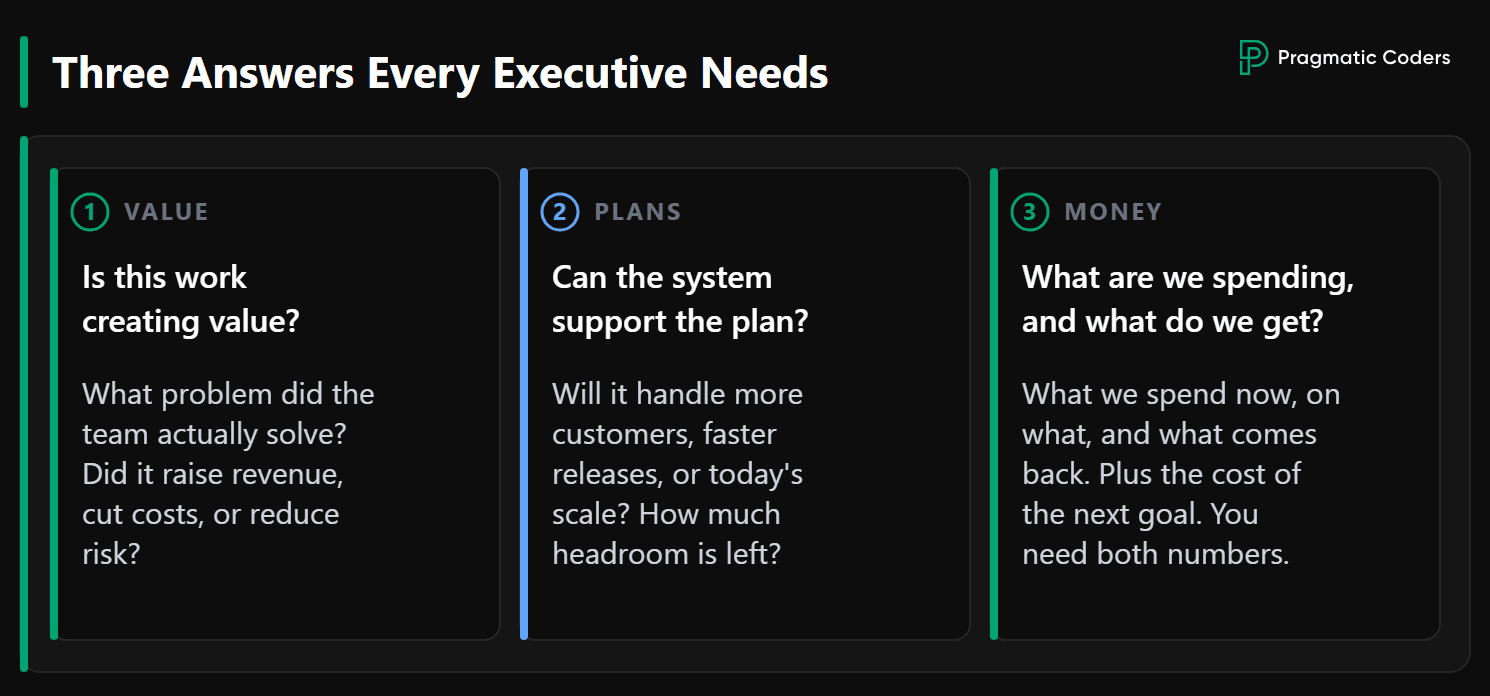
Ask IT Three Questions That Give Executives the Data They Need
Good oversight does not require twenty metrics. A few answers are enough, but you have to read them in the context of the company’s plans. Even popular DORA metrics, such as deployment frequency or the share of deployments that cause problems, mean little without a trend and context.
The same numbers can indicate either controlled rapid growth or a situation where the team is losing control. That is why you should build the conversation around the three questions below.
Does What We Are Doing Create Value?
First check whether the team’s work leads to the business result you expect. Do not ask only how many tasks were closed. Ask what problem they solved.
Check whether what the team is focused on matches what creates value for the company: work that raises revenue, cuts costs, or reduces risk. If new-customer sign-up is the priority, someone should be watching that whole path. High availability of the homepage will not help if the registration form quietly rejects some submissions.
Also check how the whole team’s time is split among agreed priorities, bugs, and urgent requests. The split itself does not prove anything yet. A sudden rise in the share of unplanned work is a good reason to ask why. Quality may be slipping. The business may be regularly bypassing agreed priorities. Those are two different situations, and each needs a different response: improve quality, or fix how priorities get set.
Headroom, Pace, and Stability Without Opening the Repo
The second question is whether the technology can deliver on the company’s plans for the coming months. Translate that into a concrete scenario: serving new customers, shipping changes faster, or keeping service stable for existing customers.
If sales plans to acquire five large customers, IT should translate that plan into expected load growth and tell you whether the current system can handle it and what that will do to infrastructure costs. The gap between current load and the point where the system starts to struggle is called headroom. You do not need an exact number. You need confidence that sales will not sell something the product cannot handle without four months of rebuilding.
Also ask whether the team can safely ship a change to production today. How often do they do it? How many deployments cause problems? Are those metrics improving or getting worse month over month?
Stability has a financial side. What matters is not only availability and the number of incidents, but also complaints, penalties for missed service-level agreements (SLAs), and the time spent supporting customers affected by an outage. The source of the information matters too. If a customer is the first to report an outage, losses grow before the team even starts fixing it. So it is worth checking whether the team can spot problems before users report them.
Technical debt also has to be described in business language. “Our tests are weak” tells executives little. “Because of gaps in testing, every change takes twice as long” already gives you a basis for comparing the cost of the fix with the cost of putting it off.
Falling team morale can be an early warning sign. Engineers are usually the first to notice that the system is becoming less stable or that every change takes more and more effort. That is a reason to have a conversation, not a metric for HR.
Check Where the Money Goes Before You Pay More
The third question links spending to outcomes: how much are we spending, on what exactly, and what do we get in return?
A report of past costs is not enough. Executives also need a current forecast of what it will cost to reach the next business goal. When a new requirement appears, they should see its effect on the budget, the timeline, and the rest of the priorities. If the new requirement does not fit the current plan and available resources, at least one of these has to change: scope, the order of priorities, the deadline, or the budget.
Suppose an important customer asks for a new way of reporting. The team can take that on immediately, but then it will delay an integration that three other customers need. The decision is not “do we build a new reporting system?” It is “is it worth delaying that integration by a month to satisfy this customer?” That is the decision executives should make.
Set thresholds for additional costs, delays, and scope changes. Once they are crossed, the team has to bring the issue back to executives. The conversation has to happen before the extra work starts, not after the invoice is issued. That way the CFO can choose: pay more, cut scope, push back the deadline, or stop the investment.
These three questions will not replace full project oversight. They will, however, help you catch the moment when technology stops supporting the company’s plan.
Require an Options Analysis for Decisions That Will Be Costly to Reverse
Executives should not approve library choices or every architecture decision. They should step in when the option under consideration needs a large budget, carries high risk, or will be hard to reverse later.
That group includes large migrations, rebuilding a substantial part of the system, changing vendors, or choosing between the cloud and your own infrastructure. The same applies to key integrations, team size, and picking an unusual technology that will make hiring harder later.
Vendor lock-in, or dependence on a single vendor, also requires a business decision. Sometimes it is worth shipping a solution faster and accepting that changing vendors later will be harder. Other times a higher cost up front gives the company more freedom later. IT should describe those consequences. Executives should decide what risk they will accept.
How to Prepare an Analysis Executives Can Use to Decide
A good recommendation can take the form of a short options analysis. The team presents options A and B, their pros and cons, and then recommends one.
Each option should answer the same questions:
- how long it will take,
- how much it will cost,
- what the company will gain,
- what risks it creates and how likely the most important ones are,
- how large the losses could be if those risks materialize,
- how hard it will be to reverse the decision later.
You also need a recommendation from the tech lead or CTO, with a rationale that takes the company’s current stage of development into account.
Then executives can accept the recommendation, choose the other option, or ask to combine important parts of both. They get the information they need to make a decision, instead of a lecture on the technology stack.
That kind of communication is one of the most important jobs of a CTO or an experienced tech lead. It does not mean the company has to hire someone specifically for that role right away. First check whether someone already on the team can take responsibility for communication between technology and the business.
Start With a Product Diagnosis Before You Bring in Outside Support
When the answers to the three questions above are unclear, ask your own team for an evidence-based diagnosis, and only then consider outside support.
You can give the team our Product Health Checklist and ask them to describe the result in terms of risk. The checklist helps you assess, among other things, product direction, understanding customer needs, delivery, quality, work with stakeholders, and ownership of the outcome.
If the diagnosis reveals serious problems, or no one can explain the costs and risks they create or what decisions they call for, it is worth talking to our CEO or CTO. In 30 minutes, we can help you validate your assessment with someone who understands both the technology and the business side. Without reading the code, and without assuming from the start that you need a large rescue project.
Conclusions
You do not need to understand the code to oversee technology. You need to know whether the team is creating value, whether the system can deliver on the company’s plans, and what you are paying for. For decisions that are expensive or hard to reverse, you need options, numbers, and a recommendation.
It gets most expensive when the problem only comes to light after the fact, because by then you have far less room to maneuver. That is why you should keep coming back to three questions: whether the team’s work creates value, whether the technology can deliver on the company’s plans, and whether the spend matches the results.