How to Talk to Your Development Team About Scope and Requirements

Business and technology rarely agree fully. Why? Because they usually look at a project from completely different angles. Business thinks in terms of goals, markets, and deadlines; the development team thinks in terms of feasibility, architecture, and technical debt. Add a different vocabulary and a barrier of specialist knowledge on top, and it becomes clear that these two worlds won’t sync up on their own.
That’s why alignment can’t be taken for granted. It has to be built, and the key tool for that is deliberate communication. The goal isn’t just to get everyone pulling in the same direction; it’s to make sure everyone, from the business side through the Product Owner to the developers, knows exactly why they’re pulling. Without that, the team will deliver exactly what you asked for, but not necessarily what you actually needed.
Most of the friction surfaces right at the intersection of scope and requirements, where the same words can carry very different meanings for business and engineers. Below, using slightly exaggerated examples, I walk through these misunderstandings and suggest how to defuse each one, so both sides can find a common language.
Key Points
|
How to Talk About Changing Requirements for a Completed Feature?
There is no more expensive time to pitch a new idea than when you are looking at a fully functional version of a feature.
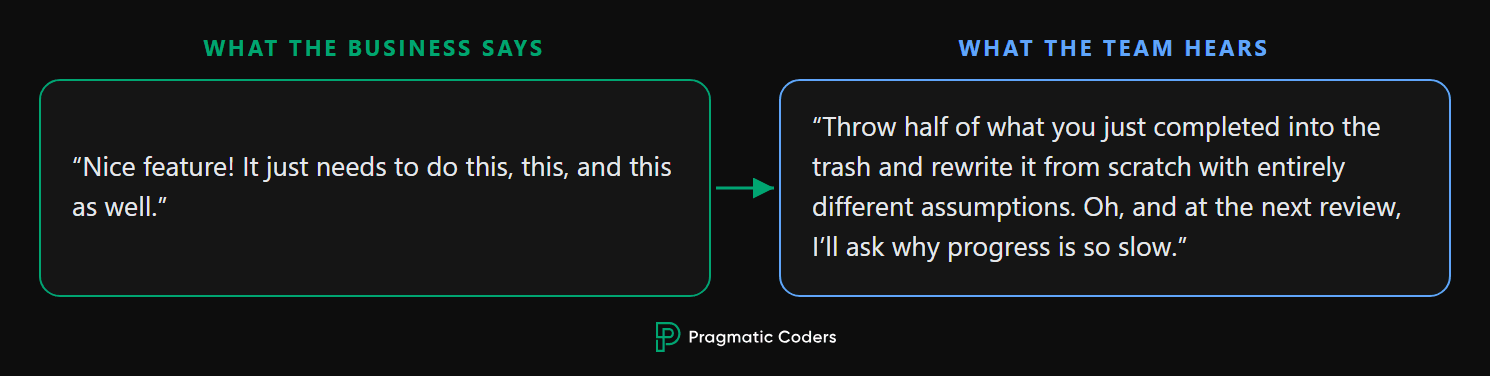
Picture a classic scenario: the team delivers a completed solution that perfectly matches what was agreed upon. Then, a new idea lands on the table. Whether it is a market-driven correction or a late afterthought, the business side usually says: “Let’s just add this small extra feature.” The trouble is, “small” typically refers to the visual effect on the screen, not what has to change under the hood. To implement that one “simple” thing, the team often has to rebuild the very foundation the entire feature rests on. To you, it is a minor tweak; to the developers, it is rewriting half the codebase from scratch. Before they can even estimate the cost, they first have to analyze the ripple effects of the change. Understanding this potential scale is crucial. Without it, it is easy to insist on building blind, only to wonder later why a “small fix” sidelined the team for two weeks and cost ten times more than anticipated.
Let’s be honest: some of these changes are fully justified. Markets, competitors, or regulations can shift overnight after requirements have been set. In those cases, adjusting the scope is not a whim, but a healthy response to a new reality. It is far worse when a change boils down to: “Oh, I just remembered one more thing…” That is usually a sign that requirements gathering failed—either the team did not dig deep enough, or you did not share the full picture. In both cases, the root of the problem is communication, not the change itself.
How to Prevent Costly Requirement Changes?
Your leverage over the final cost is greatest at the very beginning, before a single line of code is even written. Treat requirements gathering as an investment, not a tedious formality. Explain not just what needs to be built, but more importantly, why and for whom. Provide the business context and map out how the feature should behave in edge cases. Ask questions, and encourage the developers to do the same. The more ambiguities you resolve upfront, the less often you’ll have to discard finished code later. Keep in mind that refining requirements is an ongoing exchange of information, not a one-off kickoff meeting. Even the best process won’t prevent late-stage changes entirely, and it shouldn’t have to. What matters is not downplaying their impact. When a new idea arises, ask the Product Owner or tech lead how much completed work would have to be scrapped to implement it. If the answer is “most of it,” don’t pretend it’s a quick, cosmetic fix. Treat it honestly as a new task that requires its own estimate and a fresh budgetary decision.
How to Talk About Scaling a Digital Product “Just in Case”?
Scalability is not a feature you simply “add”—it is a series of decisions about costs and trade-offs. While the team or Product Owner can lay out the options, how far you should go depends entirely on your growth plans and budget. Without that data, someone else will make those choices for you, rarely in the way you would want.
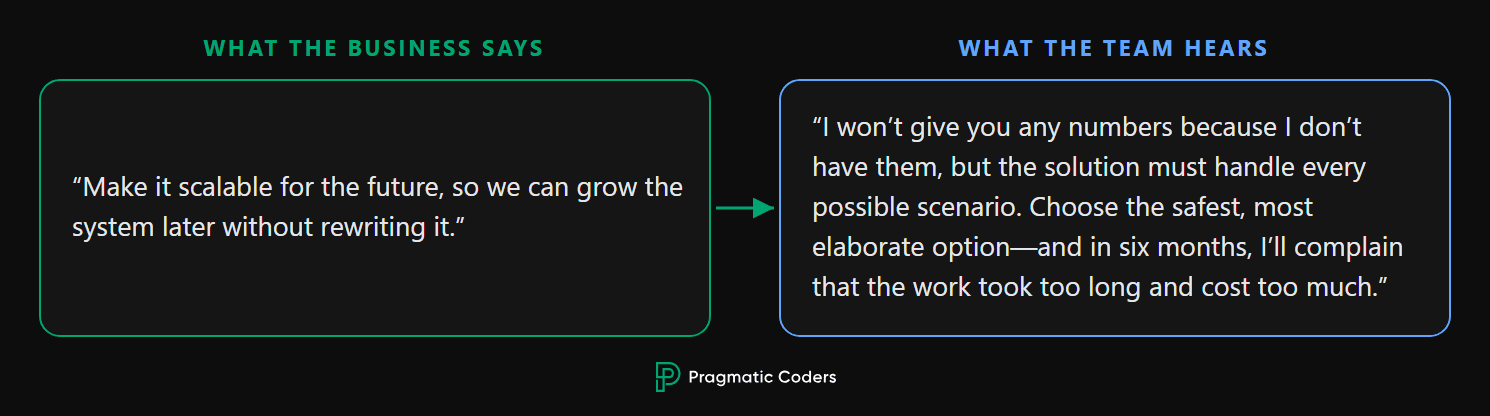
The problem is that without concrete parameters, “scalability” means one thing to you and quite another to the team. You are likely thinking about the ability to roll out new features cheaply and smoothly a year from now. The team, however, hears “prepare for massive traffic” and, with no clear reference point, designs a safer, far more complex solution. No one sets out to build a system for a million non-existent users. But without clearly defined boundaries, it is easy to succumb to the temptation of designing “just in case”: choosing a pricier, supposedly more scalable technology over a simple standard, or splitting the system into microservices before it is truly necessary. Every such decision drags down velocity from day one and complicates future development, all for traffic that may never materialize.
Let’s look at this fairly: this does not stem from malice or a lack of common sense on the engineers’ part. When hard data is missing, over-engineering becomes a rational reflex; after all, it is far easier to justify higher infrastructure bills than a system crash under load. You, in turn, don’t always have those numbers at hand. In the early stages, you might not yet know what load to expect or what budget you can allocate for maintenance. But until you define these parameters, both sides are left guessing.
How to Define Scalability Requirements Precisely?
No one expects you to predict the future with absolute precision. A product’s market journey cannot be planned down to the last detail, and traffic forecasts rarely hold up in the real world. Instead of throwing “scalability” around as a vague catchphrase, share the actual insights you have. How much you can pin down depends largely on the nature of the project. If you’re working on an internal tool where the load depends on the number of employees, branches, or processed transactions, you can estimate the scale fairly accurately. In those cases, state the parameters outright. But if you are building a commercial, market-facing product, work with ranges: a realistic target for the first year, a threshold you would consider a success, and a ceiling you are unlikely to cross anytime soon.
Be open about the level of uncertainty, too. An honest acknowledgment that your numbers are only estimates, not absolute certainties, is far more valuable to the team than false precision. It allows them to design a reasonable technical buffer rather than blindly over-engineering for every possible eventuality. Finally, ask about the price of that safeguard, not just in cloud bills but primarily in delivery time: ‘How much longer will it take to build a version prepared for tenfold growth?’ Only with those figures can you consciously decide how much future flexibility you want to buy upfront.
How to Talk About Shifting Priorities Mid-Sprint?
There is nothing inherently wrong with shifting priorities mid-sprint, provided the decision is driven by solid business reasoning. The trouble starts when new tasks are injected without justification. An ad-hoc request like that, stripped of context, instantly derails planned work and demoralizes the team.
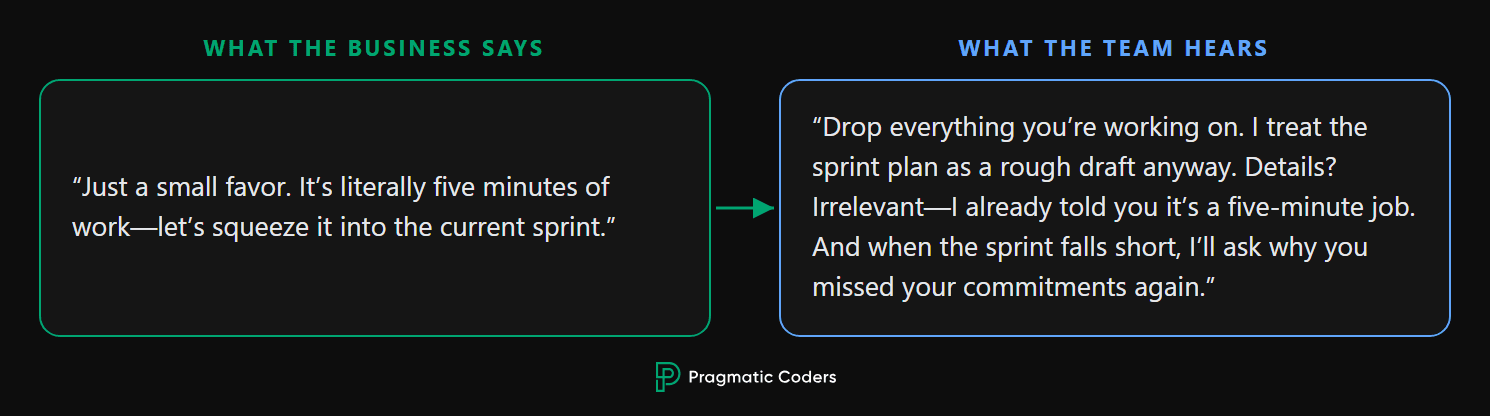
A sprint is a fixed timebox where the team focuses entirely on delivering a committed goal. Contrary to popular belief, this boundary is not set in stone. Under Scrum guidelines, the scope of work can be clarified and renegotiated with the Product Owner as the sprint progresses. What’s more, if the goal itself loses its relevance, the Product Owner has the authority to cancel the sprint entirely, replan, and start fresh. Agile methodologies do not forbid change; the real issue lies with changes slipped in quietly, without analysis or conscious decision-making. Every intervention comes with a price tag, and deciding whether it is worth paying boils down to a single question: “what for?” That answer is what separates a justified business pivot from a mere whim. A course correction driven by a real market need—such as closing a key contract, adapting to new regulations, or resolving a critical outage—is a deliberate business choice. Injecting tasks on a sudden impulse, however, is pure waste, leading to unfinished sprints, tanked morale, and zero value.
But this is not solely your fault. When a request descends suddenly from a position of authority, it is easy for the other side to slip into a passive stance. Instead of spelling out the cost of the change or proposing a task swap, the team and Product Owner often accept it in silence. And since no one tells you plainly that the new feature will delay previously promised deliverables, you have every right to assume the change is free.
How to Make Mid-Sprint Changes Without Chaos?
Before you decide to disrupt an ongoing sprint, ask yourself two key questions. First: does this change have a solid business justification? (for instance, securing a major client, fixing a critical bug blocking sales, or complying with a new legal requirement). If not, the new task belongs in the backlog to wait for the next planning session. Second: if the change is truly necessary, what will be removed from the sprint in exchange? Sit down with the Product Owner or team lead and agree on a transparent ‘one-in, one-out’ swap. When you hand over the new request, provide clear guidance: briefly describe the goal you want to achieve and the expected outcome. Without an open conversation about trade-offs, you will pay twice: first in delays to your original roadmap, and then in team chaos and frustration.
How to Talk About Technical Feasibility?
Friction in feasibility discussions rarely stems from the team’s response—far more often, it is a byproduct of the question itself. “Is it possible?” is a closed question that almost always gets a “yes.” The trouble is, this “yes” is completely silent on what actually matters to the business: time, cost, and risk.
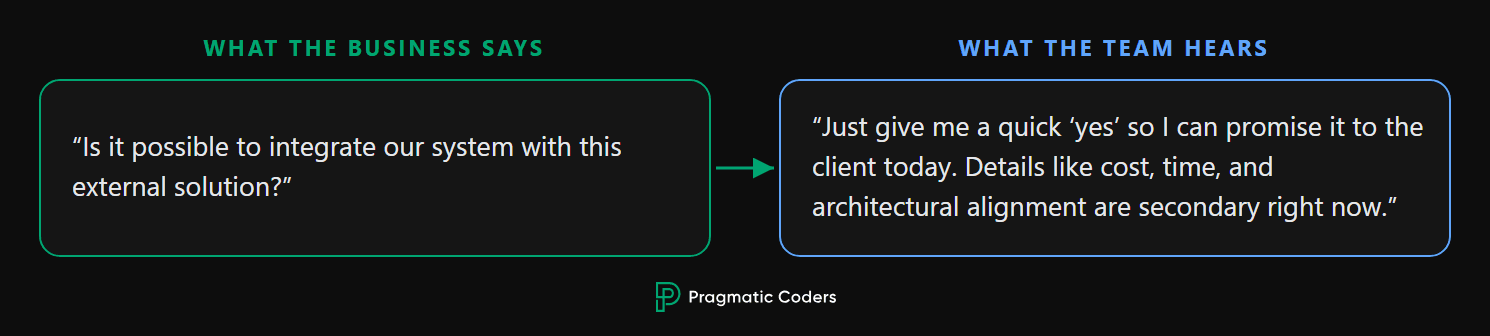
So where does this agreement that leads nowhere come from? When you ask “is it possible?”, you are usually looking for a quick green light to push negotiations forward with a client or the board. The development team, however, takes the question literally and answers with engineering precision: if even a theoretical technical path exists, the answer is “yes.” In the end, both sides walk away in high spirits—even though each understood the conversation in a completely different way.
To be fair, engineers don’t always make this easy. Faced with a binary question, they are often content to throw back a terse “doable” or “not doable.” A genuinely sharp team, however, won’t stop at a simple declaration. Instead, they will ask for context: “Yes, but what for?” This single question transforms a dry technical assessment into a conversation about business value, allowing developers to act as advisors rather than mere executors.
How to Uncover the Real Costs and Risks of a Solution?
Ban the phrase “Is it possible?” from your vocabulary once and for all. Instead, present the business goal to the team and ask for potential scenarios: ‘We want to achieve [goal]. What are our options, how long will each take, and what costs and risks should we expect?’ A mature team will map out several paths for you, structured by cost and trade-offs: from an express stopgap with a conscious decision to incur technical debt, to a solid market standard, and finally, a fully polished target solution. Only this kind of breakdown gives you the full picture, allowing you to make an informed business decision.
Summary
All of these misunderstandings boil down to a single conclusion: developers rarely have bad intentions, and they certainly don’t suffer from poor hearing. They simply filter your words through their own engineering lens. In the end, you will get exactly what you write into the requirements. But it is entirely up to you how you phrase them, what context you provide, and who you entrust them to. It is at this stage—not during the actual coding—that you have the greatest leverage over the final cost and velocity of the entire project.
This is only the beginning, however. Scope and requirements are just the first of three friction points where business and technology most often drift apart. In the upcoming articles, I will take a close look at two equally volatile topics: time estimates, as well as code quality and technical debt.