
Technical Health Checklist
60 Checks to Assess Your Product
The Technical Health Checklist is a practical self-assessment tool. No consultants, no formal audit, no six-week engagement. You run it internally with your own team.
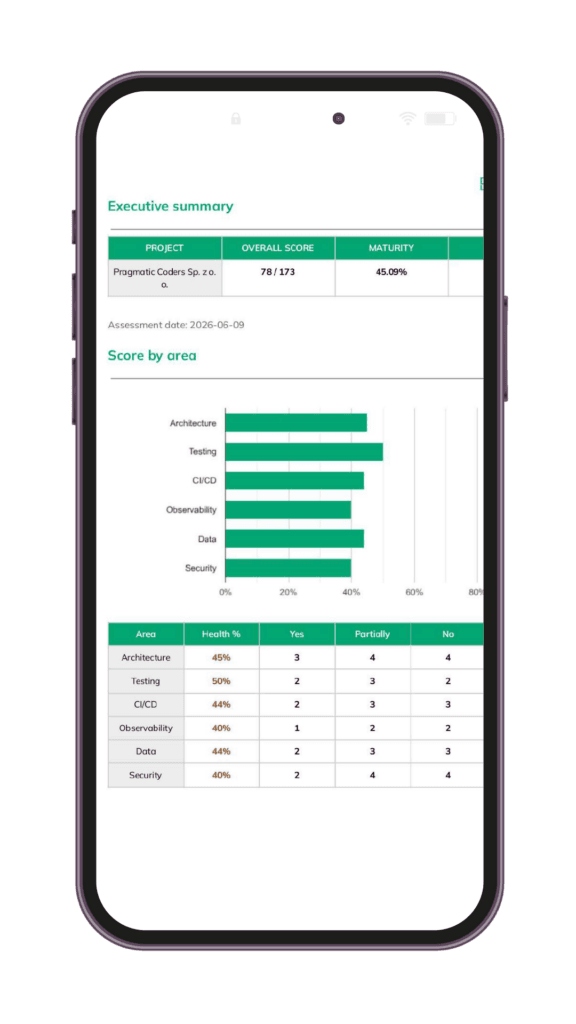
Each check covers one technical foundation (schema migrations, centralized logging, idempotent retries, and so on) and names the specific risk it mitigates. The built-in dashboard scores your overall maturity, surfaces red flags, and shows which areas to fix first.
Run it once to benchmark your current state. Rerun it every quarter, because technical health drifts as the product, team, and delivery pressure change.
Architecture
Check whether your system's design still fits its current scale and complexity. Covers architectural consistency, service boundaries, resilience, API contracts, performance, and whether infrastructure cost is proportional to usage.
Testing
Assess whether your test suite actually protects the product from regressions. Covers unit, integration, and end-to-end coverage, environment reproducibility, test reliability, and performance verification.
CI/CD
See how safely and quickly your team can ship changes. Covers automated build and deployment pipelines, failure recovery, release repeatability, branching strategy, and infrastructure as code.
Observability
Find out whether your team can actually see what's happening in production. Covers centralized logging, structured logs, error tracking, metrics, alerting, and whether observability tools are used in practice.
Data
Evaluate whether your data is safely managed and recoverable. Covers schema evolution, data ownership, backup and restore, consistency strategy, and efficient access patterns.
Security
Surface the security foundations every product should have. Covers authentication and authorization, secret management, input validation, dependency scanning, encrypted communication, and audit logging.
Would you like to talk about your project?
We are here to help! We take care of the entire product development process. Your success will make us successful.