
Based on real insights from 7 experts at Pragmatic Coders: why software projects go off track and what to do before it's too late. Free practical guide.
8 ways companies sabotage their own projects
8 ways companies sabotage their own projects
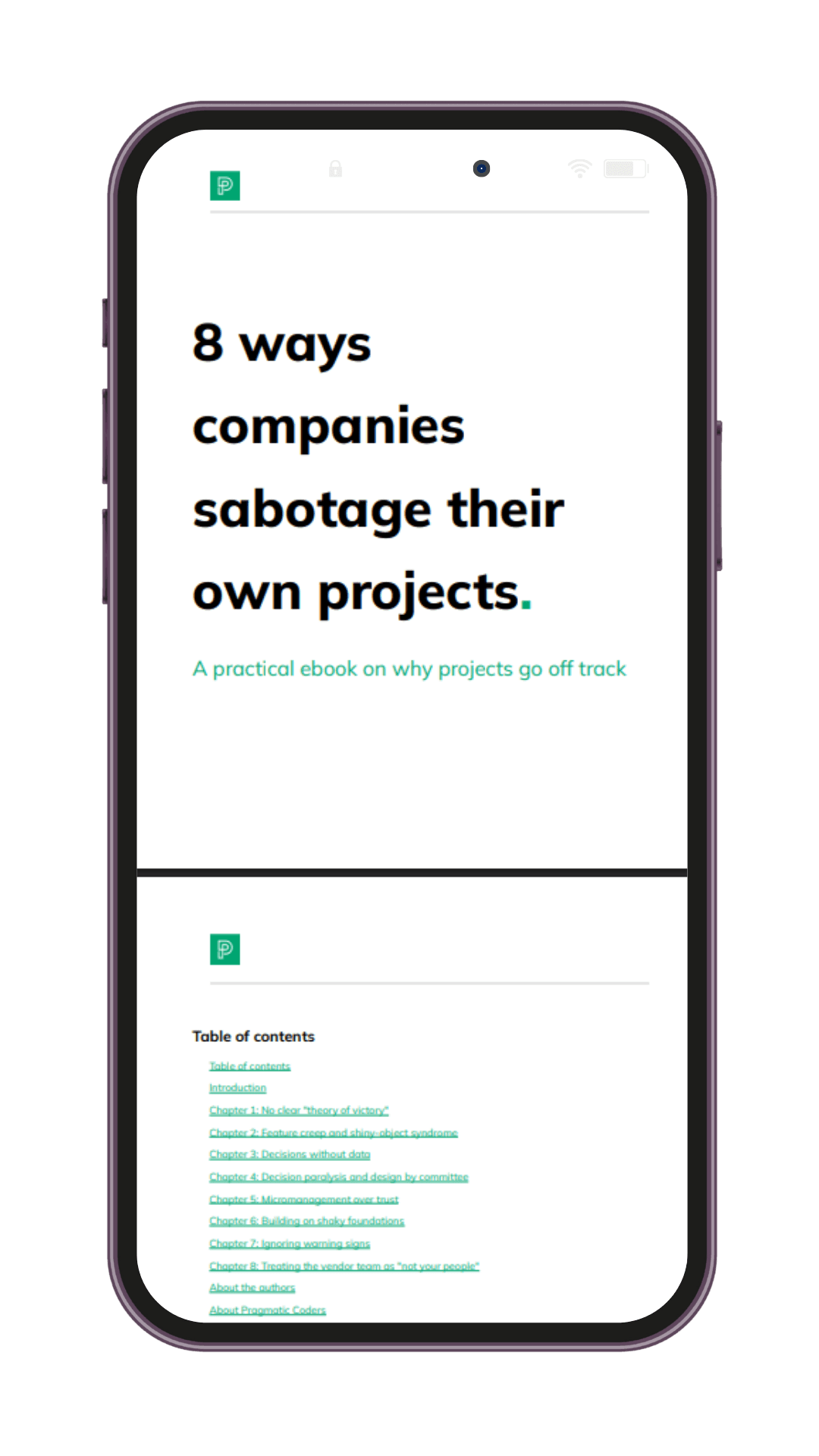
Scroll to see more
Download the ebook
Get the knowledge and resources you need to get started right away with our ebook, “8 ways companies sabotage their own projects”. Download it today and get one step closer to achieving your entrepreneurial goals.
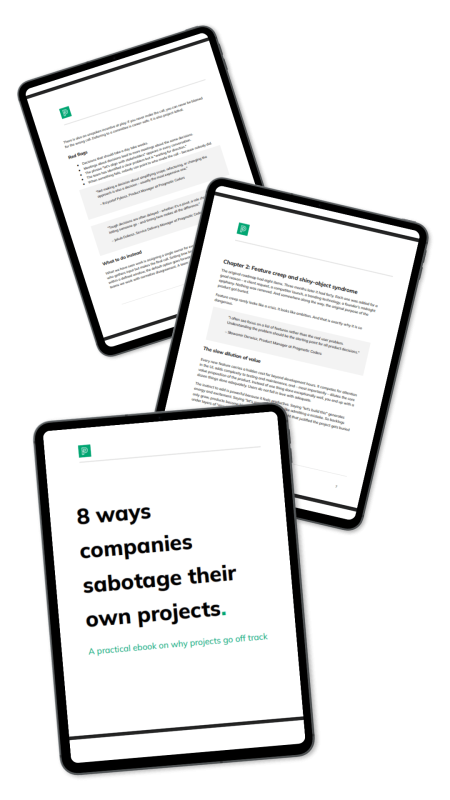
What you’ll get from the ebook?
How it shows up in practice
Learn about our market-proven methods and build your startup in an effective and predictable way.
Why it happens
Honest analysis of the organizational pressures, incentives, and fears that make smart teams repeat the same mistakes – without realizing it.
Red flags
Concrete warning signs you can spot today – before a pattern becomes a crisis. Each chapter includes a checklist to assess your own project.
What to do instead
Practical, non-theoretical fixes drawn from the daily experience of PMs, a CTO, and a delivery manager who work on real projects every day.
"Most of these problems are not about lack of knowledge. They come from avoiding
conflict, lacking the courage to say 'no,' and protecting comfort over results."

Michał Kania
Product Manager at Pragmatic Coders
39
Insightful pages
8
Chapters
37
Expert insights
What’s inside?
Curious to learn more about what’s inside the ebook? Check it out now and find out!
Chapter 1: No clear "theory of victory"
The sprints are on schedule. The team is busy. Velocity looks healthy. Six months in, someone from the board asks a simple question: "Is this project a success?" And nobody in the room can answer.
Chapter 2: Feature creep and shiny-object syndrome
The original roadmap had eight items. Three months later it had forty. Each one was added for a good reason – a client request, a competitor launch, a trending technology, a founder's midnight epiphany. Nothing was removed. And somewhere along the way, the original purpose of the product got buried.
Chapter 3: Decisions without data
A team spends weeks building an expensive feature. It launches. Almost nobody uses it. The conclusion comes fast: “The product is not needed.” The budget gets cut, morale drops, and the
feature is quietly shelved.
Chapter 4: Decision paralysis and design by committee
The team proposes switching to a simpler integration approach. It would save two sprints and reduce risk. The tech lead agrees. The product manager agrees. But the decision needs sign-off from five people across three departments. Meetings get scheduled, emails bounce back and
forth, someone is on vacation, someone else wants "more context." Six weeks later, the approval comes through – for the exact same approach the team suggested on day one.
Chapter 5: Micromanagement over trust
A senior developer reads the ticket. The implementation approach is spelled out step by step – which library to use, how to structure the code, what the API response should look like. He sees a simpler, more reliable way to do it. He says nothing. The last time he proposed an alternative, he was told to "just follow the spec." After six months of this, the best people on the team stop thinking. They execute instructions, clock out, and eventually leave.
Chapter 6: Building on shaky foundations
The client wants a new feature. The estimate comes back: two weeks. The team starts building – and immediately runs into a workaround from last year that was never cleaned up, a data feed with inconsistent formatting, and a module with zero test coverage. Two weeks turns into eight.
The client is frustrated: "Why is this so expensive?" The answer is buried under twelve months of shortcuts that nobody went back to fix.
Chapter 7: Ignoring warning signs
The post-mortem happens three days after the project is cancelled. The timeline is reconstructed, the root causes identified. And then someone pulls up a message from six months earlier – a senior engineer, clearly stating that the current approach would not scale and the deadline was
unrealistic. The message was acknowledged, politely filed away, and never acted on. Nobody in the room is surprised. Everyone knew.
Chapter 8: Treating the vendor team as "not your people"
The contract is signed. Fixed scope, fixed price, clear deadline. The client feels safe – everything is defined, the risk is on the vendor. Four months in, the business needs something different from what was specified. The vendor's response is predictable: "That wasn't in the scope." What
follows is weeks of renegotiation, frustration on both sides, and a relationship that has shifted from partnership to legal positioning. Both parties are now optimizing for the contract instead of the product.
Who is it for?
The patterns in this ebook don’t come from textbooks – they come from real conversations with our PMs, CTO, and delivery manager about what they see go wrong on projects every day. If any of these roles sound like yours, this guide was written with you in mind.
CTOs & VPs of Engineering
Who oversee technical strategy and need to protect their teams from organizational dysfunction.
Heads of Product & Product Managers
Who fight for focus, data-driven decisions, and realistic roadmaps every day.
Founders & CEOs
Who invest in software and want to understand why good teams still deliver disappointing results.
About authors
Meet the “8 ways companies sabotage their own projects” team. Thanks to them, this ebook became a reality.


Ewelina Lech
Content Marketing Specialist
Experts Insights Authors

Darek Mozgowoj
Product Owner

Michał Kania
Product Owner

Krzysztof Pykosz
Product Owner

Sławek Derwisz
Product Owner

Darek Tarasek
Product Owner

Jakub Dobosz
Service Delivery Manager

Marcin Byrdziak
CTO
Would you like to talk about your project?
We are here to help! We take care of the entire product development process. Your success will make us successful.